Does Tirzepatide Go Bad? Storage, Shelf Life, and Signs
Key Takeaways
- Tirzepatide does go bad. It's a 39-amino-acid peptide, and heat, freezing, light, and contamination break it down, often with no visible change.
- Unopened and refrigerated at 36°F to 46°F (2°C to 8°C), tirzepatide lasts until the expiration date (brand) or beyond-use date (compounded) on its label.
- Brand single-dose Zepbound and Mounjaro pens and vials can spend up to 21 days in total out of the fridge, at up to 86°F (30°C).
- Brand 4-dose vials and KwikPens must be thrown away 30 days after first use or after 4 weekly doses, whichever comes first.
- The FDA advises discarding compounded multi-dose vials within 28 days of first use, even if medication remains.
- A parked car can pass the 86°F label limit in about 10 minutes, even on a 72°F day, and reach 117°F within an hour.
- Never use tirzepatide that has been frozen or overheated, or that looks cloudy, discolored, or has particles.
- Store it on the middle shelf in its original carton. Avoid the door, the back wall, the crisper drawers, and the freezer.
If you've ever found your pen sitting on the counter after a long day, or opened a delivery box that felt a little too warm, you've probably wondered whether your tirzepatide is still good. It's a fair question. Tirzepatide can go bad, and it doesn't always look any different when it does.
Tirzepatide is the active ingredient in Zepbound and Mounjaro, and it's also prescribed as a compounded medication. This guide covers what damages it, how long each form lasts under current FDA labeling, where to keep it at home, and how to tell whether a dose is still safe to use.
Quick Answer
Yes, tirzepatide goes bad. It's a delicate, protein-like molecule that slowly breaks down, and heat, freezing, light, and contamination speed that process up. Kept in the refrigerator at 36°F to 46°F (2°C to 8°C) in its original carton, unopened tirzepatide lasts until the expiration date or beyond-use date on its label. Once it leaves the fridge or the vial is opened, a shorter clock starts:
- Brand single-dose pens and vials (Zepbound, Mounjaro): up to 21 days in total out of the fridge, at up to 86°F (30°C).
- Brand 4-dose vials and KwikPens: discard 30 days after first use or after 4 weekly doses, whichever comes first.
- Compounded multi-dose vials: the FDA advises discarding them within 28 days of first use, or sooner if the beyond-use date on the label comes first.
Never use tirzepatide that has been frozen, has been exposed to temperatures above 86°F, or looks cloudy, discolored, or has particles in it.
Why Tirzepatide Is Fragile
Tirzepatide is a peptide, a chain of 39 amino acids, which are the same building blocks that make up proteins. It's modeled on GIP and GLP-1, natural gut hormones that last only minutes in the body before enzymes break them down. Tirzepatide is engineered to last much longer. Two unusual amino acids called Aib help shield it from those enzymes, and a 20-carbon fatty acid "tail" lets it latch onto albumin, a protein in your blood. That's why one injection a week is enough.
Those features help tirzepatide last inside your body. They don't make it indestructible in the pen or vial. To activate the GIP and GLP-1 receptors that control appetite and blood sugar, the molecule has to keep its exact chemistry and shape. Change either one and the medication works less well.
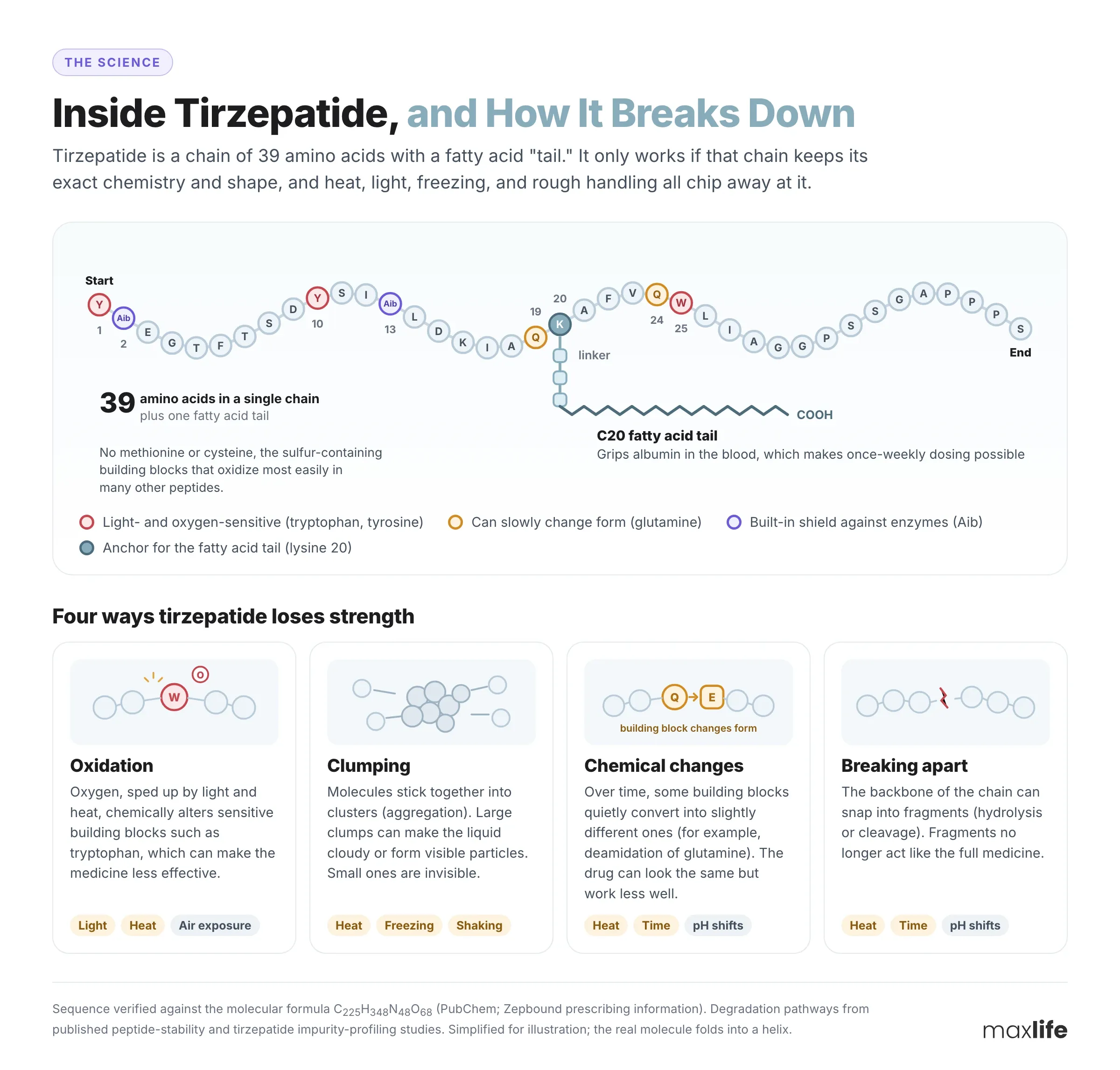 Tirzepatide's sensitive spots and the four main ways it loses strength.
Chemists group the damage into four main pathways:
- Oxidation. Oxygen chemically alters sensitive amino acids. In tirzepatide, the most vulnerable is tryptophan, along with two tyrosines. Light and heat speed this up. You may read online that tirzepatide is prone to methionine oxidation, but that doesn't apply here. Tirzepatide's molecular formula contains no sulfur, so it has no methionine at all.
- Clumping (aggregation). Molecules stick together. Large clumps can make the liquid cloudy or form visible particles, but small clumps are invisible. Heat, freezing, and vigorous shaking all encourage clumping.
- Chemical changes. Over time, some building blocks, such as glutamine, slowly convert into slightly different ones (a reaction called deamidation). The liquid looks the same, but it can work less well.
- Breaking apart. The backbone of the chain can be cut into fragments, especially with heat and changes in pH.
Lab testing backs this up. In a 2026 study that deliberately stressed tirzepatide, a solution heated to 140°F (60°C) lost about 18% of its intact drug in 90 minutes, and a day in direct light broke down about 12%. Acid, alkali, and an oxidizing agent degraded it too. Those are harsh conditions on purpose, but they show which way each stress pushes the molecule. All of these reactions run faster as temperature climbs, which is why the refrigerator matters so much.
How Long Does Tirzepatide Last?
It depends on which product you have. The current Zepbound and Mounjaro labels cover four presentations: single-dose pens, single-dose vials, 4-dose vials, and 4-dose KwikPens. Compounded tirzepatide comes in multi-dose vials prepared by a licensed pharmacy, and the pharmacy sets its dates.
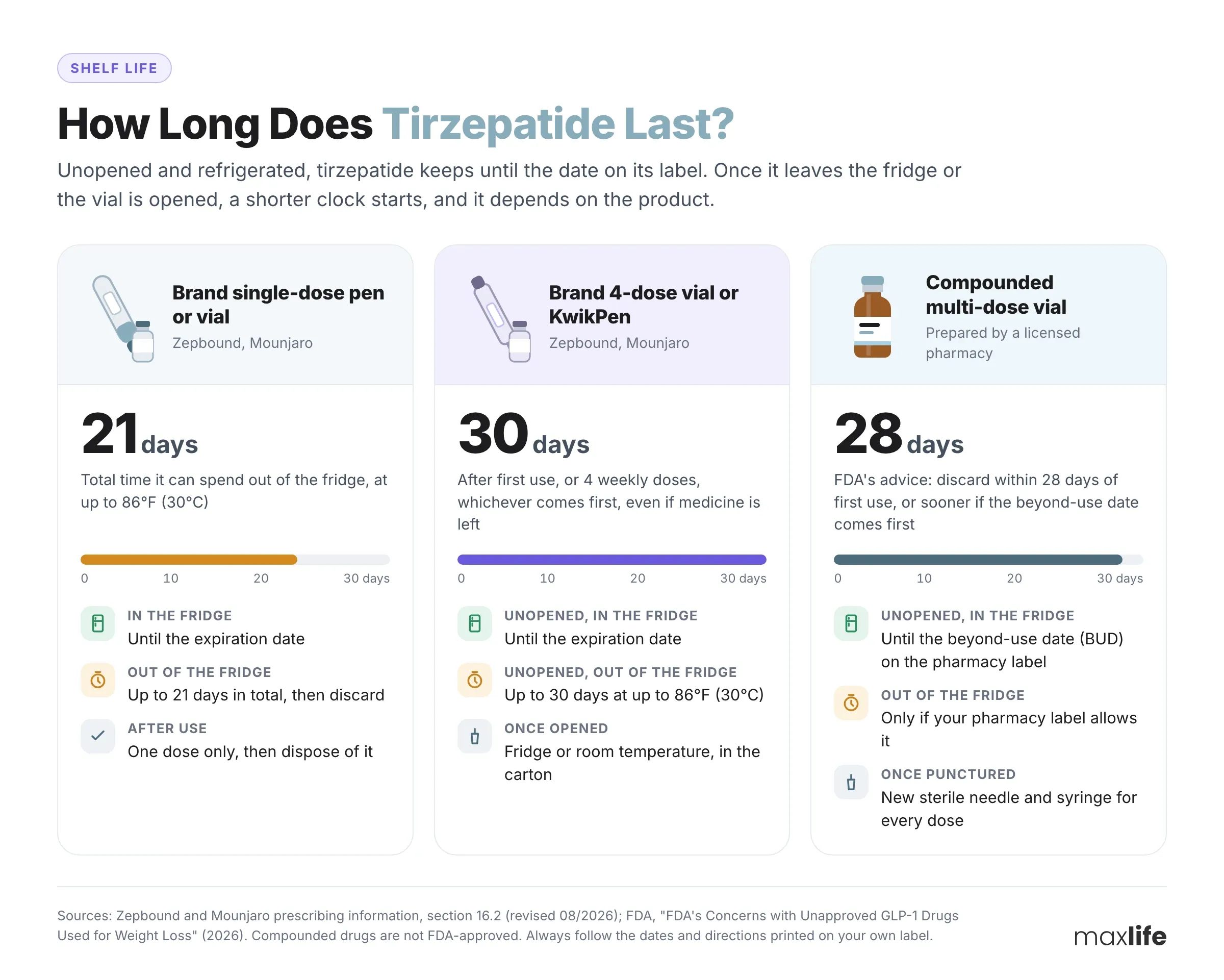 The three time limits to remember: 21, 30, and 28 days.
| Product | Unopened, in the fridge | Out of the fridge (up to 86°F / 30°C) | After first use |
|---|---|---|---|
| Brand single-dose pen or vial | Until the expiration date | Up to 21 days in total | Single use; discard any solution left in a vial |
| Brand 4-dose vial or KwikPen | Until the expiration date | Up to 30 days if unopened | Discard 30 days after first use or after 4 weekly doses, whichever comes first |
| Compounded multi-dose vial | Until the beyond-use date (BUD) | Only if your pharmacy label allows it | Discard within 28 days of first use, or by the BUD if that comes sooner |
A few details are easy to miss:
- The 21 days is a running total. The current label says single-dose pens and vials can be kept unrefrigerated "for up to a total of 21 days." Time out of the fridge adds up across the life of the pen or vial. Older versions of the label said not to put a pen back in the fridge once it had been stored at room temperature, so the leaflet in your box may still say that.
- Opened 4-dose products don't have to go back in the fridge. The label allows an opened 4-dose vial or KwikPen to be stored in its carton either in the refrigerator or at room temperature up to 86°F. The 30-day limit applies either way.
- Compounded vials follow their own label. Compounded medications aren't FDA-approved, and there is no single national shelf life for them. The pharmacy assigns a beyond-use date based on how the medication was prepared and tested, following United States Pharmacopeia (USP) standards. Your vial's label is the final word.
The Temperature Rules
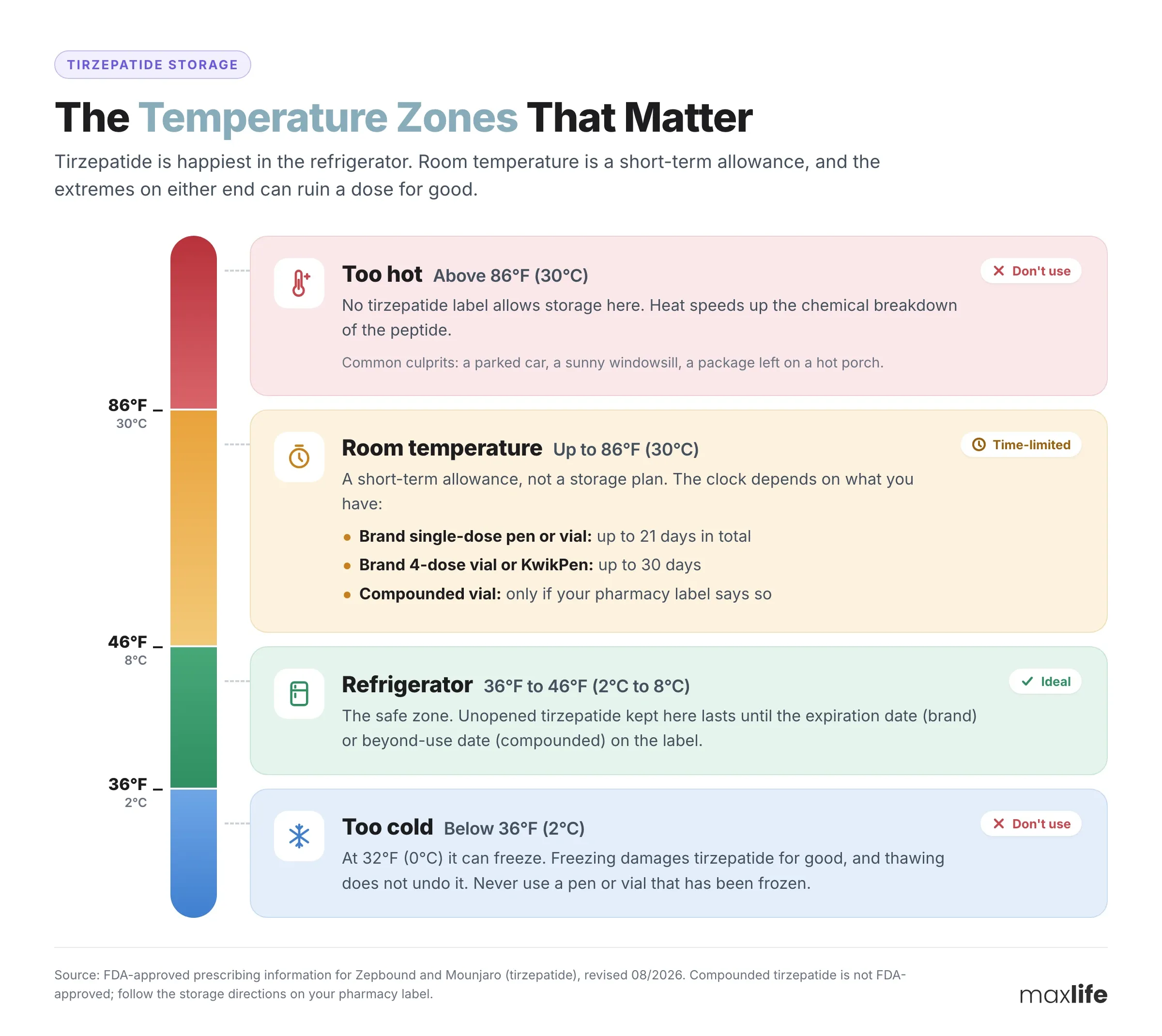 The safe zone is narrow: 36°F to 46°F (2°C to 8°C).
The Zepbound and Mounjaro labels draw a hard line at 86°F (30°C). Below that, room temperature is a short-term allowance with a time limit. Above it, or below freezing, the medication shouldn't be used at all. Keep in mind that "room temperature" on a drug label means up to 86°F, not whatever temperature your room happens to be. A sunny kitchen in July can run hotter than that.
6 Things That Shorten Tirzepatide's Life
1. Heat
Heat is the biggest threat because it speeds up every breakdown pathway at once. An hour spent warm uses up far more shelf life than an hour in the fridge.
The most common heat trap is a parked car. In a well-known study published in Pediatrics, researchers measured the inside of a dark sedan parked in the sun. On a mild 72°F day, the cabin reached 117°F within an hour, and 80% of that rise happened in the first 30 minutes. Cracking the windows made no meaningful difference.
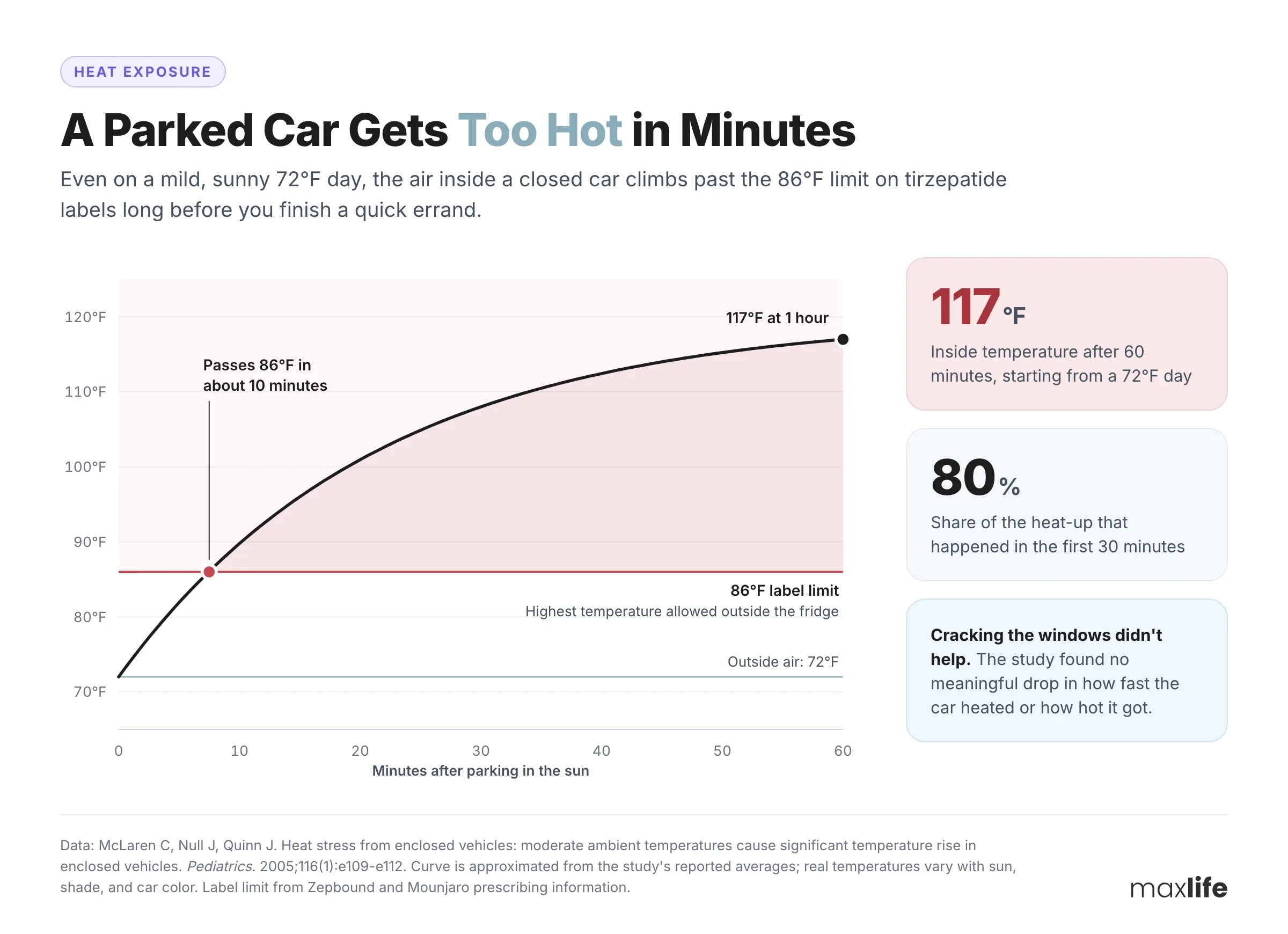 Even on a 72°F day, a parked car passes the 86°F label limit in about 10 minutes.
Other common hot spots include sunny windowsills, the counter next to the stove, and delivery boxes left on a porch or in a mailbox in summer.
2. Freezing
Freezing doesn't preserve tirzepatide. It damages it. As water turns to ice, the peptide gets squeezed into concentrated pockets and stressed at the ice surface, which promotes clumping that thawing can't undo. Both labels are blunt about it: "Do not use if frozen." Freezing usually happens by accident, in the back of a refrigerator near the cold-air vent, in a fridge set too cold, or when a pen rests directly on an ice pack.
3. Light
Light drives oxidation of tryptophan and tyrosine. In the 2026 lab study above, 24 hours of direct light broke down about 12% of the tirzepatide in solution. That's why the labels say to store it in its original carton. Amber glass vials, which many pharmacies use, filter out some light, but a carton or a closed box gives better protection.
4. Contamination
Every needle that goes into a multi-dose vial is a chance for germs to get in. Multi-dose products contain preservatives (the brand 4-dose versions use benzyl alcohol and phenol), but preservatives are a backstop, not a guarantee. That's a big reason for the 28-day and 30-day limits. Wipe the rubber stopper with alcohol and let it dry, use a new sterile needle and syringe for every dose, and never share a pen or vial with anyone, even with a new needle.
5. Shaking
Vigorous shaking stirs air into the liquid and can encourage clumping. Tirzepatide solutions don't need to be mixed before use. If your pharmacy sends any special preparation instructions, follow them exactly.
6. Time
Even perfectly stored tirzepatide breaks down slowly. Expiration dates and beyond-use dates mark how long the product is expected to stay within its quality standards. After that, there's no guarantee of strength or sterility.
Where to Store Tirzepatide at Home
Not every spot in a refrigerator is the same temperature. Aim for the place that stays the steadiest.
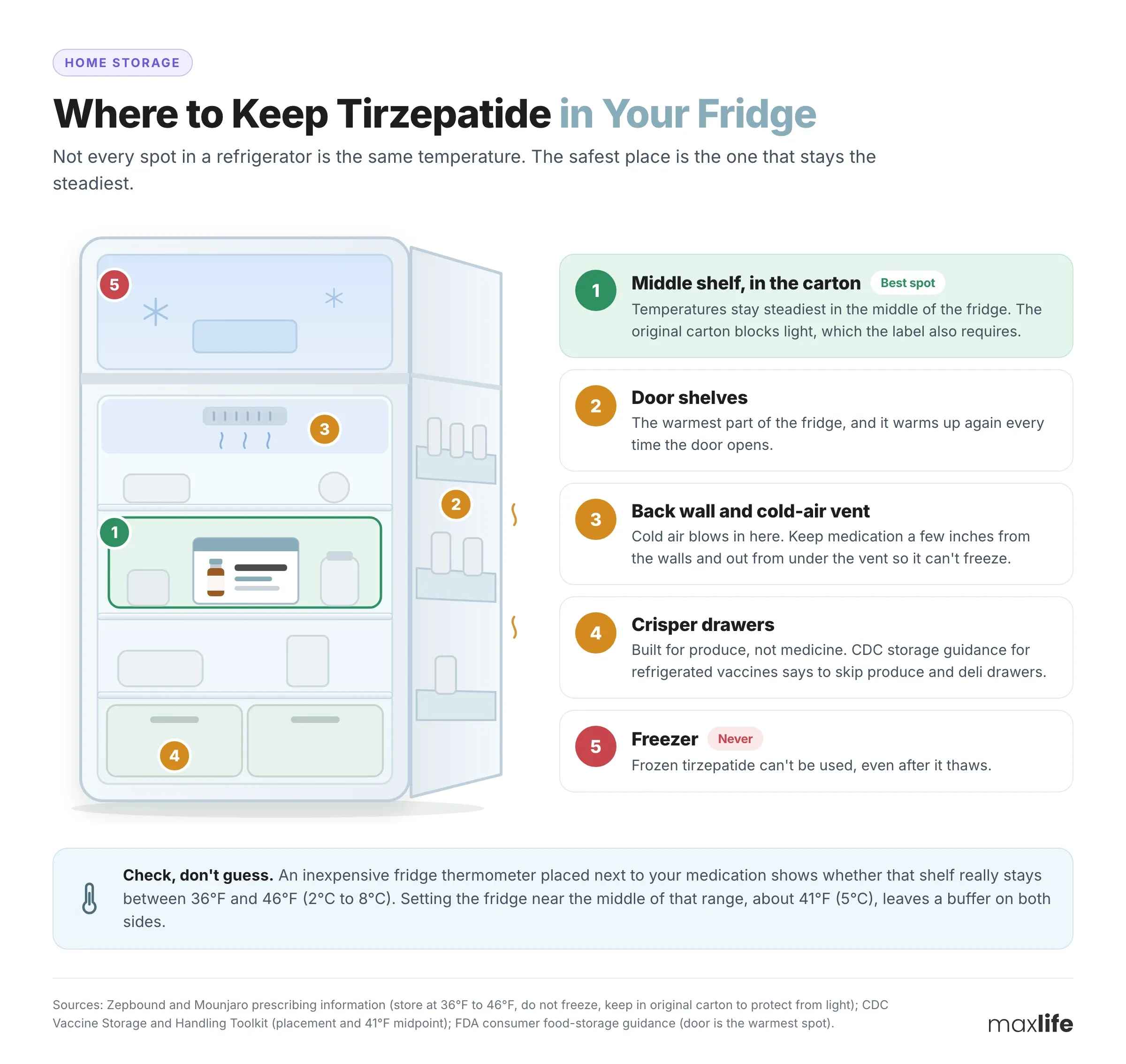 Middle shelf, in the carton, away from the back wall.
The CDC's guidance for keeping vaccines in household refrigerators is a useful model, since vaccines are temperature-sensitive too:
- Best: the middle shelf, inside the original carton, a few inches from the walls.
- Avoid the door. The FDA notes that the door is the warmest part of the fridge, and it warms up again every time you open it.
- Avoid the back wall and the cold-air vent. The CDC advises keeping vaccines 2 to 3 inches from the walls and out from directly under cooling vents, where items can freeze.
- Avoid the crisper and deli drawers. The CDC lists them, along with door shelves and the area under vents, as spots that may not hold a stable temperature.
- Never the freezer.
An inexpensive fridge thermometer placed next to your medication shows whether that shelf really stays between 36°F and 46°F. The CDC suggests setting vaccine refrigerators to the middle of that range, about 41°F (5°C), which leaves a buffer on both sides.
How to Tell If Tirzepatide Has Gone Bad
The brand labels describe tirzepatide as clear and colorless to slightly yellow, and they say not to use it if you see particles or discoloration. Check before every dose by holding the pen window or vial up to the light.
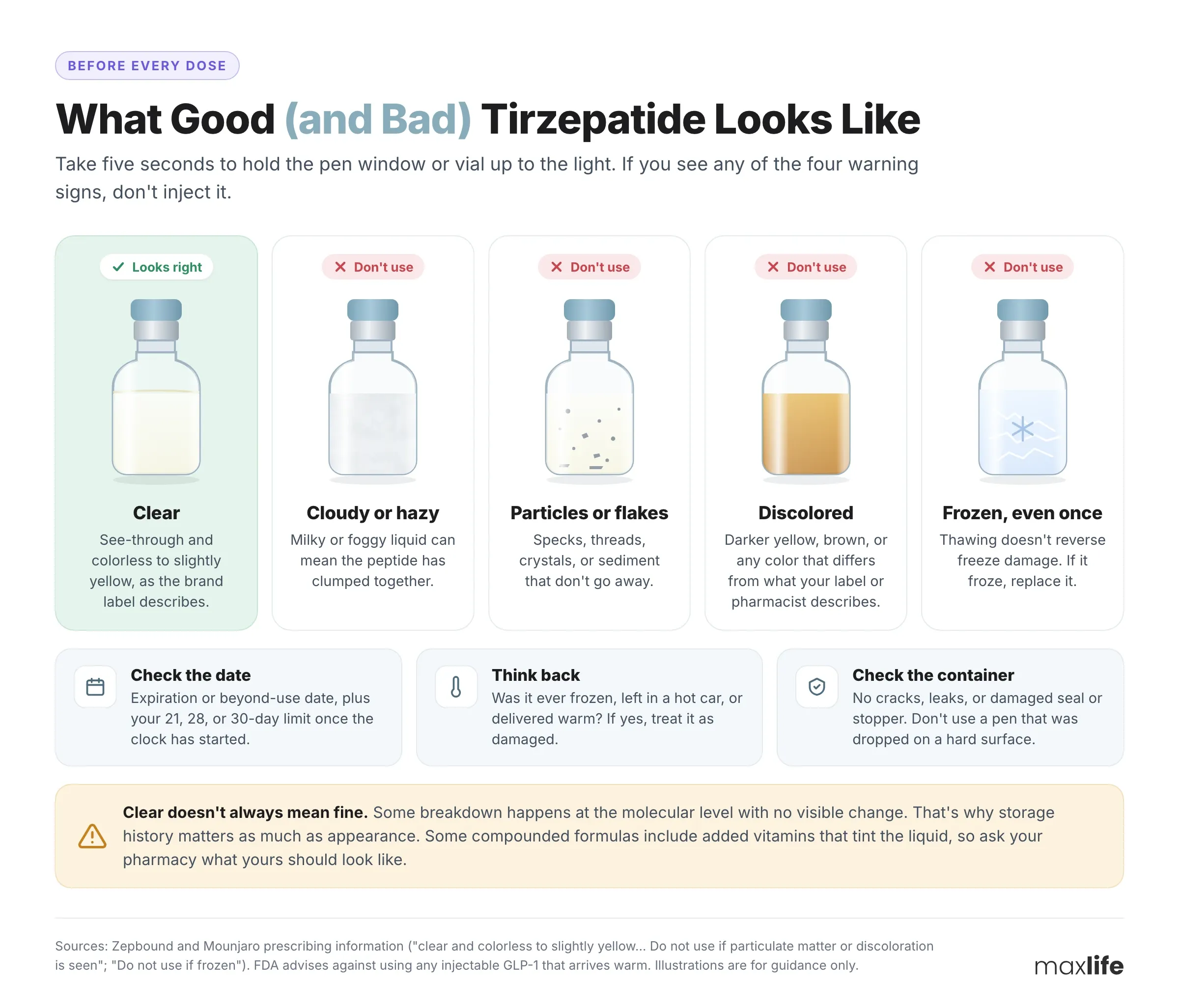 If you see any of these four warning signs, don't inject it.
Don't use tirzepatide that is:
- Cloudy, hazy, or milky
- Carrying particles, flakes, threads, or crystals
- Discolored, such as darker yellow or brown
- Frozen, or that you know was frozen at any point
The Zepbound pen instructions add one more: if you drop the pen on a hard surface, don't use it.
Compounded formulations can look a little different from the brand products. Some include added B vitamins or other ingredients that may tint the liquid. Ask your pharmacy what your medication should look like, and note it when you open a new vial so you can spot changes later.
Appearance isn't the whole story. Oxidation and other chemical changes can weaken a dose with no visible sign, which is why storage history matters as much as appearance. If your usual dose suddenly seems to stop working after a storage slip-up, talk to your provider. Don't increase your dose on your own.
What to Do If Your Tirzepatide Got Too Warm or Froze
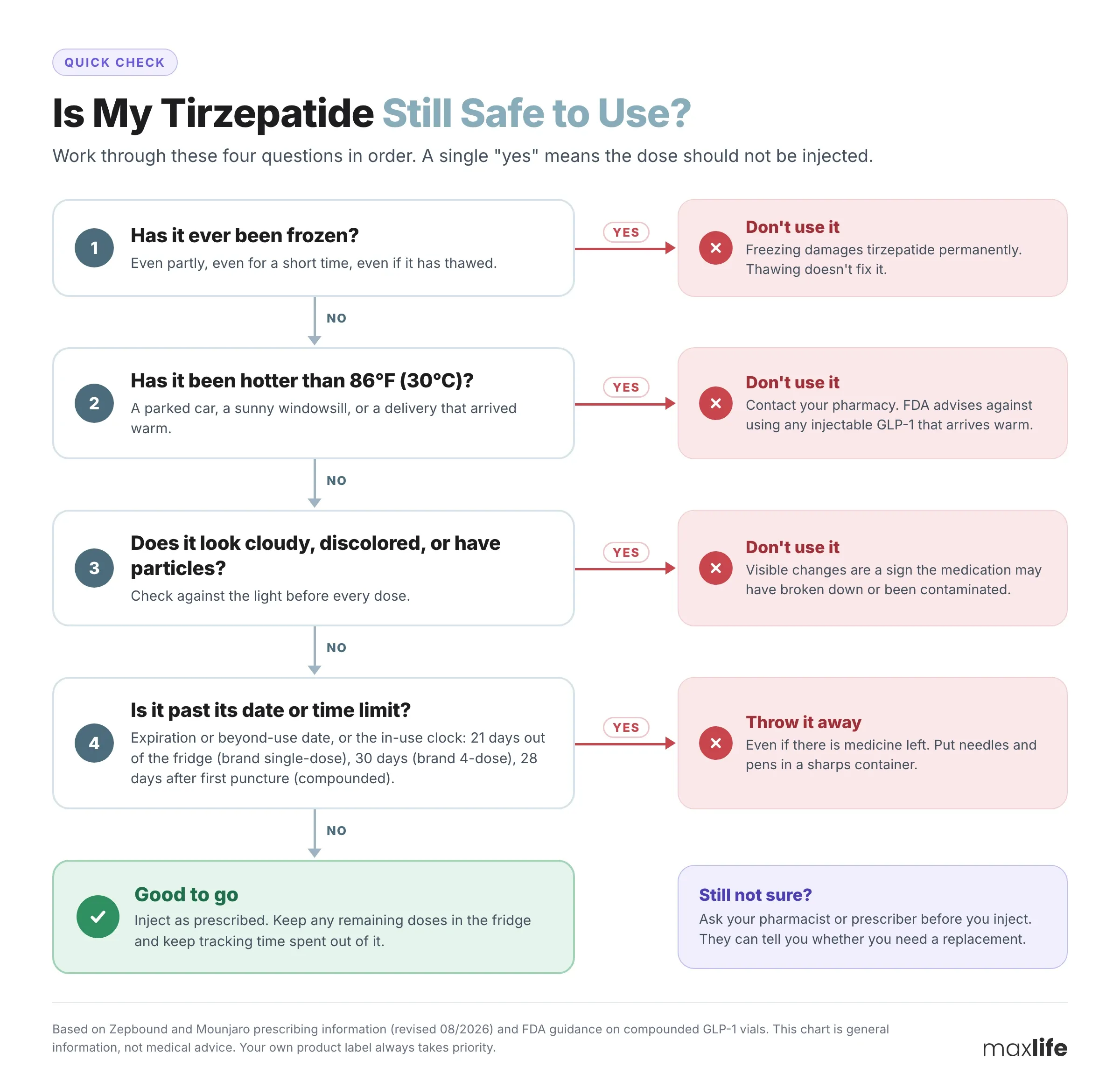 Work through the four questions in order. A single "yes" means don't inject it.
Here's how common mishaps usually play out:
- Left on the counter overnight at normal room temperature. For brand products, this is within the label's allowance as long as it stayed at or below 86°F. Count those hours toward your 21-day or 30-day limit. For compounded vials, check your label or call your pharmacy before using it.
- Left in a hot car. Don't use it. Get a replacement.
- Delivery arrived warm. If the ice packs are fully melted and the medication feels warm, don't use it. The FDA advises against using any injectable GLP-1 that arrives warm or without enough refrigeration. Contact the pharmacy or your telehealth provider for a replacement.
- Accidentally frozen. Throw it away, even if it looks normal after thawing.
- Not sure what happened. Ask your pharmacist or prescriber before you inject.
Traveling With Tirzepatide
- Pack it in your carry-on, never in checked luggage, where it can be lost or exposed to extreme temperatures.
- Use an insulated case with a cold pack, and wrap the pen or vial so it doesn't touch the cold pack directly.
- Use the room-temperature allowance when it helps. Brand pens and vials can travel unrefrigerated at up to 86°F within their time limits. Keep a note of when the clock started.
- Never leave it in a parked car, not even for a quick stop.
- Plan around time zones. Tirzepatide is taken once a week, so pick a travel-friendly dosing day with your provider if needed.
Flying is easier than many people expect. The TSA allows medically necessary liquids in reasonable quantities if you declare them at the checkpoint, and ice packs or gel packs that keep medication cool are allowed whether they're frozen, partly frozen, or melted. Unused syringes are allowed when you carry the injectable medication they go with.
Does Expired Tirzepatide Still Work?
An expiration date is the manufacturer's guarantee that, when stored as directed, the medication will keep its full strength and quality until that date. A beyond-use date plays the same role for compounded medications. Past either date, there's no guarantee. The FDA warns that expired medicines "can be less effective or risky due to a change in chemical composition or a decrease in strength," and that some are at risk of bacterial growth, which is a real concern for a multi-dose vial.
There's no way to measure potency at home, so the safest move is simple: don't use expired tirzepatide. A weaker dose means less appetite control and blood sugar control, and it can stall your progress without an obvious reason. Contact your pharmacy or prescriber for a replacement.
Why the Source of Your Tirzepatide Matters
How tirzepatide is made and shipped affects how long it stays good.
| Source | Who makes it | How its dates are set | Watch out for |
|---|---|---|---|
| Brand (Zepbound, Mounjaro) | Eli Lilly, FDA-approved | Long-term stability testing reviewed by the FDA | Heat and freezing at home |
| Compounded | State-licensed pharmacy or FDA-registered outsourcing facility, with a prescription | Beyond-use date set under USP standards or stability testing | Follow your specific label; dates vary by pharmacy |
| "Research use only" peptides | Unregulated online sellers | Often none | Not for human use; unknown purity, strength, and sterility |
The last row deserves a warning. Some websites sell tirzepatide powder labeled "for research purposes" or "not for human consumption," often with dosing instructions anyway. In 2026, the FDA sent warning letters to several of these sellers, stating that the products were really intended for people and were unapproved new drugs. The agency urges consumers not to buy them, calling them products "of unknown quality" that "may be harmful to their health." They come with no beyond-use date, no pharmacist, and no guarantee they were kept cold on the way to you.
Get Tirzepatide With Medical Guidance
If you're considering tirzepatide for weight loss, a licensed provider can help you decide whether it's right for you and show you how to use and store it safely. With MaxLife, you complete a short online assessment, and a licensed provider reviews your health history. If compounded tirzepatide is appropriate, a licensed partner pharmacy prepares it and ships it overnight in an insulated container with ice. Plans start at $120/month with a Starter Kit Plan and include your medication, supplies, and ongoing provider messaging.
Compounded medications are not FDA-approved and are not reviewed by the FDA for safety, effectiveness, or quality. Check your eligibility.
Conclusion
Tirzepatide does go bad, but a few habits keep it working. Store it in the middle of the fridge at 36°F to 46°F, in its carton. Know your product's clock: 21 days out of the fridge for brand single-dose products, 30 days for brand 4-dose products, and 28 days after first use for compounded vials. Check every dose before you inject, and never use tirzepatide that has been frozen or overheated. When in doubt, ask your pharmacist or provider.
Frequently Asked Questions
Skip the Wait. Check Your Eligibility With MaxLife
Compounded medications are not FDA-approved and are not covered by insurance. Pricing and availability are subject to change.
Check Your EligibilityThis article is for informational purposes only and is not a substitute for professional medical advice, diagnosis, or treatment. Storage and handling instructions differ by product and can change; always follow the label and instructions that come with your medication, and ask your pharmacist or prescriber if you're unsure whether a dose is safe to use. Pricing and compounding regulations described here are subject to change. Compounded medications are not FDA-approved.
Sources
- Eli Lilly: Zepbound (tirzepatide) Prescribing Information
- Eli Lilly: Mounjaro (tirzepatide) Prescribing Information
- Eli Lilly: Zepbound Single-Dose Pen Instructions for Use
- Lilly Medical: Can Remaining Solution in a Zepbound Single-Dose Vial Be Kept for a Future Dose?
- FDA: FDA's Concerns With Unapproved GLP-1 Drugs Used for Weight Loss
- FDA: Warning Letter to Gram Peptides (March 31, 2026)
- FDA: Don't Be Tempted to Use Expired Medicines
- FDA: Are You Storing Food Safely?
- FDA: Best Way to Get Rid of Used Needles and Other Sharps
- CDC: Vaccine Storage and Handling Toolkit (July 2026)
- USP: Compounding Standards and Beyond-Use Dates Fact Sheet
- Pediatrics: Heat Stress From Enclosed Vehicles (McLaren, Null, Quinn, 2005)
- BMC Chemistry: A Multimodal HPLC Stability Indicating Approach for Semaglutide and Tirzepatide (2026)
- Molecular Metabolism: LY3298176, a Novel Dual GIP and GLP-1 Receptor Agonist (Coskun et al., 2018)
- PubChem: Tirzepatide
- TSA: Disabilities and Medical Conditions
- TSA: Unused Syringes