Tirzepatide Dosage Chart for Weight Loss: Doses, Schedule and Units
Pricing is accurate as of November 2026 and subject to change.
Key Takeaways
- Tirzepatide comes in six once-weekly strengths: 2.5 mg, 5 mg, 7.5 mg, 10 mg, 12.5 mg and 15 mg (Zepbound and Mounjaro labels, August 2026).
- Everyone starts at 2.5 mg for 4 weeks; the Zepbound label says this dose is for treatment initiation and is not approved as a maintenance dose.
- Doses rise in 2.5 mg steps after at least 4 weeks on each dose, so reaching the 15 mg maximum takes at least 20 weeks.
- The Zepbound maintenance doses for weight loss are 5 mg, 10 mg and 15 mg; in SURMOUNT-1 they led to average losses of 15.0%, 19.5% and 20.9% over 72 weeks.
- On August 12, 2026, the FDA warned that compounded vials often have a different concentration from Zepbound, so dose volumes in units or mL are not interchangeable.
- If a dose is no more than 4 days late, take it; if it is more than 4 days late, skip it and keep your usual day.
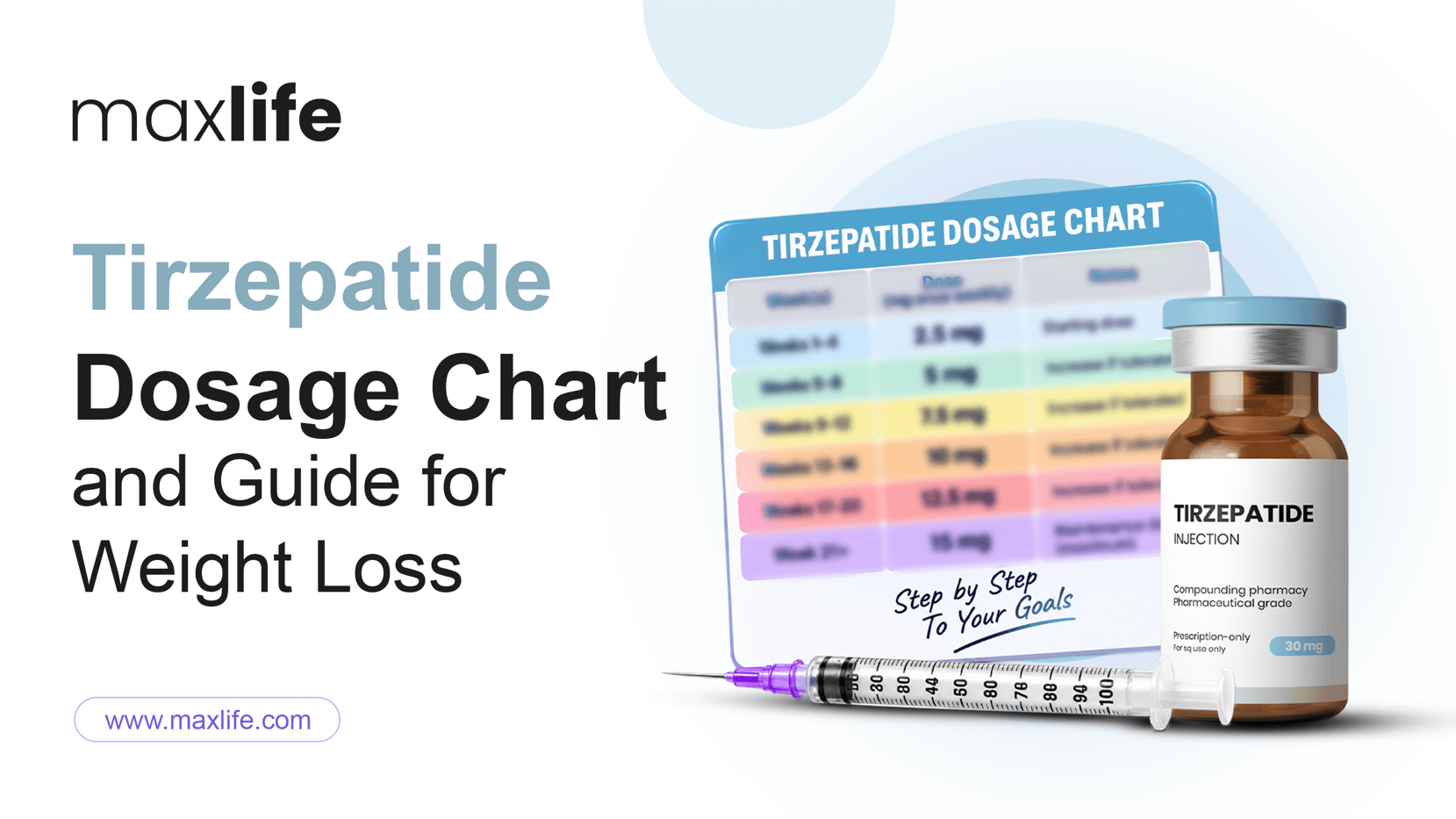
Tirzepatide for weight loss starts at 2.5 mg once a week for 4 weeks, then moves to 5 mg. After that, the dose can rise in 2.5 mg steps, no sooner than every 4 weeks, up to a maximum of 15 mg once a week. The recommended maintenance doses are 5 mg, 10 mg or 15 mg, according to the Zepbound prescribing information (revised August 2026). Your dose in syringe units is a separate question, because it depends on the strength of your vial. On August 12, 2026, the FDA warned state medical boards that compounded vials often come in a different concentration from Zepbound, so dose volumes in units or mL do not carry over between products.
This guide covers the full dosage chart, the week-by-week titration schedule, how to read a compounded dose in units, injection basics and what to do if you miss a dose. Compounded tirzepatide is prepared by a licensed pharmacy for one patient's prescription and is not FDA-approved, which means the FDA hasn't reviewed it for safety, effectiveness or quality.
Quick Answer: What Is the Standard Tirzepatide Dosage?
Tirzepatide comes in six strengths: 2.5 mg, 5 mg, 7.5 mg, 10 mg, 12.5 mg and 15 mg, each injected under the skin once a week. These are label facts for Zepbound (weight management and sleep apnea) and Mounjaro (type 2 diabetes), both made by Eli Lilly.
- Starting dose: 2.5 mg once weekly for 4 weeks. The Zepbound label says this dose "is for treatment initiation and is not approved as a maintenance dosage."
- Next step: 5 mg once weekly after those 4 weeks.
- Increases: 2.5 mg at a time, after at least 4 weeks on the current dose, based on how you respond and what you tolerate.
- Maintenance for weight loss: 5 mg, 10 mg or 15 mg once weekly. For obstructive sleep apnea, 10 mg or 15 mg.
- Maximum: 15 mg once weekly.
Going from the starting dose to 15 mg takes at least 20 weeks. The Mounjaro label uses the same strengths and the same 15 mg maximum for adults, but it ties each increase to blood sugar control rather than weight.
Tirzepatide Dosage Chart
The tirzepatide dosage chart below shows each strength, the earliest week it can start if every increase happens on schedule, and the role the Zepbound label gives it.
| Weekly dose | Earliest timing | Role in the Zepbound label |
|---|---|---|
| 2.5 mg | Weeks 1 to 4 | Starting dose only, not a maintenance dose |
| 5 mg | Weeks 5 to 8 | Lowest maintenance dose |
| 7.5 mg | Week 9 or later | Step between 5 mg and 10 mg |
| 10 mg | Week 13 or later | Maintenance dose (weight loss and sleep apnea) |
| 12.5 mg | Week 17 or later | Step between 10 mg and 15 mg |
| 15 mg | Week 21 or later | Maintenance dose and the maximum |
Each step lasts at least 4 weeks. Your prescriber decides whether and when you go up, so the weeks above are the fastest possible pace, not a target.
Not everyone climbs the whole ladder. Staying on a lower maintenance dose is a normal use of the schedule, not a shortfall.
Starting, Step-Up, and Maintenance Doses
The six strengths fall into three groups, and mixing them up is a common source of confusion.
- Starting dose (2.5 mg). It lets your body adjust before the dose climbs. A small change on the scale during these 4 weeks is expected. Our tirzepatide before and after guide shows what the trials measured over time.
- Maintenance doses (5 mg, 10 mg and 15 mg). These are the doses the Zepbound label recommends for long-term weight management.
- Step-up doses (7.5 mg and 12.5 mg). They bridge the gap between maintenance levels so each increase is only 2.5 mg. The Zepbound label does not list them as maintenance doses.
If a maintenance dose is hard to tolerate, the label tells prescribers to "consider a lower maintenance dosage." The right dose is the one that works for you, not the highest one.
Tirzepatide Dosing for Weight Loss: The Titration Schedule
Tirzepatide dosing for weight loss follows a fixed rhythm: start low, then step up slowly.
- Weeks 1 to 4: 2.5 mg once weekly
- Weeks 5 to 8: 5 mg once weekly
- Week 9 onward: increases of 2.5 mg, each after at least 4 weeks on the current dose, as tolerated, up to 15 mg
At that pace, reaching 10 mg takes 12 weeks and reaching 15 mg takes 20 weeks. The SURMOUNT-1 trial of Zepbound used the same 20-week escalation.
The slow climb has a purpose. The label says to follow the escalation "to reduce the risk of gastrointestinal adverse reactions." In the Zepbound weight-loss trials, most nausea, vomiting and diarrhea happened while the dose was being raised and decreased over time. Tirzepatide also delays stomach emptying, and the label says that effect is largest after the first dose.
Your prescriber may keep you at a dose for longer, or move you to a lower maintenance dose, if side effects are hard to manage. Neither means treatment has failed. Follow the schedule on your own prescription rather than a generic timeline. If low energy is part of the picture, see does tirzepatide make you tired.
What Is the Starting Dose of Compounded Tirzepatide?
The starting dose of compounded tirzepatide is the dose your prescriber writes. Many prescribers use the same milligram steps as the Zepbound label, starting at 2.5 mg once weekly for 4 weeks, because the reason for a slow start does not change. But there is no FDA-approved dosing schedule for compounded tirzepatide, and the FDA has received adverse event reports tied to compounded tirzepatide given "in doses beyond what is in the FDA-approved drug label," including faster increases.
The bigger difference is how the dose is measured. Zepbound comes in single-dose pens and vials that each hold one 0.5 mL dose, and in 4-dose vials and KwikPens that deliver 0.6 mL per dose. Compounded tirzepatide usually comes in a multi-dose vial that you draw from with a syringe. In its August 12, 2026 letter, the FDA said compounded drugs "often have different concentrations than FDA approved products" and that the volumes "are not interchangeable between the two."
So two people on the same 2.5 mg dose can draw very different amounts of liquid. Your prescription label and the pharmacy that dispensed your vial are the only reliable guide to how much to draw. You can also look up your pharmacy's medication instructions for weight loss.
Tirzepatide Dosing for Weight Loss in Units
Your prescription is written in milligrams (mg), which measure the drug. An insulin syringe is marked in units, which measure volume. There is no fixed link between the two: the number of units for a dose depends on your vial's concentration in mg per mL.
On a standard U-100 insulin syringe, 100 units equals 1 mL, so 1 unit equals 0.01 mL. That conversion describes the syringe, not the medicine.
Same Dose, Different Volume
This table shows why a units figure cannot move from one product to another. The compounded column is the example the FDA gave in its August 2026 letter.
| Dose | Zepbound single-dose pen or vial | Zepbound 4-dose vial or KwikPen | Compounded example from the FDA (17 mg/mL vial) |
|---|---|---|---|
| 2.5 mg | 0.5 mL | 0.6 mL | 0.15 mL (15 units) |
| 5 mg | 0.5 mL | 0.6 mL | 0.29 mL (29 units) |
| 10 mg | 0.5 mL | 0.6 mL | 0.59 mL (59 units) |
| 15 mg | 0.5 mL | 0.6 mL | 0.88 mL (88 units) |
With Zepbound, the volume stays the same and the strength of the pen or vial changes. With a compounded multi-dose vial, the strength stays the same and the volume you draw changes. A units chart made for one vial can mean a large overdose or underdose from another. In a 2024 alert, the FDA described patients who drew 5 to 20 times their intended dose of compounded semaglutide from multi-dose vials, partly from confusion between milligrams, milliliters and units.
How to Check the Math (Illustration Only)
To convert, divide your dose in mg by your vial's concentration in mg/mL to get mL, then multiply by 100 to get units.
- From a 10 mg/mL vial: 2.5 mg ÷ 10 mg/mL = 0.25 mL, which is 25 units.
- From a 20 mg/mL vial: 2.5 mg ÷ 20 mg/mL = 0.125 mL, which is 12.5 units.
Same 2.5 mg, half the units. These numbers show the method and are not instructions for your vial. Our weight loss medication dosage calculator does the same math for your pharmacy's label and explains how strengths are written.
The rule is simple. Read the concentration printed on your own vial. Use the units figure on your prescription label, or from your pharmacy, for that specific vial. If it is missing, unclear or doesn't match what you calculate, call the pharmacy or your prescriber before you inject.
What Is the Highest Dose of Tirzepatide?
The highest dose of tirzepatide is 15 mg once weekly. That is the maximum in the Zepbound label and the adult maximum in the Mounjaro label (Mounjaro's maximum for children 10 and older is 10 mg). No FDA-approved schedule goes above 15 mg.
Which dose works best? In SURMOUNT-1, as reported in the Zepbound label, adults without diabetes taking Zepbound lost an average of 15.0% of body weight at 5 mg, 19.5% at 10 mg and 20.9% at 15 mg over 72 weeks, compared with 3.1% on placebo. These results have not been shown for compounded tirzepatide, and individual results vary.
Higher doses also brought more side effects for some people. In the label's pooled weight-loss trials, nausea affected 25% of people at 5 mg, 29% at 10 mg and 28% at 15 mg (8% on placebo), and vomiting rose from 8% to 11% to 13% (2% on placebo). The share who stopped treatment because of stomach side effects rose from 1.9% at 5 mg to 3.3% at 10 mg and 4.3% at 15 mg. The best dose for you is the one you tolerate and can stay on, chosen with your prescriber.
Never take more than prescribed, and never go above 15 mg a week, even if your vial has medicine left.
How to Inject Your Tirzepatide Dose
Follow the Instructions for Use that came with your product. This summary is based on the Zepbound instructions.
- Wash your hands with soap and water.
- Check the medicine. It should be clear and colorless to slightly yellow, with no particles, and within its date. Don't use it if it looks cloudy or discolored.
- Choose a site: your stomach area (abdomen) or thigh. Another person can inject into the back of your upper arm. The KwikPen instructions say to stay at least 2 inches from the belly button. Our guide on where to inject tirzepatide covers each site, rotation and device steps.
- Rotate sites with each dose. Avoid skin that is tender, bruised, scarred, hard or lumpy.
- With a single-dose pen, place the base flat on your skin, unlock it, then press and hold the button for up to 10 seconds, until the second click.
- With a vial, wipe the rubber stopper with an alcohol swab, draw your prescribed dose with a new syringe and needle, tap out air bubbles, and keep the needle in your skin for at least 5 seconds after you push the plunger.
- Put used needles, syringes and pens in a sharps disposal container right away.
Keep unused tirzepatide in the refrigerator at 36°F to 46°F (2°C to 8°C), in its carton, and never freeze it. For room-temperature limits and signs that a dose has gone bad, see our guide to tirzepatide storage and shelf life. Compounded vials follow the storage directions on the dispensing pharmacy's label.
What to Do If You Miss a Dose of Tirzepatide
If you miss a dose, take it as soon as possible within 4 days (96 hours). If more than 4 days have passed, skip it and take your next dose on your usual day. Both the Zepbound and Mounjaro labels give this rule.
| Scenario | What to do |
|---|---|
| Your dose day is Monday. You remember on Wednesday (2 days late). | Inject on Wednesday, then go back to Mondays. |
| Your dose day is Monday. You remember on Saturday (5 days late). | Skip it. Inject on Monday as usual. |
Never take two doses to make up for a missed one, and keep at least 3 days (72 hours) between any two doses.
The Zepbound label doesn't say how to restart after several missed weeks. If you have missed two or more doses in a row, contact your prescriber before your next injection. They may restart you at a lower dose and step up again, because tolerance can drop during a gap.
Can You Change Your Tirzepatide Injection Day?
Yes. The label allows you to change your weekly injection day as long as the two doses are at least 3 days (72 hours) apart.
Say you inject on Monday and want to move to Thursday. Thursday is 3 days after Monday, so it meets the rule, and Thursday becomes your new day. Moving earlier needs more care: to switch from Monday to Saturday, inject on the Saturday 5 days after your Monday dose, not the Saturday 2 days before it.
Pick a day you can keep every week, including when you travel, and set a recurring reminder on your phone.
Signs Your Tirzepatide Dose Is Too High
Some nausea and a lower appetite are expected, especially in the first days after an increase. The signal to act on is side effects that get in the way of daily life.
Talk to your provider if you notice:
- Nausea that lasts more than a few days after a dose increase
- Vomiting, or trouble keeping food and fluids down
- Constipation that does not improve with fluids, fiber and movement
- Tiredness that does not ease as the week goes on
- Eating so little that you struggle to get through the day
The fix is usually a conversation, not quitting. Your provider can hold your dose, lower it or treat the symptom. Stopping on your own removes those options.
Get medical help right away for severe or lasting stomach pain, with or without vomiting, especially if it spreads to your back, which the label lists as a possible sign of pancreatitis. Signs of dehydration also need prompt care, because the label links dehydration from stomach side effects to kidney problems. If you take insulin or a sulfonylurea, ask about low blood sugar: the label says the risk is higher with those medicines. Tirzepatide should not be used by anyone with a personal or family history of medullary thyroid carcinoma or MEN 2. Talk to your provider about your health history before you start.
How Does Semaglutide Dosing Compare?
Semaglutide follows the same idea with different numbers. In the June 2026 Wegovy label, the injection starts at 0.25 mg once weekly for 4 weeks, then rises every 4 weeks through 0.5 mg, 1 mg and 1.7 mg. For weight reduction in adults, the maintenance dose is 1.7 mg or 2.4 mg (2.4 mg recommended), and people who tolerate 2.4 mg for at least 4 weeks may go up to a maximum of 7.2 mg.
The shared principle is to start low, step up about every 4 weeks and settle on a dose that works and that you tolerate. The milligram amounts are different, so a tirzepatide dose and a semaglutide dose are not interchangeable.
Choosing between them is a clinical decision. For how the two compare in head-to-head research, see tirzepatide vs Wegovy. MaxLife offers both compounded tirzepatide and compounded semaglutide when a licensed provider prescribes them.
Get Your Dosing Plan From a Licensed Provider
A tirzepatide dosage chart shows what the label allows. It cannot tell you what is right for you. Where you start, how fast you step up, where you stop and whether you pause depend on your response, your side effects and your health history.
With MaxLife, you complete a short online intake that takes about 2 minutes. An independent licensed provider reviews it, usually within 24 hours, and decides whether a prescription is right for you, and you can ask for a video visit. If compounded tirzepatide is prescribed, a licensed partner pharmacy prepares and dispenses it, and the pharmacy label on your vial gives your dose. Higher doses are available when a provider prescribes them. MaxLife is a telehealth patient management platform, not a pharmacy or drug maker.
Conclusion
Tirzepatide dosing runs from 2.5 mg to 15 mg once weekly across six strengths. Everyone starts at 2.5 mg for 4 weeks, each increase comes after at least 4 weeks, and the Zepbound label's maintenance doses for weight loss are 5 mg, 10 mg and 15 mg. Reaching 15 mg takes at least 20 weeks, and staying on a lower dose is a normal outcome.
If you use a compounded vial, your dose in units depends on that vial's concentration. As the FDA warned in August 2026, volumes don't carry over between products, so follow your own label rather than an online chart. Every dose change belongs to your prescriber.
Frequently Asked Questions
Compounded Tirzepatide: $120/mo Flat, All-Inclusive
MaxLife compounded tirzepatide: $120 a month, flat. All-inclusive, no membership fee, the same price at every dose. A licensed provider decides.
Check Your EligibilityThis article is for informational purposes only and is not a substitute for professional medical advice, diagnosis, or treatment. Always follow the dose and instructions on your own prescription and pharmacy label. Do not change your dose without talking to your provider. Compounded medications are not FDA-approved.
Why trust our experts

April Foster, DO MPH
Reviewer
Board Certified Family Medicine Physician licensed nationwide providing collaborative oversight to NPs, PAs, and RN. Also specializing in telemedicine services nationwide.
Sources
- Zepbound (tirzepatide) prescribing information, Medication Guide and Instructions for Use (DailyMed, revised 08/2026)
- Mounjaro (tirzepatide) prescribing information (DailyMed, revised 08/2026)
- FDA letter to the Federation of State Medical Boards on compounded GLP-1 multi-dose vials (August 12, 2026)
- FDA: FDA's Concerns with Unapproved GLP-1 Drugs Used for Weight Loss (current as of October 1, 2026)
- FDA: Dosing errors associated with compounded semaglutide (July 26, 2024)
- New England Journal of Medicine: Tirzepatide Once Weekly for the Treatment of Obesity (SURMOUNT-1, 2022)
- Wegovy (semaglutide) injection and tablets prescribing information (DailyMed, June 2026)
Update History
- November 1, 2026 — Doses re-checked against the August 2026 Zepbound and Mounjaro labels; FDA's August 2026 compounded-vial warning, a units comparison table and new FAQs added.
Does Tirzepatide Go Bad? How Long It Lasts In and Out of the Fridge
October 16, 202614 min

Does Tirzepatide Make You Tired? Why It Happens and How Long It Lasts
September 30, 202612 min
Tirzepatide and Alcohol: Can You Drink, and What Are the Risks?
October 21, 202613 min

Tirzepatide vs Ozempic (Mounjaro, Zepbound): 8 Differences to Know
September 15, 202615 min