Can GLP-1 Drugs Cause Vision Loss? The FDA's NAION Warning Explained
Pricing is accurate as of November 2026 and subject to change.
Key Takeaways
- On November 9, 2026, the FDA required the makers of all GLP-1 medicines, including Ozempic, Wegovy, Zepbound and Mounjaro, to add a warning about a potential increased risk of NAION, a rare cause of sudden vision loss in one eye.
- In the FDA's review of 126 trials, NAION occurred at 6.4 vs 3.8 cases per 100,000 person-years, about 2.6 extra cases per 100,000 people treated for a year. It has not been proven that the drugs cause it.
- As of November 2026, none of the labels on DailyMed (Ozempic injection and tablets, Wegovy, Zepbound, Mounjaro) mention NAION yet.
- The evidence is strongest for semaglutide in people with type 2 diabetes; data for weight loss are thinner, and tirzepatide has been studied much less.
- Sudden, painless vision loss, a new blind spot or washed-out colors in one eye need same-day eye care. Otherwise, don't stop your medicine without talking to your provider.
- Compounded semaglutide and tirzepatide are not FDA-approved, have no FDA label and have not been studied for NAION, so watch for the same symptoms.
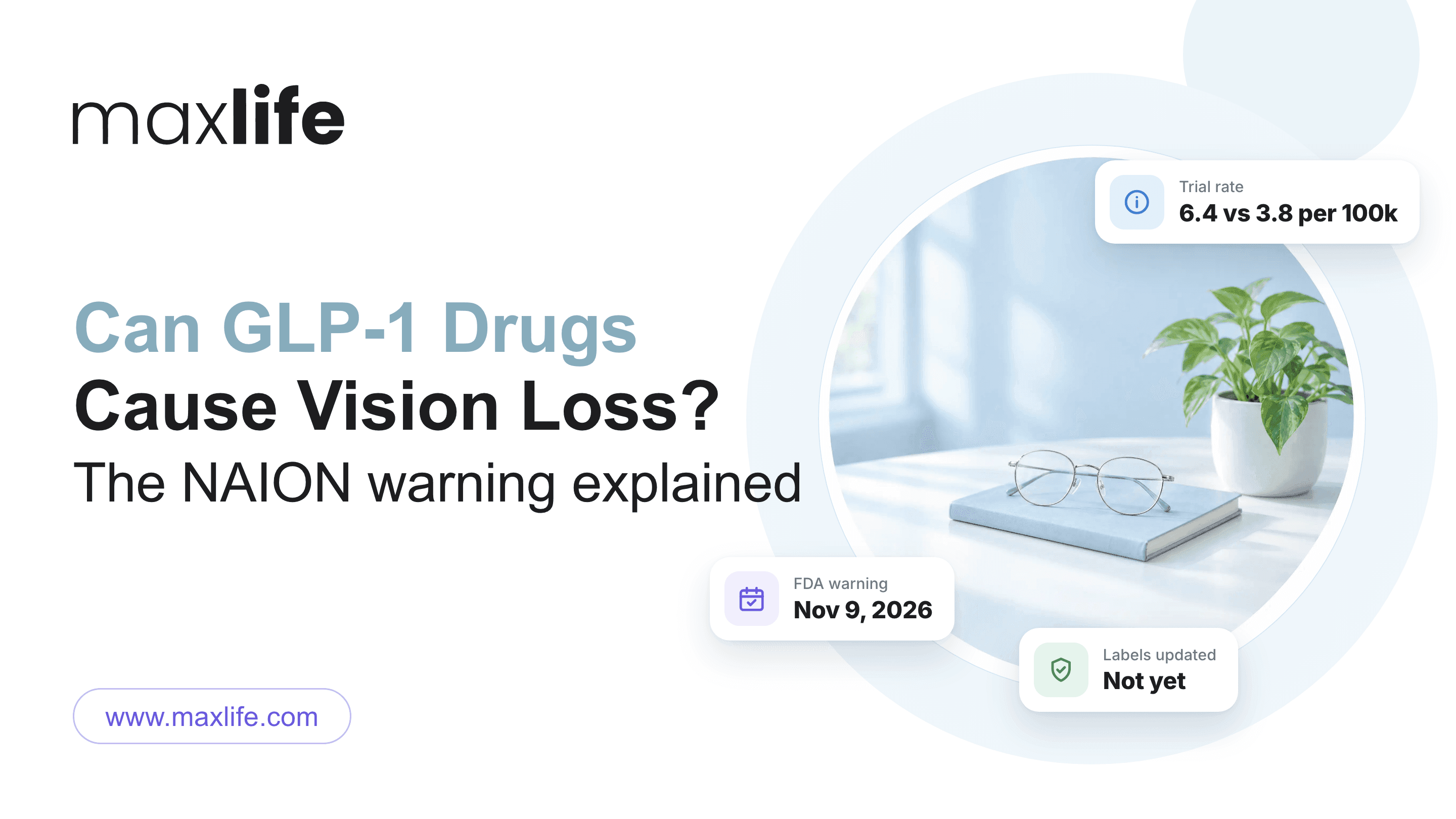
Possibly, but it is rare, and it has not been proven that the drugs cause it. On November 9, 2026, the FDA required a new warning about non-arteritic anterior ischemic optic neuropathy (NAION), an eye condition that causes sudden, painless vision loss in one eye, for every GLP-1 medicine, including Ozempic®, Wegovy®, Mounjaro® and Zepbound®. In the FDA's review of 126 clinical trials, NAION occurred at a rate of 6.4 cases per 100,000 person-years in people taking a GLP-1 medicine and 3.8 in people on comparison treatments. The FDA calls it a "potential increased risk." When we read the labels on DailyMed in November 2026, none had been updated yet.
If you suddenly lose vision in one eye, get eye care the same day, even if nothing hurts. For anything less urgent, talk to your provider before you stop or change your medicine.
The eye warning sits alongside the better-known GLP-1 side effects, most of which are digestive. Compounded semaglutide and tirzepatide are not FDA-approved and have no FDA label, so they won't carry the new warning, but the same symptoms matter. At MaxLife, ongoing medical support is included with compounded semaglutide ($89/mo flat) and compounded tirzepatide ($120/mo flat), so you can raise an eye symptom with a provider at any time.
What Did the FDA Say About GLP-1 Drugs and Vision Loss?
The FDA said GLP-1 medicines may slightly raise the risk of NAION, and it is requiring the makers of all of them to add that risk to the Warnings and Precautions section of their labels. The Drug Safety Communication of November 9, 2026 covers the whole class: Ozempic, Rybelsus and Wegovy (semaglutide), Mounjaro and Zepbound (tirzepatide), Trulicity, Victoza, Saxenda, Xultophy, Soliqua, exenatide and Foundayo (orforglipron).
What the FDA found:
- In clinical trials: across 126 trials with 134,253 people, there were 15 probable cases of NAION, 10 in people taking a GLP-1 medicine and 5 in people taking placebo. That works out to 6.4 vs 3.8 cases per 100,000 person-years.
- In real-world data: in the FDA's Sentinel study of adults with type 2 diabetes (2019 to 2024), NAION occurred at 26 to 32 cases per 100,000 person-years on a GLP-1. Compared with SGLT-2 inhibitors, the difference was not statistically significant (hazard ratio 1.19). Compared with DPP-4 inhibitors, the risk was 43% higher (hazard ratio 1.43).
- In published studies: the more rigorous ones "generally reported" a higher risk with GLP-1s than with those two other classes of diabetes medicine.
- No mechanism: animal studies did not show how GLP-1s could cause NAION. Cases have been reported with every GLP-1 on the market.
The FDA's wording is careful. It describes a "potential increased risk of rare NAION events," says the cause of NAION "is not completely understood," and notes that reports are hard to interpret because the risk factors for NAION, such as diabetes and sleep apnea, are common in people who take these medicines.
Do the Ozempic, Wegovy, Zepbound and Mounjaro Labels Mention NAION Yet?
Not yet. The FDA has required the change, but when we read the current labels on DailyMed in November 2026, none of them mentioned NAION or ischemic optic neuropathy, and Drugs@FDA showed no label approval for any of them after August 2026. The FDA's announcement gives no date for the updates.
| Label (DailyMed) | Newest version | NAION warning? |
|---|---|---|
| Ozempic injection (semaglutide) | June 2026 | Not yet |
| Ozempic tablets and Rybelsus (oral semaglutide) | August 2026 | Not yet |
| Wegovy injection and tablets (semaglutide) | June 2026 | Not yet |
| Mounjaro (tirzepatide) | September 2026 | Not yet |
| Zepbound (tirzepatide) | September 2026 | Not yet |
Today's labels already carry a different eye warning for people with type 2 diabetes: diabetic retinopathy can get temporarily worse when blood sugar improves quickly (more in the blurred vision section below). To see whether the NAION wording has been added, open the label on DailyMed and look for it in section 5, Warnings and Precautions.
What Is NAION?
NAION, short for non-arteritic anterior ischemic optic neuropathy, is damage to the front of the optic nerve caused by poor blood flow. It is often called an "eye stroke." The optic nerve carries what your eye sees to your brain, so when part of it loses its blood supply, part of the vision in that eye goes dark or blurry. "Non-arteritic" means it is not caused by inflamed arteries, a separate condition called giant cell arteritis.
NAION symptoms, as the FDA lists them:
- sudden, painless vision loss in one eye, often noticed on waking
- blind spots or tunnel vision
- colors that look faded or wrong
- blurry or hazy vision in the center
NAION is more common in people 50 and older. The FDA lists smoking, diabetes, high blood pressure, sleep apnea, anemia and kidney disease as risk factors. The American Academy of Ophthalmology (AAO) says there is no treatment to improve vision lost to ischemic optic neuropathy and that the loss is usually permanent. After NAION in one eye, the other eye is at higher risk: in a large US study, 14.7% of people developed NAION in their second eye over a median of about 5 years (American Journal of Ophthalmology, 2002).
How Rare Is NAION on a GLP-1?
Rare. In the FDA's trial analysis, the gap between 6.4 and 3.8 cases per 100,000 person-years is about 2.6 extra cases for every 100,000 people treated for a year (our arithmetic from the FDA's figures). A person-year is one person followed for one year, so 100,000 person-years could be 100,000 people for one year or 50,000 people for two.
Other numbers for scale:
- Without any GLP-1: NAION occurs in 2.3 to 10.2 of every 100,000 adults over 50 each year, according to the FDA.
- Europe's estimate: in adults with type 2 diabetes, large studies point to about one extra case per 10,000 person-years of semaglutide treatment (European Medicines Agency, 2025). People with diabetes start at a higher risk, which is one reason this figure is higher than the trial figure.
- A 2026 meta-analysis of 15 studies with more than 1.5 million people found NAION in 0.09% of GLP-1 users and an absolute increase of 0.037 percentage points, about 1 extra case for every 2,700 people treated (Diabetes Care, 2026).
Rare is not zero, and the possible result, lasting vision loss in one eye, is serious. That is why the FDA's advice centers on knowing the symptoms and getting care fast.
What Do the Studies Show?
The studies disagree on how large the risk is, and most are observational, which means they can show a link but can't prove that the drug caused it. The first study was small and found a large effect, larger registry studies found smaller ones, and some found none.
| Study | What it found | Limits |
|---|---|---|
| Boston eye hospital (JAMA Ophthalmology, 2024) | NAION about 4 times as often on semaglutide in diabetes, 7.6 times in overweight or obesity | One specialist clinic's patients; 17 and 20 cases |
| All of Denmark, 424,152 adults with type 2 diabetes (2024) | About 2.2 times the risk with semaglutide | Diabetes only; observational |
| Denmark and Norway, 61,377 semaglutide users (2025) | About 2.8 times the risk vs SGLT-2 inhibitors; 1.4 extra cases per 10,000 person-years | Diabetes only; 32 cases in total |
| 14 US databases, 37.1 million adults with diabetes (JAMA Ophthalmology, 2025) | No clear difference vs three diabetes drugs in the main analysis; 32% higher in a within-person analysis | Relies on diagnosis codes |
| 160 health systems in 21 countries (Ophthalmology, 2025) | No significant link in diabetes, obesity or both | Health-record data; wide uncertainty |
| FDA review of 126 trials (2026) | 10 vs 5 cases; 6.4 vs 3.8 per 100,000 person-years | Only 15 cases in total |
| Meta-analysis of 15 studies (Diabetes Care, 2026) | About 70% higher odds; absolute risk 0.09% | Mixes trials and observational studies |
Two patterns stand out. First, the signal is clearest in people with type 2 diabetes. A 2026 review that separated studies by the reason for treatment found more NAION with semaglutide in observational studies of diabetes (26.7 vs 18.9 cases per 100,000 person-years) but no clear increase in observational studies of weight loss and no significant increase in randomized trials of either group (Ophthalmology, 2026). Second, the big trials didn't set out to measure eye problems: they recorded them as side effects, so the trial counts are small and depend on reporting (Diabetes Care, 2026).
Does Ozempic Cause Blindness?
Ozempic has not been proven to cause blindness, but semaglutide, the drug in Ozempic, is the GLP-1 most often linked to NAION, and most studies above looked at people taking it for type 2 diabetes. In May 2026, the North American Neuro-Ophthalmology Society (NANOS) and the AAO concluded that there is "a possible small increased risk of NAION in patients taking semaglutide," that the risk "remains low and is yet to be confirmed," and that "causation has not been shown" (NANOS and AAO, 2026). If the risk is real, they wrote, it is likely "in the range of about 2-fold," lower than the first study suggested.
What people call "Ozempic blindness" is usually NAION, which tends to affect one eye at a time. Diabetes itself raises NAION risk, which makes it hard to separate the effect of the drug from the effect of the disease it treats.
Can Wegovy Cause Vision Loss?
Wegovy is semaglutide at higher doses for weight management, so the FDA warning and Europe's conclusion cover it too. The evidence in people taking semaglutide for weight loss is thinner and less consistent. The 2024 Boston study found its largest effect in the overweight and obesity group (20 cases among 361 semaglutide users vs 3 among 618 people on other weight-loss medicines). Later reviews that pooled weight-loss studies did not find a clear increase: one reported a hazard ratio of 1.57 that was not statistically significant (Ophthalmology, 2026), and another 0.47, also not significant (Ophthalmology, 2026). With so few cases, not finding a clear increase is not proof that there is no risk. For how the two semaglutide brands differ, see Ozempic vs Wegovy.
Can Zepbound or Mounjaro Cause Blindness?
The FDA warning covers tirzepatide, the drug in Zepbound and Mounjaro, but there is much less research on it. NANOS and the AAO wrote that tirzepatide "has been less frequently studied and warrants further investigation" and that "one should not assume that this risk is specific to semaglutide." Here is what exists so far:
- A US study of 159,398 adults with type 2 diabetes grouped semaglutide and tirzepatide together. Over two years, NAION was diagnosed in 0.04% of them vs 0.02% of matched people on other diabetes medicines (hazard ratio 1.76) (JAMA Network Open, 2025).
- A 2026 study of 102,590 adults with type 2 diabetes starting tirzepatide and the same number starting another GLP-1 found less NAION with tirzepatide (hazard ratio 0.45) (Ophthalmology Retina, 2026). It compared GLP-1 medicines with each other, so it can't tell you whether tirzepatide raises risk compared with taking no GLP-1.
- A few single case reports describe NAION after starting tirzepatide. Case reports can't show cause or frequency.
So for Zepbound and Mounjaro, the warning applies, the data are limited, and the symptoms to watch for are the same. For how the two drugs compare on other points, see semaglutide vs tirzepatide.
What Did Europe's Regulator Conclude in 2025?
In June 2025, the safety committee of the European Medicines Agency (EMA) concluded that NAION is a "very rare side effect" of the semaglutide medicines Ozempic, Rybelsus and Wegovy, meaning it may affect up to 1 in 10,000 people taking them. It reviewed trials, safety reports and several large studies, which suggested about twice the risk in adults with type 2 diabetes, or about one extra case per 10,000 person-years. EMA asked for NAION to be added to the European product information and advised that "if NAION is confirmed, treatment with semaglutide should be stopped." Europe's decision covered semaglutide only. The FDA's 2026 action covers every GLP-1, tirzepatide included.
Does Blurred Vision From Ozempic Go Away?
Usually, yes, when it comes from changing blood sugar. But blurred vision has several possible causes on a GLP-1, and they need different responses:
- Blood sugar changes: when blood sugar falls quickly, the lens of the eye can change shape for a while. The AAO says this "is a temporary side effect, usually subsiding after three or four months" (AAO, 2026).
- Diabetic retinopathy getting worse: in a 2-year trial of adults with type 2 diabetes, diabetic retinopathy complications occurred in 3.0% of people on Ozempic vs 1.8% on placebo, and in 8.2% vs 5.2% of those who already had retinopathy, according to the Ozempic label. The labels say rapid improvement in blood sugar "has been associated with a temporary worsening of diabetic retinopathy" and that people with a history of it should be monitored. The Wegovy, Zepbound and Mounjaro labels carry similar warnings.
- Low blood sugar: blurred vision is a listed sign of low blood sugar in the Medication Guides, a risk mainly if you also take insulin or a sulfonylurea.
- NAION: sudden loss or dimming of vision in one eye, often on waking, usually without pain.
Blur that comes and goes with your blood sugar is different from a sudden loss in one eye; the second needs same-day care. The Ozempic and Mounjaro Medication Guides tell everyone to report vision changes to their provider (the Wegovy and Zepbound guides say this for people with type 2 diabetes). If you have diabetes, keep your regular eye exams.
Which Vision Symptoms Need Same-Day Care?
Get eye care the same day, from an ophthalmologist, an urgent eye clinic or an emergency room, if you notice any of these, even without pain:
- sudden loss or dimming of vision in one eye, including when you wake up
- a new blind spot, a dark or missing area, or tunnel vision
- colors that suddenly look washed out or wrong
- new blurry or hazy vision in the center of one eye
Call 911 if vision loss comes with weakness or numbness on one side, trouble speaking, confusion or loss of balance, which can be signs of a stroke (MedlinePlus). Don't wait to see if eye symptoms pass: inflamed arteries in the head (giant cell arteritis) can cause similar vision loss, and the AAO calls that condition potentially life-threatening. Tell the eye doctor which GLP-1 you take, then let your prescriber know.
Should You Stop Your GLP-1 Because of the Warning?
Not on your own. The FDA, the AAO and NANOS all say that decisions about continuing or stopping belong with your prescriber. Where they differ is what should happen after NAION is diagnosed:
- FDA (2026): prescribers should consider stopping the GLP-1 in people who develop NAION "unless the benefits of treatment clearly outweigh the risk."
- EMA (2025): if NAION is confirmed, semaglutide "should be stopped."
- NANOS and AAO (2026): they "do not support" stopping automatically and recommend a shared decision that weighs the medicine's benefits against the possible risk.
If you have no eye symptoms, the FDA's advice is to know the signs and act fast if they appear. Stopping or changing your medicine is a decision for you and your provider, who can weigh your eye risk factors against what the medicine is doing for your health.
What Should You Tell Your Provider?
Before you start a GLP-1, or at your next check-in, tell your provider if you have:
- had NAION or sudden vision loss in either eye before
- diabetic retinopathy, glaucoma or another eye disease, and when your last eye exam was
- sleep apnea, high blood pressure, anemia or kidney disease, or if you smoke
- noticed any change in your vision since you started or raised your dose
After the FDA's announcement, the AAO said people with a history of NAION should discuss the risk to their other eye before starting a GLP-1. It does not recommend a routine eye exam only to check NAION risk before starting, but people with diabetes should keep their regular diabetic eye exams (AAO, November 2026). Sleep apnea is both a NAION risk factor and a condition Zepbound is approved to treat in some adults with obesity; see Zepbound for sleep apnea.
Does the Warning Apply to Compounded Semaglutide and Tirzepatide?
The FDA's warning is for FDA-approved medicines, and compounded GLP-1s are not FDA-approved. Compounded semaglutide or tirzepatide is prepared by a licensed pharmacy for one patient's prescription and is not FDA-approved, which means the FDA hasn't reviewed it for safety, effectiveness or quality. It has no FDA label, so it won't carry the new warning, and no study has looked at NAION in people using compounded versions. None of that means a lower risk. If you use a compounded GLP-1, watch for the same symptoms and tell your provider about the same risk factors.
Here is how MaxLife works. MaxLife is a telehealth patient management platform, not a pharmacy or drug maker. A licensed provider reviews your online intake, health history and clinical records, usually within 24 hours, can follow up with questions, and you can ask for a video visit. Mention any past NAION, vision loss or eye disease in your intake. If the provider decides a prescription is right for you, licensed partner pharmacies prepare and dispense it. Compounded semaglutide is $89/mo flat and compounded tirzepatide is $120/mo flat, the same price at every dose, including the provider's review and follow-up, the medicine if prescribed, supplies and free ongoing medical support, with no membership fee.
The Bottom Line
GLP-1 medicines may slightly raise the risk of NAION, a rare cause of sudden, painless vision loss in one eye, and on November 9, 2026, the FDA required a warning for all of them, from Ozempic and Wegovy to Zepbound and Mounjaro. As of November 2026, the labels on DailyMed have not been updated yet. The evidence is strongest for semaglutide in people with type 2 diabetes, thinner for weight loss and limited for tirzepatide. Know the symptoms, get same-day eye care if they appear, don't stop your medicine on your own, and tell your provider about past vision problems and risk factors. For the rest of the side-effect picture, see our guide to tirzepatide side effects.
Frequently Asked Questions
Semaglutide or Tirzepatide, With Ongoing Provider Support
MaxLife compounded semaglutide $89 a month and tirzepatide $120 a month, flat. All-inclusive, no membership fee, the same price at every dose. A licensed provider decides.
Check Your EligibilityThis article is for informational purposes only and is not a substitute for professional medical advice, diagnosis, or treatment. Individual results vary. Pricing, insurance coverage, and compounding regulations described here are subject to change; verify current details with your insurance provider, the manufacturer, or your prescriber before making treatment decisions. Compounded medications are not FDA-approved.
Why trust our experts

April Foster, DO MPH
Reviewer
Board Certified Family Medicine Physician licensed nationwide providing collaborative oversight to NPs, PAs, and RN. Also specializing in telemedicine services nationwide.
Sources
- FDA Drug Safety Communication: safety labeling changes for GLP-1 receptor agonists due to potential increased risk of NAION, November 9, 2026
- Ozempic (semaglutide) injection prescribing information (DailyMed)
- Ozempic tablets and Rybelsus (oral semaglutide) prescribing information (DailyMed)
- Wegovy (semaglutide) injection and tablets prescribing information (DailyMed)
- Mounjaro (tirzepatide) prescribing information (DailyMed)
- Zepbound (tirzepatide) prescribing information (DailyMed)
- European Medicines Agency: PRAC concludes NAION is a very rare side effect of semaglutide medicines, June 2025
- NANOS and American Academy of Ophthalmology: GLP-1 receptor agonists and the risk of NAION, consensus statement, 2026
- American Academy of Ophthalmology: What you need to know about the FDA's new GLP-1 warning, November 2026
- American Academy of Ophthalmology: Can Ozempic affect eye health?, November 2026
- American Academy of Ophthalmology: What is ischemic optic neuropathy?
- JAMA Ophthalmology: Risk of NAION in patients prescribed semaglutide, 2024
- International Journal of Retina and Vitreous: Semaglutide and NAION in a Danish cohort of 424,152 people with type 2 diabetes, 2024
- Diabetes, Obesity and Metabolism: Semaglutide and NAION, a Danish-Norwegian cohort study, 2025
- JAMA Ophthalmology: Semaglutide and NAION in the OHDSI network, 2025
- Ophthalmology: Semaglutide and NAION, a multinational population-based study, 2025
- JAMA Network Open: Semaglutide or tirzepatide and optic nerve disorders in type 2 diabetes, 2025
- Ophthalmology Retina: Ocular outcomes with tirzepatide vs other GLP-1 receptor agonists, 2026
- Diabetes Care: GLP-1 receptor agonists and ischemic optic neuropathy, meta-analysis, 2026
- Diabetes Care: GLP-1 receptor agonists and optic nerve or vision-threatening events, meta-analysis of randomized trials, 2026
- Ophthalmology: Rate and risk of NAION with semaglutide for diabetes and weight loss, meta-analysis, 2026
- Ophthalmology: Semaglutide and NAION, certainty of evidence meta-analysis, 2026
- Case Reports in Ophthalmology: Acute unilateral NAION following tirzepatide therapy, 2026
- American Journal of Ophthalmology: The fellow eye in NAION, IONDT follow-up study, 2002
- MedlinePlus: Stroke
Tirzepatide Side Effects: What's Common, What's Serious, What Helps
November 12, 202615 min
Ozempic vs Wegovy: Same Drug, Different Doses and Uses
November 14, 202612 min
Semaglutide vs Tirzepatide: Weight Loss, Side Effects and Cost
November 13, 202613 min
Zepbound for Sleep Apnea: Coverage and Who Qualifies
November 7, 202612 min