Semaglutide vs Tirzepatide: Weight Loss, Side Effects and Cost
Pricing is accurate as of November 2026 and subject to change.
Key Takeaways
- Semaglutide (Ozempic, Wegovy, Rybelsus) is a GLP-1 receptor agonist. Tirzepatide (Mounjaro, Zepbound) is a GIP and GLP-1 receptor agonist. They are different drugs, and no dose of one converts to a dose of the other.
- In SURMOUNT-5 (NEJM, 2025), the only head-to-head trial, adults on Zepbound lost an average of 20.2% of their body weight over 72 weeks vs 13.7% on Wegovy. These results have not been shown for compounded semaglutide or tirzepatide.
- In that trial, nausea (43.6% vs 44.4%), constipation and diarrhea were about equally common, and fewer people stopped tirzepatide because of stomach side effects (2.7% vs 5.6%).
- Semaglutide has its own advantages: Wegovy is approved to lower heart risk in people without diabetes and for teens 12 and older, Ozempic has a kidney approval, and semaglutide comes as a daily pill. There is no tirzepatide pill.
- As of November 2026, Wegovy injections cost $349 a month at NovoCare (after $199 for 2 fills for new patients) and Zepbound $299 to $449 per 28 days at LillyDirect. At MaxLife, compounded semaglutide is $89/mo flat and compounded tirzepatide is $120/mo flat; compounded medicines are not FDA-approved.
- Never take them together. Switching from semaglutide to tirzepatide is common, but your provider sets the timing and the starting dose.
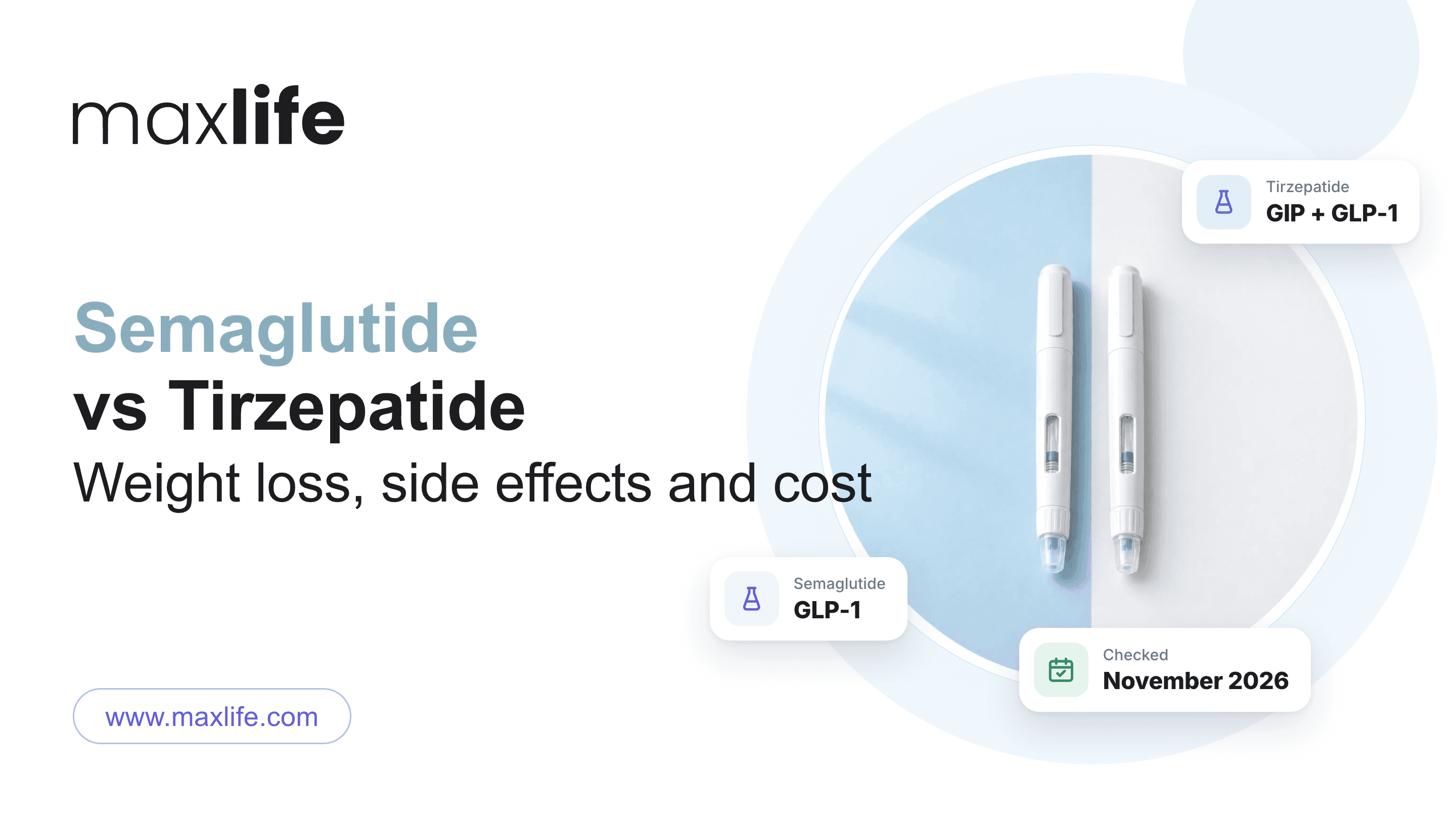
Semaglutide and tirzepatide are both GLP-1 medicines for weight loss and type 2 diabetes, but they are different drugs. Semaglutide, sold as Ozempic®, Wegovy® and Rybelsus®, acts on one gut-hormone receptor, GLP-1. Tirzepatide, sold as Mounjaro® and Zepbound®, acts on two: GIP and GLP-1. In SURMOUNT-5, the only head-to-head weight-loss trial (NEJM, 2025), adults taking Zepbound lost an average of 20.2% of their body weight over 72 weeks, compared with 13.7% on Wegovy. Nausea and other stomach side effects were about as common on both. As of November 2026, the makers' self-pay prices are $299 to $449 a month for Zepbound and $199 to $399 for Wegovy injections.
Semaglutide still has advantages tirzepatide lacks. Wegovy is approved to lower the risk of heart attack and stroke in adults with heart disease who don't have diabetes, it is approved for teens 12 and older, and it comes as a daily pill. Ozempic is approved to protect the kidneys in type 2 diabetes. And semaglutide has been on the US market since 2017, five years longer than tirzepatide.
Both molecules are also available as compounded medicines with a prescription. Through MaxLife, compounded semaglutide is $89/mo flat and compounded tirzepatide is $120/mo flat, all-inclusive, the same price at every dose. Compounded versions are not FDA-approved, and the trial results below belong to the brand products studied. Here is how the two compare across every brand, with the numbers and their sources.
Tirzepatide vs Semaglutide at a Glance
| Feature | Semaglutide | Tirzepatide |
|---|---|---|
| How it works | GLP-1 receptor agonist | GIP and GLP-1 receptor agonist |
| Brands | Ozempic, Wegovy, Rybelsus, Ozempic pill, Wegovy pill | Mounjaro, Zepbound |
| Brand for weight loss | Wegovy (injection, Wegovy HD, pill) | Zepbound |
| Forms | Weekly injection or daily pill | Weekly injection only |
| Weight loss, head to head (72 weeks) | 13.7% (Wegovy) | 20.2% (Zepbound) |
| Nausea in that trial | 44.4% | 43.6% |
| Heart-risk approval | Wegovy (injection and pill): adults with heart disease and obesity or overweight. Ozempic and Rybelsus: type 2 diabetes | Mounjaro: type 2 diabetes at high risk (since August 2026) |
| Other approvals | Ozempic: kidney disease in type 2 diabetes. Wegovy: teens 12+, MASH liver disease | Zepbound: obstructive sleep apnea with obesity |
| Half-life | About 1 week | About 5 to 6 days |
| First US approval | 2017 (Ozempic) | 2022 (Mounjaro) |
| Self-pay price, November 2026 | Wegovy injection $199 to $399 a month; Wegovy pill $149 to $299 | Zepbound $299 to $449 per 28 days ($499 to $699 if refilled late) |
| Compounded through MaxLife | $89/mo flat | $120/mo flat |
Sources: the FDA labels on DailyMed for Wegovy, Ozempic, Rybelsus and Ozempic tablets, Mounjaro and Zepbound; SURMOUNT-5; NovoCare and LillyDirect, as of November 2026.
What Is the Difference Between Semaglutide and Tirzepatide?
The main difference is how many hormone signals each one copies. Semaglutide mimics GLP-1, a hormone your gut releases after meals. Tirzepatide is a single molecule that activates both the GIP and the GLP-1 receptors, which makes it a dual agonist. Both slow how fast your stomach empties, help the pancreas release insulin when blood sugar is high, and act on appetite centers in the brain, so you feel full sooner and eat less. The added GIP signal is the leading explanation for tirzepatide's larger weight loss in direct trials, although the exact reason is still being studied.
They also last different lengths of time. Semaglutide's half-life is about 1 week, and it stays in the body for about 5 to 7 weeks after the last dose, according to the Wegovy label. Tirzepatide's half-life is about 5 to 6 days, and it reaches a steady level after 4 weekly doses, according to the Zepbound label. Both labels say the drug lowers body weight with more fat loss than lean mass loss.
And they have different track records. Semaglutide was first approved in the US in 2017, as Ozempic. Tirzepatide followed in 2022, as Mounjaro. The two are not interchangeable, and no dose of one converts to a dose of the other.
Which Brands Are Semaglutide and Which Are Tirzepatide?
Novo Nordisk makes semaglutide, and Eli Lilly makes tirzepatide. Each brand name follows an approved use, not the molecule.
| Brand | Medicine and form | FDA-approved for (November 2026) |
|---|---|---|
| Ozempic® | Semaglutide, weekly injection | Type 2 diabetes; heart and kidney risk reduction in type 2 diabetes |
| Rybelsus® and Ozempic pill | Semaglutide, daily tablet | Type 2 diabetes; heart risk reduction in type 2 diabetes at high risk |
| Wegovy® injection | Semaglutide, weekly injection, including Wegovy HD | Weight management (adults, and teens 12+ except Wegovy HD); heart risk reduction with heart disease; MASH liver disease |
| Wegovy pill | Semaglutide, daily tablet | Weight management and heart risk reduction in adults |
| Mounjaro® | Tirzepatide, weekly injection | Type 2 diabetes (ages 10+); heart risk reduction in type 2 diabetes at high risk |
| Zepbound® | Tirzepatide, weekly injection (pen, KwikPen or vial) | Weight management in adults; moderate to severe obstructive sleep apnea with obesity |
| Compounded versions | Prepared by a licensed pharmacy for one patient's prescription | Not FDA-approved |
Two points cause most of the confusion. First, Ozempic and Mounjaro are diabetes medicines, so prescribing either one for weight loss alone is off-label. That is why the like-for-like weight-loss pair is Zepbound vs Wegovy (see Zepbound vs Mounjaro for the two tirzepatide brands). Second, there is no tirzepatide pill. Lilly's weight-loss pill, Foundayo™ (orforglipron), approved on April 1, 2026, is a different molecule. Semaglutide is the only one of the two that comes as a pill; our Wegovy pill vs injection guide compares the two forms.
Is Tirzepatide Better Than Semaglutide for Weight Loss?
On average, yes, for the brand products tested. In the only head-to-head trial, Zepbound (tirzepatide) produced about 6.5 percentage points more weight loss than Wegovy (semaglutide), a 47% larger relative loss. SURMOUNT-5 randomly assigned 751 adults with obesity, or overweight with a weight-related condition, and without type 2 diabetes to Zepbound or Wegovy at the highest dose each person tolerated (Zepbound 10 or 15 mg, Wegovy 1.7 or 2.4 mg) for 72 weeks. Everyone also got diet and activity counseling. The results appeared in the New England Journal of Medicine in 2025.
| SURMOUNT-5 at 72 weeks | Zepbound (tirzepatide) | Wegovy (semaglutide) |
|---|---|---|
| Average weight loss | 20.2% | 13.7% |
| Average pounds lost | 50.3 lb | 33.1 lb |
| Lost at least 10% | 81.6% | 60.5% |
| Lost at least 15% | 64.6% | 40.1% |
| Lost at least 20% | 48.4% | 27.3% |
| Lost at least 25% | 31.6% | 16.1% |
| Waist size | 7.2 in smaller | 5.1 in smaller |
| Stopped because of side effects | 6.1% | 8.0% |
Sources: PubMed abstract and Eli Lilly's results release, May 11, 2025.
Three caveats matter. The trial was open label, so everyone knew which drug they took, and it was funded by Lilly, which makes Zepbound. It tested Wegovy up to 2.4 mg, not Wegovy HD (7.2 mg), which the FDA approved on March 19, 2026, so that matchup has not been tested head to head. And these are averages: about 1 in 5 people on Zepbound lost less than 10% of their weight, and some people lose more on semaglutide.
The separate placebo-controlled trials agree:
- Wegovy (STEP 1): adults without diabetes lost 14.9% of their body weight on Wegovy 2.4 mg vs 2.4% on placebo over 68 weeks (NEJM, 2021).
- Zepbound (SURMOUNT-1): adults without diabetes lost 15.0%, 19.5% and 20.9% on 5, 10 and 15 mg vs 3.1% on placebo over 72 weeks (NEJM, 2022).
- Wegovy HD: adults with obesity lost 18.8% on 7.2 mg vs 15.5% on 2.4 mg and 3.9% on placebo over 72 weeks, according to the Wegovy label.
- Wegovy pill: adults lost 13.6% on 25 mg a day vs 2.4% on placebo over 64 weeks, according to the same label.
For blood sugar in type 2 diabetes, the head-to-head trial was SURPASS-2. Over 40 weeks, A1C fell 2.01 to 2.30 points on tirzepatide 5 to 15 mg, the doses sold as Mounjaro, vs 1.86 points on semaglutide 1 mg, then Ozempic's top dose (it now goes up to 2 mg).
These results belong to the brand products studied. They have not been shown for compounded semaglutide or tirzepatide.
Wegovy does have heart-outcome data that no tirzepatide brand has yet for people without diabetes. In SELECT, 17,604 adults with heart disease and overweight or obesity, but no diabetes, had fewer heart attacks, strokes and heart-related deaths on Wegovy than on placebo (6.5% vs 8.0%), and Wegovy is approved for that use. Zepbound has no heart indication. For the brand-by-brand details, see Zepbound vs Wegovy and tirzepatide vs Ozempic.
Tirzepatide vs Semaglutide Side Effects: Which Is Easier to Tolerate?
Neither is clearly easier. In the head-to-head trial, stomach side effects were almost equally common: nausea affected 43.6% of people on Zepbound and 44.4% on Wegovy, constipation 27.0% and 28.5%, and diarrhea 23.5% and 23.4%, according to a British Columbia Ministry of Health summary of the SURMOUNT-5 paper. Fewer people stopped Zepbound than Wegovy because of them (2.7% vs 5.6%). Most of these effects were mild to moderate and happened while the dose was being raised.
Many comparisons read the two FDA labels side by side and conclude that tirzepatide causes much less nausea. The label numbers do differ, but they come from separate trials, and both labels say rates from one drug's trials cannot be directly compared with another drug's. Here they are, with placebo rates in parentheses:
| Side effect | Wegovy 2.4 mg (68 weeks) | Zepbound 5 to 15 mg (72 weeks) |
|---|---|---|
| Nausea | 44% (16%) | 25% to 29% (8%) |
| Diarrhea | 30% (16%) | 19% to 23% (8%) |
| Vomiting | 24% (6%) | 8% to 13% (2%) |
| Constipation | 24% (11%) | 11% to 17% (5%) |
| Abdominal pain | 20% (10%) | 9% to 10% (5%) |
| Hair loss | 3% (1%) | 4% to 5% (1%) |
| Stopped because of side effects | 6.8% (3.2%) | 4.8% to 6.7% (3.4%) |
Sources: Wegovy label, Table 3, and Zepbound label, Table 1 (DailyMed, current as of November 2026).
The higher Wegovy HD dose adds one effect worth knowing. In its trials, 22% of people on 7.2 mg reported dysesthesia, a changed skin sensation such as tingling or burning, compared with 6% on 2.4 mg. On Zepbound, the label reports 0.2% to 0.4%. For a closer look at each effect and when to call your provider, see our guide to tirzepatide side effects.
Which Is Safer, Semaglutide or Tirzepatide?
Their safety profiles are very similar, and no head-to-head trial has been large enough to show that one is safer. Both labels carry the same boxed warning: in rodents, the drugs caused thyroid C-cell tumors, and it is not known whether this happens in people. Neither should be used if you or a family member has had medullary thyroid carcinoma or if you have multiple endocrine neoplasia syndrome type 2 (MEN 2). Both labels also warn about pancreatitis, gallbladder disease, kidney injury from dehydration, severe stomach problems, serious allergic reactions, low blood sugar when combined with insulin or a sulfonylurea, and the risk of inhaling stomach contents during anesthesia.
A few differences are worth knowing:
- Birth control pills: tirzepatide may make them less effective. The Zepbound label advises switching to a non-oral method, or adding a barrier method, for 4 weeks after starting and for 4 weeks after each dose increase.
- Pregnancy: the Wegovy label advises stopping at least 2 months before a planned pregnancy because semaglutide clears slowly. The Zepbound label says to stop when a pregnancy is recognized.
- Track record: semaglutide has been prescribed in the US since 2017, and Wegovy has heart-outcome data in people without diabetes. Tirzepatide has been on the market since 2022.
- A new eye warning for both: on November 9, 2026, the FDA required new warnings about NAION, a rare condition that causes sudden, painless vision loss in one eye, on the labels of all GLP-1 medicines, semaglutide and tirzepatide included.
Talk to your provider about any side effect that is severe or doesn't settle, and get care right away for severe stomach pain that won't go away or sudden loss of vision.
How Do Semaglutide and Tirzepatide Doses Compare?
Both start low and rise every 4 weeks to limit stomach side effects, but the milligrams are not comparable: a milligram of semaglutide and a milligram of tirzepatide are different medicines on different scales. These are the label schedules for the two weight-loss injections:
| Label fact | Wegovy injection | Zepbound |
|---|---|---|
| Starting dose | 0.25 mg weekly for 4 weeks | 2.5 mg weekly for 4 weeks |
| How it rises | 0.5, 1 and 1.7 mg, 4 weeks each | 2.5 mg steps, at least 4 weeks apart |
| Maintenance dose | 2.4 mg (or 1.7 mg) from week 17 | 5, 10 or 15 mg |
| Highest dose | 7.2 mg (Wegovy HD) | 15 mg |
| Missed dose | Take it if the next dose is more than 2 days away | Take it within 4 days |
| Time to peak level | 1 to 3 days | About 24 hours |
Sources: Wegovy and Zepbound labels on DailyMed, as of November 2026.
The diabetes brands use similar ladders. Ozempic starts at 0.25 mg weekly and goes up to 2 mg. Mounjaro starts at 2.5 mg and goes up to 15 mg. The pills are taken once a day on an empty stomach with up to 4 ounces of water, at least 30 minutes before food: the Wegovy pill rises from 1.5 mg to 25 mg over 3 months, and Rybelsus (3 to 14 mg) and the Ozempic pill (1.5 to 9 mg) are not interchangeable milligram for milligram. Our semaglutide dosage chart and tirzepatide dosage chart show each step.
There is no official conversion between the two. No dose of semaglutide equals a dose of tirzepatide, and the Zepbound label gives one starting dose, 2.5 mg, with no separate schedule for people coming from another GLP-1. If you use a compounded product, dose by milligrams with your provider: in an August 12, 2026 letter, the FDA warned that compounded GLP-1 vials often come in different concentrations from the brand products, so the volume you draw is not interchangeable with a brand dose.
How Much Do Semaglutide and Tirzepatide Cost in 2026?
Without insurance, semaglutide usually costs less than tirzepatide. As of November 2026, Wegovy injections cost $349 a month from Novo Nordisk's NovoCare pharmacy after a $199 offer for new patients, and Zepbound costs $449 per 28 days at maintenance doses from Lilly's LillyDirect, if you refill on time.
| Option | Self-pay price, November 2026 | Source |
|---|---|---|
| Wegovy injection, 0.25 to 2.4 mg | $199 a month for the first 2 fills (new patients, through December 31, 2026), then $349 | NovoCare |
| Wegovy HD, 7.2 mg | $399 a month | NovoCare |
| Wegovy pill | $149 (1.5 mg), $199 (4 mg), $299 (9 and 25 mg) | NovoCare |
| Ozempic injection | $199 for the first 2 fills, then $349 (up to 1 mg) or $499 (2 mg) | NovoCare |
| Zepbound vial or KwikPen | $299 (2.5 mg), $399 (5 mg), $449 (7.5 to 15 mg) per 28 days if you refill within 45 days; $499 to $699 if later | LillyDirect |
| Mounjaro | $499 a month, every strength | LillyDirect |
| Compounded semaglutide, MaxLife | $89/mo flat, all-inclusive | MaxLife |
| Compounded tirzepatide, MaxLife | $120/mo flat, all-inclusive | MaxLife |
With insurance, coverage follows the approved use. Plans often cover Ozempic and Mounjaro for type 2 diabetes but decline them when they are prescribed for weight loss alone, and coverage of Wegovy and Zepbound for weight loss varies by plan. With commercial coverage, the makers' savings cards can bring the cost down to as little as $25 a month, within their limits. And since July 1, 2026, the Medicare GLP-1 Bridge has offered eligible Part D members certain GLP-1 medicines for weight loss, including Wegovy and the Zepbound KwikPen, for a $50 copay, through December 31, 2027.
Why Is Tirzepatide More Expensive Than Semaglutide?
The makers set different prices. At maintenance doses, Lilly charges $449 per 28 days for Zepbound, while Novo Nordisk charges $349 a month for Wegovy 2.4 mg and $299 for the top Wegovy pill dose. Neither molecule has a generic on sale in the US as of November 2026. The compounded prices differ too: at MaxLife, compounded tirzepatide is $120/mo flat and compounded semaglutide is $89/mo flat.
Can You Switch From Semaglutide to Tirzepatide?
Yes. Switching from semaglutide to tirzepatide is common, but your prescriber decides when and at what dose. The usual reasons are a weight-loss plateau on semaglutide or side effects that won't settle. What to expect:
- No conversion chart. Being on semaglutide 2.4 mg doesn't let you start partway up the tirzepatide ladder. Zepbound's label starting dose is 2.5 mg for 4 weeks, so some early side effects may come back as the dose rises.
- Timing is a clinical call. Semaglutide's half-life is about a week, and it stays in the body for 5 to 7 weeks after the last dose. Your provider sets the gap between your last semaglutide dose and your first tirzepatide dose.
- The reverse works too. If tirzepatide's side effects are hard to manage at the doses that help you, moving to semaglutide is a normal step.
- Response varies. Averages hide wide individual differences. Some people lose more on semaglutide than on tirzepatide, and no test predicts who in advance.
Can You Take Semaglutide and Tirzepatide Together?
No. The Zepbound and Wegovy labels both say their drug should not be used with any other GLP-1 receptor agonist, and both molecules act on the GLP-1 receptor. Taking both stacks the side effects, such as nausea, vomiting and dehydration, with no proven benefit. If you use more than one clinic or telehealth service, make sure each one has your full medication list.
What About Compounded Semaglutide and Compounded Tirzepatide?
Compounded versions are a lower-cost cash route, and they differ from the brands in one important way. Compounded tirzepatide is prepared by a licensed pharmacy for one patient's prescription and is not FDA-approved, which means the FDA hasn't reviewed it for safety, effectiveness or quality. The same is true of compounded semaglutide. Neither is a generic of Ozempic, Wegovy, Mounjaro or Zepbound, and none of the trial results in this article have been shown for compounded versions.
The FDA ended the tirzepatide shortage on December 19, 2024, and the semaglutide shortage on February 21, 2025. The agency says a compounded drug "might be appropriate if a patient's medical need cannot be met by an FDA-approved drug" (FDA). Whichever route you choose, ask which licensed pharmacy prepares your medicine and follow the directions on the vial you receive. For how compounded semaglutide differs from the brand, see compounded semaglutide vs Ozempic.
MaxLife is a telehealth patient management platform, not a pharmacy or drug maker. The online intake takes about 2 minutes. A licensed provider reviews your online intake, health history and clinical records, usually within 24 hours, can follow up with questions, and you can ask for a video visit. If the provider decides compounded semaglutide or compounded tirzepatide is right for you, a licensed partner pharmacy prepares it and ships it with free expedited shipping, in all 50 states. Compounded semaglutide is $89/mo flat and compounded tirzepatide is $120/mo flat: all-inclusive (the provider's review and follow-up, the medicine if prescribed, and supplies), the same price at every dose, with no membership fee. No insurance is needed, and HSA and FSA funds may be eligible.
Semaglutide or Tirzepatide: Which Should You Choose?
It depends on your health, your goals and your budget, and the decision belongs with a licensed provider. These are the situations where the evidence points one way:
- The most weight loss is your goal: the head-to-head data favor Zepbound (tirzepatide).
- You have heart disease and no diabetes: Wegovy is approved to lower your risk of heart attack and stroke; Zepbound is not.
- You have type 2 diabetes and chronic kidney disease: Ozempic has a kidney approval that no tirzepatide brand has.
- You are 12 to 17: Wegovy is the approved option of the two, and that choice belongs with a pediatric specialist. MaxLife's program is for adults.
- You'd rather not inject: the Wegovy pill is a daily semaglutide tablet for weight loss. There is no tirzepatide pill.
- Side effects have been hard for you before: neither is clearly gentler, so a slow dose increase matters more than the molecule.
- You've plateaued on semaglutide: switching to tirzepatide, or for some adults moving up to Wegovy HD, are both reasonable to discuss.
- Cost decides: semaglutide usually costs less, both at the makers' self-pay prices and as a compounded medicine ($89/mo flat vs $120/mo flat at MaxLife).
The Bottom Line
Semaglutide and tirzepatide are different molecules: semaglutide acts on GLP-1 alone, tirzepatide on GIP and GLP-1. In the only head-to-head trial, Zepbound produced more weight loss than Wegovy (20.2% vs 13.7% over 72 weeks), with stomach side effects at nearly the same rates. Semaglutide keeps real advantages: a heart approval for people without diabetes (Wegovy), a kidney approval in diabetes (Ozempic), a pill, approval for teens and usually a lower price. Both carry the same boxed warning, and they should never be taken together. Which one fits you is a prescribing decision, made with a licensed provider who knows your history.
Frequently Asked Questions
Semaglutide $89/mo or Tirzepatide $120/mo, Flat
MaxLife compounded semaglutide $89 a month and tirzepatide $120 a month, flat. All-inclusive, no membership fee, the same price at every dose. A licensed provider decides.
Check Your EligibilityThis article is for informational purposes only and is not a substitute for professional medical advice, diagnosis, or treatment. Individual results vary. Pricing, insurance coverage, and compounding regulations described here are subject to change; verify current details with your insurance provider, the manufacturer, or your prescriber before making treatment decisions. Compounded medications are not FDA-approved.
Why trust our experts

April Foster, DO MPH
Reviewer
Board Certified Family Medicine Physician licensed nationwide providing collaborative oversight to NPs, PAs, and RN. Also specializing in telemedicine services nationwide.
Sources
- New England Journal of Medicine: Tirzepatide as Compared with Semaglutide for the Treatment of Obesity (SURMOUNT-5), 2025
- Eli Lilly: complete SURMOUNT-5 results, Zepbound vs Wegovy, May 11, 2025
- British Columbia Ministry of Health, Provincial Academic Detailing: tirzepatide vs semaglutide for weight loss (SURMOUNT-5 summary), November 2025
- New England Journal of Medicine: Once-Weekly Semaglutide in Adults with Overweight or Obesity (STEP 1), 2021
- New England Journal of Medicine: Tirzepatide Once Weekly for the Treatment of Obesity (SURMOUNT-1), 2022
- New England Journal of Medicine: Tirzepatide versus Semaglutide Once Weekly in Patients with Type 2 Diabetes (SURPASS-2), 2021
- New England Journal of Medicine: Semaglutide and Cardiovascular Outcomes in Obesity without Diabetes (SELECT), 2023
- Wegovy (semaglutide) injection and tablets prescribing information (DailyMed)
- Ozempic (semaglutide) injection prescribing information (DailyMed)
- Rybelsus and Ozempic (semaglutide) tablets prescribing information (DailyMed)
- Zepbound (tirzepatide) prescribing information, revised August 2026 (DailyMed)
- Mounjaro (tirzepatide) prescribing information, revised August 2026 (DailyMed)
- FDA: approval of Wegovy HD (semaglutide 7.2 mg), March 19, 2026
- FDA: approval of Foundayo (orforglipron), April 1, 2026
- FDA Drug Safety Communication: NAION labeling changes for GLP-1 receptor agonists, November 9, 2026
- FDA: clarifies policies for compounders as national GLP-1 supply begins to stabilize (shortage dates)
- FDA: concerns with unapproved GLP-1 drugs used for weight loss
- FDA letter to the Federation of State Medical Boards on compounded GLP-1 concentrations, August 12, 2026
- CMS: Medicare GLP-1 Bridge
- NovoCare: Wegovy self-pay pricing
- NovoCare: Ozempic self-pay pricing
- LillyDirect: Zepbound self-pay pricing
- LillyDirect: Mounjaro self-pay pricing
Zepbound (Tirzepatide) vs Wegovy: 7 Differences to Know
September 11, 202615 min
Tirzepatide vs Ozempic (Mounjaro, Zepbound): 8 Differences to Know
September 15, 202615 min
Zepbound vs Mounjaro: What's the Difference?
November 5, 202614 min
Wegovy Pill vs Injection: Results, Side Effects and Cost Compared
November 5, 202612 min