Does Aetna Cover Zepbound? What Changed in 2026
Pricing is accurate as of November 2026 and subject to change.
Key Takeaways
- As of November 2026, Aetna can cover Zepbound on many plans that include weight-loss drugs. CVS Caremark, which runs Aetna's pharmacy benefits, removed Zepbound from its commercial template formularies on July 1, 2025 and added it back as an additional preferred option on October 1, 2026.
- Your employer decides whether your plan covers weight-loss drugs at all, and it can keep Zepbound off its formulary. Aetna says many of its plans exclude weight reduction medications.
- Aetna's current Zepbound policy (6192-C, 08-2026) requires 6 months in a weight management program and a BMI of 30, or 27 with a listed condition, for weight loss. Some plans use a stricter version with a BMI of 35. Approval lasts 8 months, and renewal needs at least 5% weight loss.
- For obstructive sleep apnea, Aetna requires a sleep study with an AHI of at least 15 and a BMI of 30 or higher.
- Aetna Medicare doesn't cover Zepbound for weight loss alone. The CMS Medicare GLP-1 Bridge charges $50 a month for the Zepbound KwikPen through December 31, 2027 if you qualify, and Aetna doesn't approve those requests.
- If Aetna denies Zepbound, you have 180 days to appeal. Lilly's self-pay price is $299 to $449 a month, and every Lilly savings card ends December 31, 2026. Compounded tirzepatide costs less but is not FDA-approved and isn't covered by Aetna.
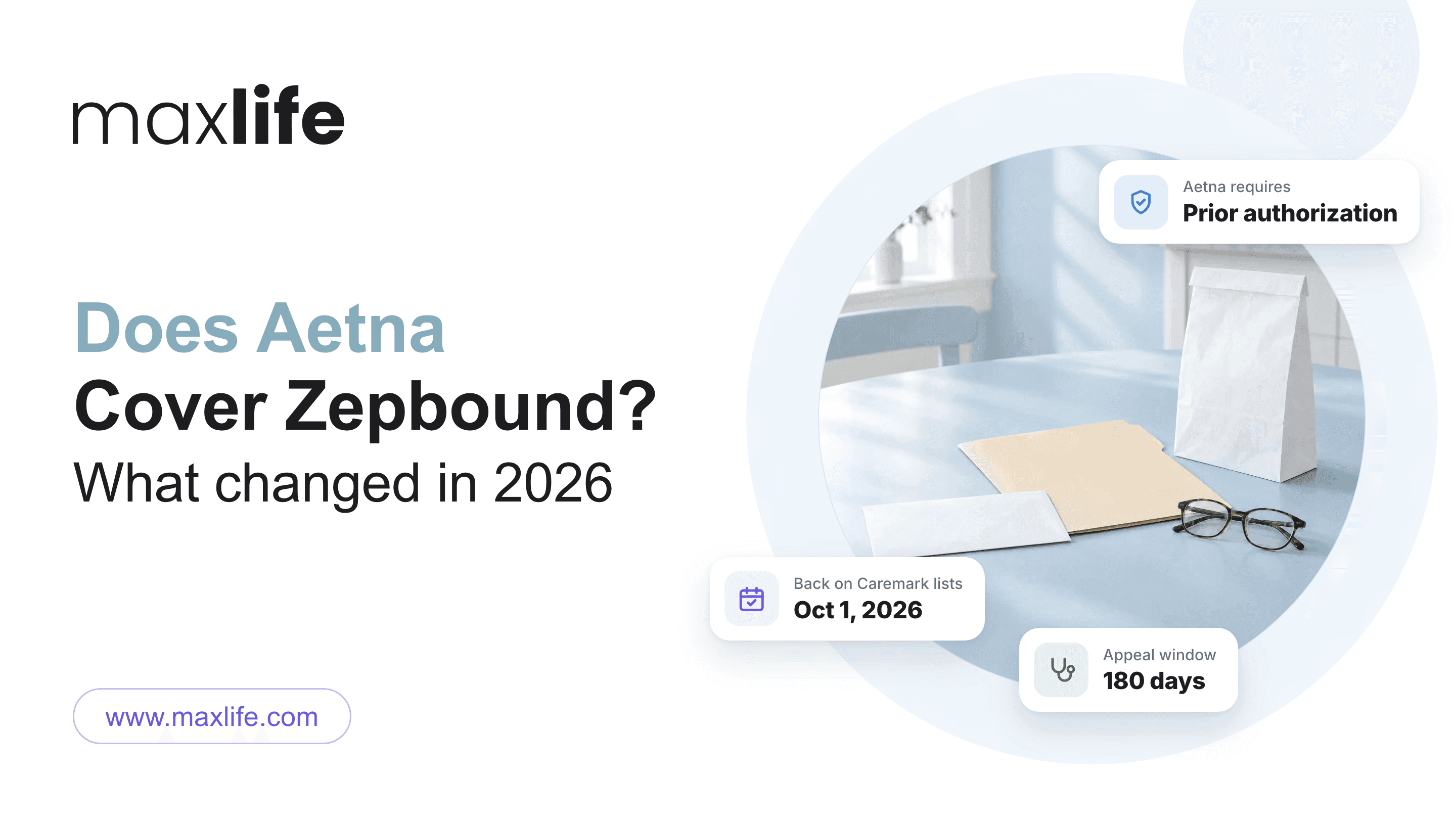
It depends on your plan, but more Aetna plans can cover Zepbound® now than a year ago. CVS Caremark, the pharmacy benefit manager that runs Aetna's pharmacy plans, removed Zepbound from its standard commercial formularies on July 1, 2025 and made Wegovy® the preferred drug. On October 1, 2026, it added Zepbound back as an additional preferred option for plans that cover weight-loss drugs. Your employer can still leave weight-loss drugs out, and when Zepbound is covered, Aetna requires prior authorization. This is the picture as of November 2026.
MaxLife doesn't take insurance. If Aetna says no and you're comparing cash options, compounded tirzepatide at MaxLife is $120/mo flat, prescribed only if a licensed provider decides it's right for you. It is not Zepbound, and compounded tirzepatide is not FDA-approved.
Does Aetna Cover Zepbound in 2026?
Yes, on many Aetna plans that include weight-loss drug coverage, since October 1, 2026. Aetna says its "pharmacy benefits are administered through an affiliated pharmacy benefits manager, CVS Caremark," so Caremark's formulary decisions shape most Aetna drug lists. Here is what changed and when:
| Date | What changed | Source |
|---|---|---|
| July 1, 2025 | Caremark preferred Wegovy and removed Zepbound from its commercial template formularies | CVS Health |
| July 1, 2026 | Aetna's exclusion list for the Standard Control Plan still listed Zepbound as not covered, with Wegovy among the alternatives | Aetna |
| October 1, 2026 | Caremark added Zepbound back as "an additional preferred option"; Aetna's High Value Formulary lists Zepbound as added that day | CVS Health, Aetna |
| November 2026 | Lilly says Zepbound coverage "has been restored" on select CVS Caremark formularies | Lilly |
So if you were told in 2025 that Aetna doesn't cover Zepbound, check again. CVS announced the change on May 28, 2026, saying it would add Zepbound back "for plan sponsors who elect to provide coverage of those medications." That last part is the catch: the change helps only if your plan covers weight-loss drugs at all.
Why Does Aetna Cover Zepbound for Some Members and Not Others?
Because your employer, not Aetna's name on your card, decides most of it. Three layers have to line up before Zepbound is covered for weight loss:
- Your plan must include weight-loss drugs. Aetna's clinical policy on weight reduction says "many Aetna benefit plans specifically exclude coverage of weight reduction medications," and when a plan excludes them, the medical criteria don't apply at all (Aetna CPB 0039, last reviewed March 2026). If your plan has this exclusion, an approval isn't possible for weight loss, however strong your records are.
- Your formulary must list Zepbound. CVS says "plan sponsors that adopt CVS Caremark template formularies retain discretion to customize coverage." A large employer that pays its own claims can keep Zepbound off its list even after October 1, 2026.
- You must meet Aetna's clinical criteria. Aetna's standard criteria are below, but some plans use a stricter version that requires a BMI of 35 or higher for every weight-loss GLP-1, including Zepbound and Wegovy (Aetna policy 6450-C).
That is why two people with Aetna cards can get different answers for the same prescription. Our guide to weight loss drugs covered by insurance explains how employer plans, Medicare and Medicaid differ across insurers.
What Are Aetna's Prior Authorization Requirements for Zepbound?
Aetna requires prior authorization: your prescriber must show that you meet its criteria before the plan pays. Under Aetna's current Zepbound policy for non-Medicare plans (policy 6192-C, version 08-2026, last reviewed September 2026), approval for weight management needs all of the following:
- A weight management program first. You have taken part in a comprehensive program with behavior change, a reduced-calorie diet and more physical activity, "with continuing follow-up for at least 6 months prior to using drug therapy."
- A qualifying BMI, with documentation. A baseline BMI of 30 or higher, or 27 or higher with at least one listed condition: high blood pressure, high cholesterol or other lipid problems, type 2 diabetes, prediabetes, obstructive sleep apnea, cardiovascular disease, fatty liver disease (MASLD or MASH), chronic kidney disease stage 2 or higher, or osteoarthritis of the knee or hip.
- Use with diet and activity. Zepbound must be used with a reduced-calorie diet and increased physical activity, as its label says.
If you switched from another weight-loss medicine, Aetna looks at your BMI and conditions from before you started any drug therapy, so your progress on a previous drug doesn't count against you.
The first approval lasts 8 months. To renew for 12 months, you need at least 3 months at a stable maintenance dose and a loss of at least 5% of your starting weight, or you must have kept that 5% off.
Two practical details: the policy covers Zepbound single-dose pens and KwikPens, but not vials, which Lilly sells self-pay through LillyDirect. And it limits each fill to 4 pens or 1 KwikPen per month, or 12 pens or 3 KwikPens for a 3-month fill.
Does Aetna Cover Zepbound for Sleep Apnea?
It can, through a separate sleep apnea route in Aetna's Zepbound policy, if your plan covers the drug. Zepbound is FDA-approved to treat moderate to severe obstructive sleep apnea (OSA) in adults with obesity, according to its label. Aetna's criteria for this use are:
- A diagnosis of moderate to severe OSA with an apnea-hypopnea index (AHI) of at least 15 events per hour, on a sleep study in a lab or a home sleep test, with documentation.
- A baseline BMI of 30 or higher, with documentation.
- Use with a reduced-calorie diet and more physical activity.
The OSA route doesn't list the 6-month weight program. The first approval lasts 6 months; renewal for 12 months requires fewer OSA symptoms and a maintenance dose based on how you respond. If your plan excludes weight-loss drugs, ask whether that exclusion also applies when Zepbound is prescribed for sleep apnea, because plans word their exclusions differently. More on this use is in our post on Zepbound for sleep apnea.
Does Aetna Cover Wegovy?
Yes, on plans that cover weight-loss drugs, with prior authorization. Wegovy became Caremark's preferred weight-loss drug in July 2025, so it was the usual Aetna alternative while Zepbound was off. Aetna's current Wegovy policy (4774-C, version 08-2026) has weight-management rules like those for Zepbound: 6 months in a weight program, then a BMI of 30, or 27 with a weight-related condition. It also has two other routes:
- Heart risk: for adults with established cardiovascular disease and a BMI of 27 or higher who don't have type 2 diabetes. Aetna's policy notes that people with type 2 diabetes can be treated for this with Ozempic®.
- MASH: for adults with noncirrhotic MASH liver disease with moderate to advanced fibrosis, for the injection.
When Caremark made the switch in 2025, it said members with an active Zepbound prior authorization didn't need a new one to move to Wegovy. If you are weighing the two medicines, our comparison of Zepbound alternatives covers Wegovy and other options.
Does Aetna Medicare Cover Zepbound?
Not for weight loss alone through your Aetna Medicare plan. Medicare drug plans generally don't cover drugs used only for weight loss. Since July 1, 2026, there is a separate federal route: the Medicare GLP-1 Bridge. According to Aetna's Medicare page (updated October 15, 2026):
- If you qualify, you pay $50 a month for Foundayo™, Wegovy (injection and tablet) or Zepbound (KwikPen only), through December 31, 2027.
- "This is a CMS program that's not part of an Aetna Medicare plan," and "Aetna Medicare does not approve requests" for it. Your doctor sends the prior authorization to CMS.
- You need Part D coverage, such as an Aetna Medicare Advantage plan with drugs or a stand-alone drug plan.
- The Bridge is for weight loss only. If your Part D plan covers your GLP-1 for type 2 diabetes, sleep apnea or MASH, you get it through the plan instead.
- The $50 doesn't count toward your Part D deductible or out-of-pocket maximum.
So if you have Aetna Medicare and sleep apnea, ask about Zepbound under your Part D plan's own rules. Lilly's savings card can't be used with Medicare.
Does Aetna Medicaid Cover Zepbound?
It depends on your state. Aetna Better Health runs Medicaid plans in several states, and each one follows its state's Medicaid drug rules. Many state Medicaid programs don't cover drugs for weight loss alone, while uses such as sleep apnea may be covered with prior authorization. Check your Aetna Better Health plan's preferred drug list or call member services. Our insurance guide lists which states covered GLP-1 drugs for obesity in 2026.
How Do You Check if Your Aetna Plan Covers Zepbound?
The fastest way is your plan's own drug list and a phone call. Public Aetna pages show the general rules; only your plan shows yours.
- Log in to your Aetna member website or app and search the drug list for Zepbound. Note whether it shows prior authorization, a quantity limit or "not covered."
- Call the member services number on your ID card and ask the questions below.
- Read your plan documents (the Summary of Benefits or Summary Plan Description) for an exclusion of weight-loss drugs or "treatment of obesity."
- Ask your HR or benefits team if you have coverage through work. They chose the plan and can tell you whether weight-loss drugs are included.
Questions to ask:
- "Does my plan cover weight-loss drugs at all, or does it exclude them?"
- "Is Zepbound on my formulary since October 1, 2026, and in which tier?"
- "Which prior authorization criteria apply to me, and do you use the BMI 35 version?"
- "Is Zepbound covered for obstructive sleep apnea on my plan?"
- "What would I pay each month after approval?"
What Can You Do If Aetna Denies Zepbound?
First, read the denial letter to see which kind of denial it is, because the fix differs:
- Missing documentation or criteria not shown: your prescriber can resubmit with the BMI records, the 6-month program notes or the sleep study.
- Not on your formulary: your prescriber can ask for a formulary exception, usually by explaining why preferred options such as Wegovy don't work for you.
- Your plan excludes weight-loss drugs: Aetna's own policy says its medical criteria don't apply when a plan excludes weight-loss drugs, so a medical-necessity appeal usually can't override the exclusion. Your employer decides what the plan covers, so ask HR, and ask whether another approved use, such as sleep apnea, applies to you.
Then appeal if you disagree. According to Aetna's claim denial page:
- You have 180 days from the denial notice to appeal, unless your plan documents give you more time. You can appeal yourself or authorize someone, such as your prescriber, to appeal for you.
- Send records and your prescriber's letter with the appeal. Aetna will send you the documents from your file if you ask.
- Aetna decides in set times. For a drug you haven't received yet, it decides within 30 days on plans with one appeal level, or within 15 days at each level on plans with two. You can ask for a second review within 60 days of the first decision.
- Ask for an expedited appeal if waiting could seriously harm your health. Aetna decides within 72 hours on one-level plans, or 36 hours on two-level plans.
- Ask for an external review after your internal appeals. You may be able to have an independent third party review the denial. If your plan follows the federal appeal rules, Aetna says the Employee Benefits Security Administration can help (1-866-444-3272).
For a step-by-step guide to prior authorization and appeals across insurers, see weight loss drugs covered by insurance.
How Much Does Zepbound Cost With or Without Aetna Coverage?
With Aetna coverage, Zepbound can cost as little as $25 for up to a 3-month fill with Lilly's savings card. Without coverage, Lilly's self-pay prices start at $299 a month. As of November 2026, according to Lilly:
- Aetna covers it: the commercial savings card can bring single-dose pens to as little as $25 for a 1, 2 or 3 month fill. Savings are capped at $100 per month of medicine and $1,300 a year, so a high copay may cost you more.
- Your commercial Aetna plan doesn't cover it: the card can bring the single-dose pen to as low as $499 a month, or the KwikPen to $299 to $449.
- No coverage, paying cash: LillyDirect sells vials and KwikPens at $299 for 2.5 mg, $399 for 5 mg and $449 for 7.5 mg to 15 mg if you refill within 45 days ($499 or $699 if you refill later).
- Aetna Medicare or Medicaid: Lilly's savings card can't be used, but the Medicare GLP-1 Bridge may apply, and cash prices are still available.
Every Lilly savings card expires on December 31, 2026, and Lilly had not published 2027 terms as of November 2026. Full details are in how much Zepbound costs without insurance.
Is Compounded Tirzepatide an Option If Aetna Says No?
For some people paying cash, yes, but know what it is. Compounded tirzepatide is prepared by a licensed pharmacy for one patient's prescription and is not FDA-approved, which means the FDA hasn't reviewed it for safety, effectiveness or quality. It is not Zepbound, there is no FDA-approved generic of Zepbound, and Aetna doesn't cover it. Zepbound's trial results come from studies of Zepbound; these results have not been shown for compounded tirzepatide.
MaxLife is a telehealth patient management platform for people paying cash, not a pharmacy, drug maker or compounder, and it doesn't bill Aetna or any insurer. You complete an online intake in about 2 minutes. A licensed provider reviews your online intake, health history and clinical records, usually within 24 hours, can follow up with questions, and you can ask for a video visit. If the provider decides compounded tirzepatide is right for you, licensed partner pharmacies prepare and dispense it. The price is $120/mo flat, all-inclusive and the same at every dose, with no membership fee, and it is HSA and FSA eligible; eligibility depends on your plan (how HSA and FSA rules apply). Our page on GLP-1 treatment without insurance explains how cash-pay programs work.
Be clear about the trade-offs. If Aetna approves Zepbound and the savings card brings it to $25, the brand will cost you less than any cash option. If you need Zepbound's sleep apnea approval, the brand is the route. Compounded tirzepatide is a lower-cost cash option to discuss when your plan excludes weight-loss drugs, and a licensed provider decides whether it fits you.
The Bottom Line
As of November 2026, Aetna can cover Zepbound again on many plans that include weight-loss drugs: CVS Caremark, Aetna's pharmacy benefit manager, removed it on July 1, 2025 and added it back as a preferred option on October 1, 2026. Coverage still depends on your employer's plan, and Aetna requires prior authorization: 6 months in a weight program and a BMI of 30, or 27 with a condition, under its standard policy, or a sleep study for sleep apnea. Aetna Medicare doesn't cover it for weight loss alone, but the CMS Bridge may. Check your plan's drug list, appeal within 180 days if denied, and compare Lilly's cash prices and compounded tirzepatide, which is not FDA-approved, if Aetna says no.
Frequently Asked Questions
Aetna Said No? Compounded Tirzepatide, $120/mo Flat
MaxLife compounded tirzepatide: $120 a month, flat. All-inclusive, no membership fee, the same price at every dose. A licensed provider decides.
Check Your EligibilityThis article is for informational purposes only and is not a substitute for professional medical advice, diagnosis, or treatment. Individual results vary. Pricing, insurance coverage, and compounding regulations described here are subject to change; verify current details with your insurance provider, the manufacturer, or your prescriber before making treatment decisions. Compounded medications are not FDA-approved.
Why trust our experts

April Foster, DO MPH
Reviewer
Board Certified Family Medicine Physician licensed nationwide providing collaborative oversight to NPs, PAs, and RN. Also specializing in telemedicine services nationwide.
Sources
- CVS Health (May 28, 2026): CVS Caremark adds Zepbound back to commercial formularies on October 1, 2026
- CVS Health (June 2025): CVS Caremark prefers Wegovy and removes Zepbound on July 1, 2025
- Aetna: Formulary updates for High Value Formulary effective October 1, 2026
- Aetna: 2026 Formulary Exclusions Drug List, Standard Control Plan (July 1, 2026)
- Aetna pharmacy clinical policy: Zepbound PA with Limit 6192-C (08-2026)
- Aetna pharmacy clinical policy: Weight Loss (BMI 35) GIP-GLP-1, GLP-1 Agonists 6450-C
- Aetna pharmacy clinical policy: Wegovy PA with Limit 4774-C (08-2026)
- Aetna Clinical Policy Bulletin 0039: Weight Reduction Programs and Devices
- Aetna Medicare: Medicare GLP-1 Bridge coverage and eligibility (updated October 15, 2026)
- Aetna: Claim denials and appeals
- Aetna: Complaints, grievances and appeals
- Lilly: Zepbound coverage and savings, savings card terms
- LillyDirect: Zepbound self-pay prices
- Zepbound (tirzepatide) prescribing information, DailyMed
Weight Loss Drugs Covered by Insurance: What to Know
August 20, 202614 min
How Much Is Zepbound Without Insurance? Prices and Savings Card Rules
November 14, 202613 min
Zepbound for Sleep Apnea: Coverage and Who Qualifies
November 7, 202612 min
Zepbound Alternatives: 8 Options Compared by Price and Coverage
November 9, 202611 min