Does Tirzepatide Cause Hair Loss? Zepbound, Mounjaro, Ozempic and Wegovy
Pricing is accurate as of November 2026 and subject to change.
Key Takeaways
- In the Zepbound trials, 4% to 5% of adults on tirzepatide reported hair loss vs 1% on placebo; the label says it was associated with weight reduction.
- The Wegovy label reports hair loss in 3% of adults on 2.4 mg vs 1% on placebo, and 5.8% on Wegovy HD (7.2 mg). The Mounjaro and Ozempic labels give no trial rate and list hair loss only among reports after approval.
- Women reported hair loss far more often than men: 7.1% vs 0.5% on Zepbound, 4% vs 0.9% on Wegovy 2.4 mg.
- Most GLP-1 hair loss is telogen effluvium, temporary shedding that starts 2 to 4 months after rapid weight loss and usually settles within 6 to 9 months.
- There is no good evidence that biotin or other supplements help without a deficiency, and biotin can distort some blood tests. Tell your provider and don't stop your medicine on your own.
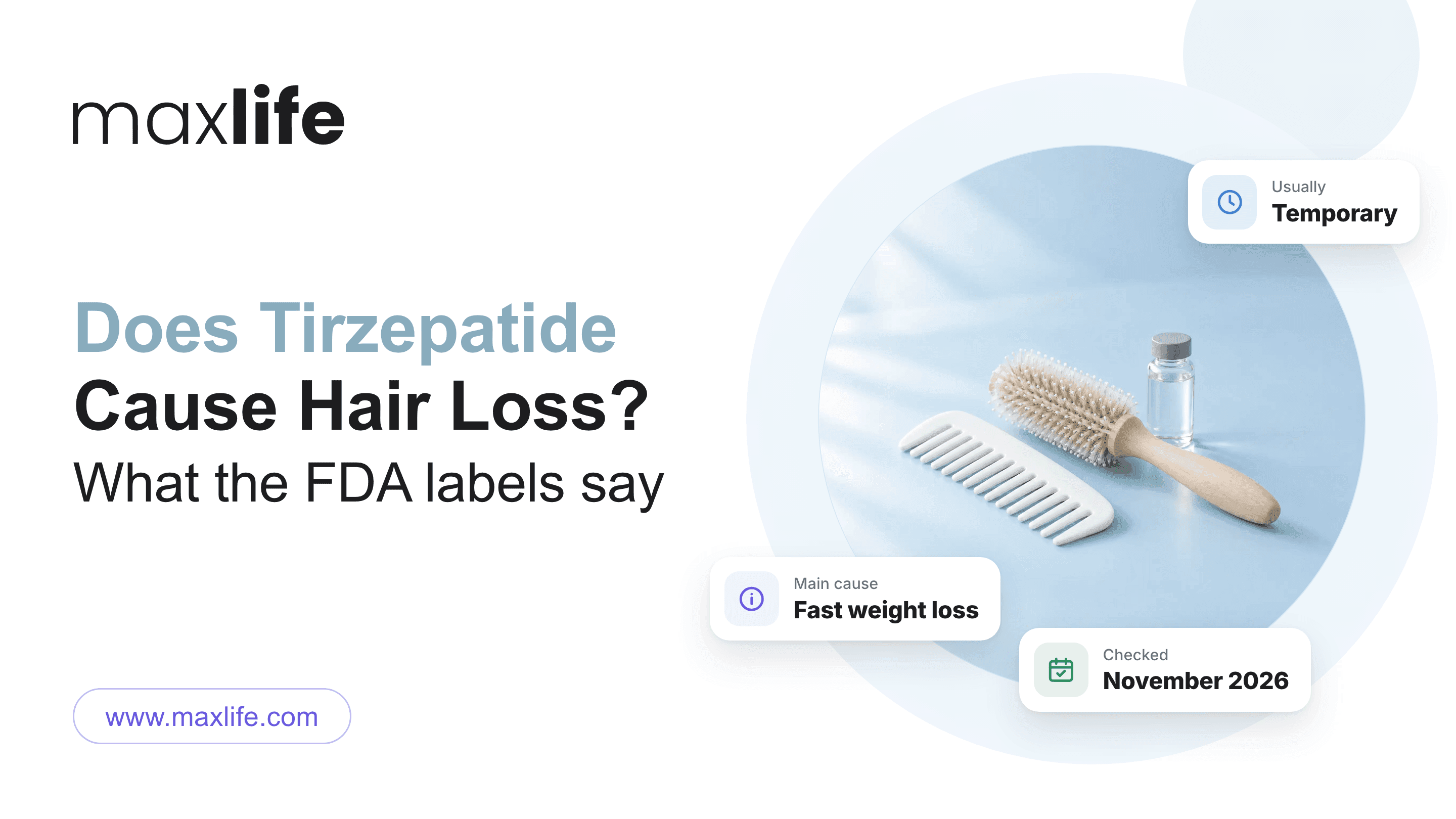
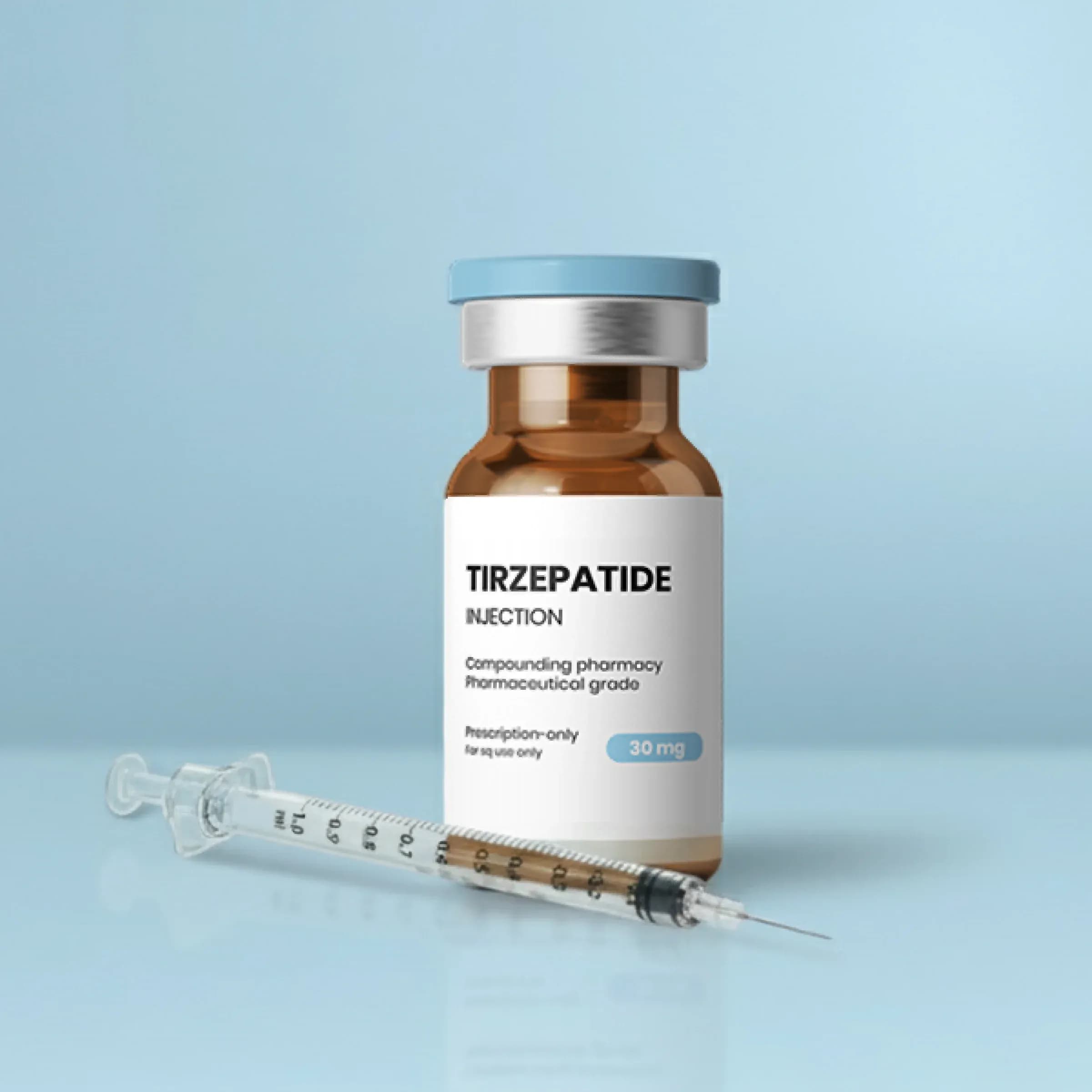
Yes, tirzepatide can cause hair loss, but only in a small share of people, and it is usually temporary. In the trials behind the Zepbound® label, 4% to 5% of adults taking tirzepatide reported hair loss, compared with 1% on placebo. The Wegovy® label reports 3% vs 1% for semaglutide. Both labels say the hair loss was associated with weight reduction. Most of it is telogen effluvium: extra shedding that starts a few months after rapid weight loss and usually settles within 6 to 9 months.
The Mounjaro® and Ozempic® labels are different. They give no hair-loss rate from their trials and list alopecia (the medical word for hair loss) only among reports collected after approval. We read all four labels on DailyMed in November 2026.
If you notice more hair in your brush, tell your provider instead of stopping your medicine. At MaxLife, where compounded tirzepatide is $120/mo flat (it is not FDA-approved), ongoing medical support is included. For every other side effect, see our guide to tirzepatide side effects.
Hair Loss Rates on Zepbound, Mounjaro, Ozempic and Wegovy
Hair loss is a listed side effect of all four brands, but only Zepbound and Wegovy have a rate from placebo-controlled trials. Here is what each FDA label reports:
| Medicine | Hair loss on the medicine | On placebo |
|---|---|---|
| Zepbound (tirzepatide), 5, 10 or 15 mg, up to 72 weeks | 5%, 4%, 5% | 1% |
| Mounjaro (tirzepatide) | No trial rate; reported after approval | Not given |
| Wegovy (semaglutide) 2.4 mg, 68 weeks | 3% | 1% |
| Wegovy HD (semaglutide) 7.2 mg, 72 weeks | 5.8% (3.3% on 2.4 mg) | 1.0% |
| Wegovy 2.4 mg in teens 12 and older | 4% | 0% |
| Ozempic (semaglutide) | No trial rate; reported after approval | Not given |
Sources: prescribing information on DailyMed for Zepbound, Mounjaro, Wegovy and Ozempic, current as of November 2026.
The numbers come from separate trials with different people, doses and lengths, and the Zepbound label notes that rates from one drug's trials cannot be directly compared with another drug's. Read the table as "hair loss happened to a few people in each trial, a little more often than on placebo", not as a ranking. Pooling the trials, a 2026 meta-analysis of 9 studies (7 of them randomized) found hair loss in 3.9% of people taking a GLP-1 medicine, about three times the risk on placebo (Diabetes Research and Clinical Practice, 2026).
Does Zepbound Cause Hair Loss?
Yes, in about 1 in 20 people. In the two main Zepbound weight-loss trials, which lasted up to 72 weeks, hair loss was reported by 5% of people on 5 mg, 4% on 10 mg and 5% on 15 mg, compared with 1% on placebo. It is one of the most common side effects listed in the Zepbound patient information.
Three details in the label help put that in context:
- It tracked weight loss. The label says hair loss in Zepbound-treated patients was associated with weight reduction.
- Women reported it far more often. 7.1% of women on Zepbound reported hair loss, compared with 0.5% of men. On placebo, the rates were 1.3% and 0%.
- Nobody quit over it. No one taking Zepbound stopped the trial because of hair loss; one person on placebo did.
Does Mounjaro Cause Hair Loss?
It can, but the Mounjaro label gives no rate. Mounjaro and Zepbound are both tirzepatide, made by Eli Lilly, but Mounjaro is approved for type 2 diabetes, and its trials did not list hair loss among their common side effects. The label lists alopecia in its postmarketing section, which collects reports sent in after approval. The label itself says these reports come "from a population of uncertain size", so it is not possible to estimate how often hair loss happens or to prove the drug caused it.
So treat claims like "5% to 10% of Mounjaro users lose hair" with care. That figure does not appear on the Mounjaro label, and Zepbound's 4% to 5% came from people without diabetes taking it for weight loss, a different group. What a large 2026 study does show: among 12,004 adults with type 2 diabetes who started a GLP-1 medicine, hair loss was diagnosed more often than in people starting two other classes of diabetes pills (37% higher risk than with SGLT-2 inhibitors, 68% higher than with DPP-4 inhibitors), and the effect was limited to non-scarring hair loss. The authors added that "the absolute risk is low" (BMJ, 2026).
Does Ozempic Cause Hair Loss?
It can, rarely, but like Mounjaro, the Ozempic label has no trial rate. Ozempic is semaglutide approved for type 2 diabetes, and its label lists alopecia only among postmarketing reports. The best trial numbers for semaglutide come from Wegovy, which is semaglutide at higher doses for weight management: 3% on Wegovy 2.4 mg vs 1% on placebo.
Ozempic's top dose is 2 mg a week, and people with type 2 diabetes in its trials took it for blood sugar, not weight. A 2026 systematic review found that semaglutide doses under 2 mg a week were rarely linked to hair loss, while the higher weight-loss doses were more often (Sci Prog, 2026). The same BMJ study above, in adults with type 2 diabetes, found a small rise in risk across GLP-1 medicines.
Does Wegovy Cause Hair Loss?
Yes, in a few people, and a bit more often at the highest dose. The Wegovy label reports:
- Wegovy 2.4 mg: hair loss in 3.3% of adults vs 1% on placebo across three 68-week trials. It was more common in women (4%) than men (0.9%), and the label says it was associated with weight reduction.
- Wegovy HD (7.2 mg): hair loss in 5.8% of adults, compared with 3.3% on 2.4 mg and 1.0% on placebo. Among women, the rate was 8.4% on 7.2 mg. On the higher dose, 5 people had their dose lowered, 1 paused treatment and 1 stopped because of it.
- Teens 12 and older: hair loss in 4% on Wegovy 2.4 mg vs none on placebo.
- Wegovy pill: the label says side effects with the 25 mg daily tablet were similar in type and frequency to the injection's. It gives no separate hair-loss figure.
Why Do GLP-1 Medicines Cause Hair Loss?
The main cause is the weight loss itself, through a type of shedding called telogen effluvium. At any time, about 85% of the hair on your scalp is growing and about 15% is resting. A shock to the body, such as rapid weight loss, surgery, a high fever or childbirth, can push many growing hairs into the resting phase at once. A few months later, those hairs fall out together (DermNet).
The American Academy of Dermatology lists "lost 20 pounds or more" among the common triggers. It's normal to shed 50 to 100 hairs a day; telogen effluvium means noticeably more than that. This is not unique to GLP-1 medicines: in two large reviews, about half of people had hair loss after weight-loss surgery (57% and 47%) (Obesity Surgery, 2021; 2025).
Eating less can add to it. A smaller appetite can mean less protein and fewer nutrients, and the AAD notes that too little iron, protein, zinc or biotin can cause noticeable hair loss.
Is it only the weight loss, or does the drug play a part? Researchers don't know for sure. A 2026 review concluded that shedding is "driven primarily by the magnitude and velocity of weight loss rather than drug toxicity", and that women and people who lose more than 10% of their weight are most at risk (Acta Diabetologica, 2026). A 2026 meta-analysis of 17 studies found that GLP-1 use was linked to more telogen effluvium and pattern hair loss, but not to alopecia areata, an autoimmune type (Skin Appendage Disorders, 2026). No study has yet ruled out a direct effect of the medicine on hair follicles.
Is Hair Loss Worse on Tirzepatide or Semaglutide?
No trial has compared them directly for hair loss, so there is no firm answer. On the labels, Zepbound's rate (4% to 5%) is a little higher than Wegovy 2.4 mg's (3%) and close to Wegovy HD's (5.8%), but these come from separate trials. Some database studies have found more telogen effluvium with tirzepatide than with other GLP-1 medicines, which fits with tirzepatide producing more weight loss on average (Laryngoscope, 2026). Reports to drug-safety databases, on the other hand, show a somewhat stronger signal for semaglutide (Skin Appendage Disorders, 2026). For how the two medicines compare on weight loss and other side effects, see semaglutide vs tirzepatide.
Why Is Hair Loss More Common in Women?
Both labels show a large gap between women and men:
| Medicine | Women | Men |
|---|---|---|
| Zepbound (weight trials) | 7.1% | 0.5% |
| Wegovy 2.4 mg | 4% | 0.9% |
| Wegovy HD 7.2 mg | 8.4% | 0.2% |
Source: Zepbound and Wegovy labels, section 6.1. On placebo, 1.3% to 2% of women and 0% of men reported hair loss.
The labels don't explain the gap. Part of it may be noticing: DermNet points out that people with longer, thicker hair tend to see shed hairs more. Women also have more reasons for shedding that can overlap, such as low iron or a recent pregnancy. And telogen effluvium can unmask female pattern hair loss in women who are prone to it. If you are a woman losing hair on a GLP-1, ask about an iron and thyroid check.
When Does GLP-1 Hair Loss Start, and How Long Does It Last?
Shedding usually starts 2 to 4 months after the trigger, so on a GLP-1 it tends to show up a few months into treatment, once weight is coming off, not after the first shot. It then peaks and tapers back to normal over 6 to 9 months in most cases (DermNet). The AAD says that once the shedding stops, most people see their hair regain its normal fullness within 6 to 9 months.
The catch is that weight loss on these medicines continues for months while the dose rises (see the tirzepatide dosage chart for the label schedule). The AAD notes that if a stressor continues, shedding can last longer, so expect it to ease as your weight loss slows and levels off.
Will Your Hair Grow Back?
Usually, yes. Telogen effluvium does not destroy hair follicles: new hairs are already growing in as the old ones fall, and dermatology references describe it as self-correcting. It does not cause complete baldness.
Two exceptions are worth knowing. First, if you have a family tendency to pattern hair loss, an episode of shedding can make it show up sooner, and that type doesn't regrow on its own (DermNet). The AAD adds that hereditary hair loss tends to continue without treatment. Second, hair loss that started for another reason, such as a thyroid problem, iron deficiency or alopecia areata, needs its own treatment. A dermatologist can tell the types apart.
How Can You Reduce Hair Loss on a GLP-1?
No trial has tested ways to prevent hair loss on these medicines, but dermatology advice for telogen effluvium applies:
- Eat enough protein and a balanced diet, even when your appetite is small. DermNet recommends "plenty of protein, fruit and vegetables". Our guides to protein on a GLP-1 and what to eat on a GLP-1 have practical targets and meal ideas.
- Don't stack a crash diet on top of the medicine. Very low-calorie eating speeds up weight loss and cuts nutrients, two triggers for shedding.
- Tell your provider early. They can review how fast you are losing weight and whether your plan still fits you. Don't change your dose on your own.
- Ask about blood tests if you are shedding a lot. DermNet advises correcting any problem with thyroid function, iron, vitamin B12 or folic acid.
- Be gentle with your hair. Avoid harsh styling, tight hairstyles and vigorous brushing while it settles.
- Don't stop your medicine without talking to your prescriber. The AAD warns that stopping a treatment abruptly can cause serious side effects of its own, and the shedding has usually already been triggered.
Do Biotin or Other Supplements Help?
There is no good evidence that biotin, other B vitamins or "hair, skin and nails" supplements prevent or treat hair loss on a GLP-1, and we don't recommend any. A review of the research on biotin found that the people it helped all had an underlying deficiency or condition, and that evidence for healthy people is lacking (Skin Appendage Disorders, 2017). Dermatologists writing in Dermatology Practical & Conceptual concluded that any benefit of supplements without a documented deficiency is unproven, and that some supplements can make hair loss worse or be toxic.
Two cautions:
- Too much can backfire. The AAD notes that large amounts of vitamin A or selenium can cause hair loss.
- Biotin can distort blood tests. In a JAMA study, taking 10 mg of biotin a day for a week gave falsely high or low results on some lab tests, including thyroid tests and ferritin (an iron test). Tell your provider about any biotin before blood work.
If a test does show a deficiency, such as low iron, your provider can treat that specific problem.
When Should You See a Provider or Dermatologist?
See a provider if your shedding is heavy, lasts longer than about 6 months, or doesn't look like the diffuse thinning of telogen effluvium. These patterns point to something else:
| What you notice | What it may be | What to do |
|---|---|---|
| More hair in your brush or shower, all over the scalp, a few months after weight loss | Telogen effluvium | Tell your provider; usually settles in 6 to 9 months |
| Round bald patches | Alopecia areata | See a dermatologist |
| Widening part or receding hairline over months | Pattern hair loss | See a dermatologist; treatment works best early |
| Scalp pain, redness, scaling or sores | A scalp condition | See a dermatologist soon |
| Shedding along with unusual tiredness | Possible low iron or a thyroid problem | Ask your provider about blood tests |
| Shedding beyond 6 to 9 months | Long-lasting shedding or another cause | See a dermatologist |
Does Compounded Tirzepatide Cause Hair Loss?
No study has measured hair loss with compounded tirzepatide or compounded semaglutide. Compounded tirzepatide is prepared by a licensed pharmacy for one patient's prescription and is not FDA-approved, which means the FDA hasn't reviewed it for safety, effectiveness or quality. The rates in this article come from the brand trials (Zepbound and Wegovy), and these results have not been shown for compounded tirzepatide or compounded semaglutide. Because shedding is tied to weight loss itself, the same advice applies whichever product you use: eat well, keep your provider informed and don't stop on your own.
How MaxLife Supports You if Shedding Starts
MaxLife is a telehealth patient management platform, not a pharmacy or drug maker. The online intake takes about 2 minutes. A licensed provider reviews your online intake, health history and clinical records, usually within 24 hours, can follow up with questions, and you can ask for a video visit. If the provider decides compounded tirzepatide or compounded semaglutide is right for you, a licensed partner pharmacy prepares it and ships it with free expedited shipping, in all 50 states.
If side effects such as hair shedding or fatigue (on tirzepatide or on semaglutide) show up, free ongoing medical support is included: message the care team, and a provider can review your progress and decide whether anything in your plan should change. For blood tests or a scalp exam, your primary care doctor or a dermatologist is the right place.
Compounded tirzepatide is $120/mo flat and compounded semaglutide is $89/mo flat, all-inclusive, the same price at every dose, with no membership fee. That means a slower pace or a lower dose doesn't change what you pay. If your insurance covers Zepbound, Wegovy, Mounjaro or Ozempic, or you need Mounjaro or Ozempic for type 2 diabetes, the brand route may suit you better.
The Bottom Line
Tirzepatide and semaglutide can cause hair loss, but in the trials it affected about 3% to 6% of people, compared with about 1% on placebo, and far more women than men. The Mounjaro and Ozempic labels have no trial rate and list hair loss only from reports after approval. Most of it is telogen effluvium, temporary shedding triggered by fast weight loss, which usually settles within 6 to 9 months. Eat enough protein, skip unproven supplements, tell your provider and see a dermatologist for patches, scalp symptoms or shedding that doesn't stop.
Frequently Asked Questions
Compounded Tirzepatide, $120/mo Flat, With Provider Support
MaxLife compounded tirzepatide: $120 a month, flat. All-inclusive, no membership fee, the same price at every dose. A licensed provider decides.
Check Your EligibilityThis article is for informational purposes only and is not a substitute for professional medical advice, diagnosis, or treatment. Individual results vary. Pricing, insurance coverage, and compounding regulations described here are subject to change; verify current details with your insurance provider, the manufacturer, or your prescriber before making treatment decisions. Compounded medications are not FDA-approved.
Why trust our experts

April Foster, DO MPH
Reviewer
Board Certified Family Medicine Physician licensed nationwide providing collaborative oversight to NPs, PAs, and RN. Also specializing in telemedicine services nationwide.
Sources
- Zepbound (tirzepatide) prescribing information, revised August 2026 (DailyMed)
- Mounjaro (tirzepatide) prescribing information, revised August 2026 (DailyMed)
- Wegovy (semaglutide) injection and tablets prescribing information (DailyMed)
- Ozempic (semaglutide) injection prescribing information (DailyMed)
- The BMJ: Risk of hair loss associated with GLP-1 receptor agonists in adults with type 2 diabetes, 2026
- Diabetes Research and Clinical Practice: GLP-1 receptor agonists and hair loss, systematic review and meta-analysis, 2026
- Skin Appendage Disorders: GLP-1 receptor agonists and alopecia, systematic review and meta-analysis, 2026
- Science Progress: GLP-1 therapies and hair loss, systematic review, 2026
- Acta Diabetologica: GLP-1 receptor agonists and hair loss, review, 2026
- Laryngoscope: Nonscarring alopecia in adults treated with GLP-1s, TriNetX cohort, 2026
- American Academy of Dermatology: Do you have hair loss or hair shedding?
- American Academy of Dermatology: Hair loss, who gets it and causes
- DermNet: Telogen effluvium
- Obesity Surgery: Hair loss after metabolic and bariatric surgery, meta-analysis, 2021
- Obesity Surgery: Hair loss and metabolic and bariatric surgery, updated meta-analysis, 2025
- Skin Appendage Disorders: A review of the use of biotin for hair loss, 2017
- Dermatology Practical & Conceptual: Diet and hair loss, nutrient deficiency and supplement use, 2017
- JAMA: Biotin ingestion and the performance of hormone and nonhormone assays, 2017
Tirzepatide Side Effects: What's Common, What's Serious, What Helps
November 12, 202615 min
Does Tirzepatide Make You Tired? Why It Happens and How Long It Lasts
September 30, 202612 min
Semaglutide vs Tirzepatide: Weight Loss, Side Effects and Cost
November 13, 202613 min
Semaglutide Before and After: Weight Loss Results and What to Expect
November 5, 202612 min