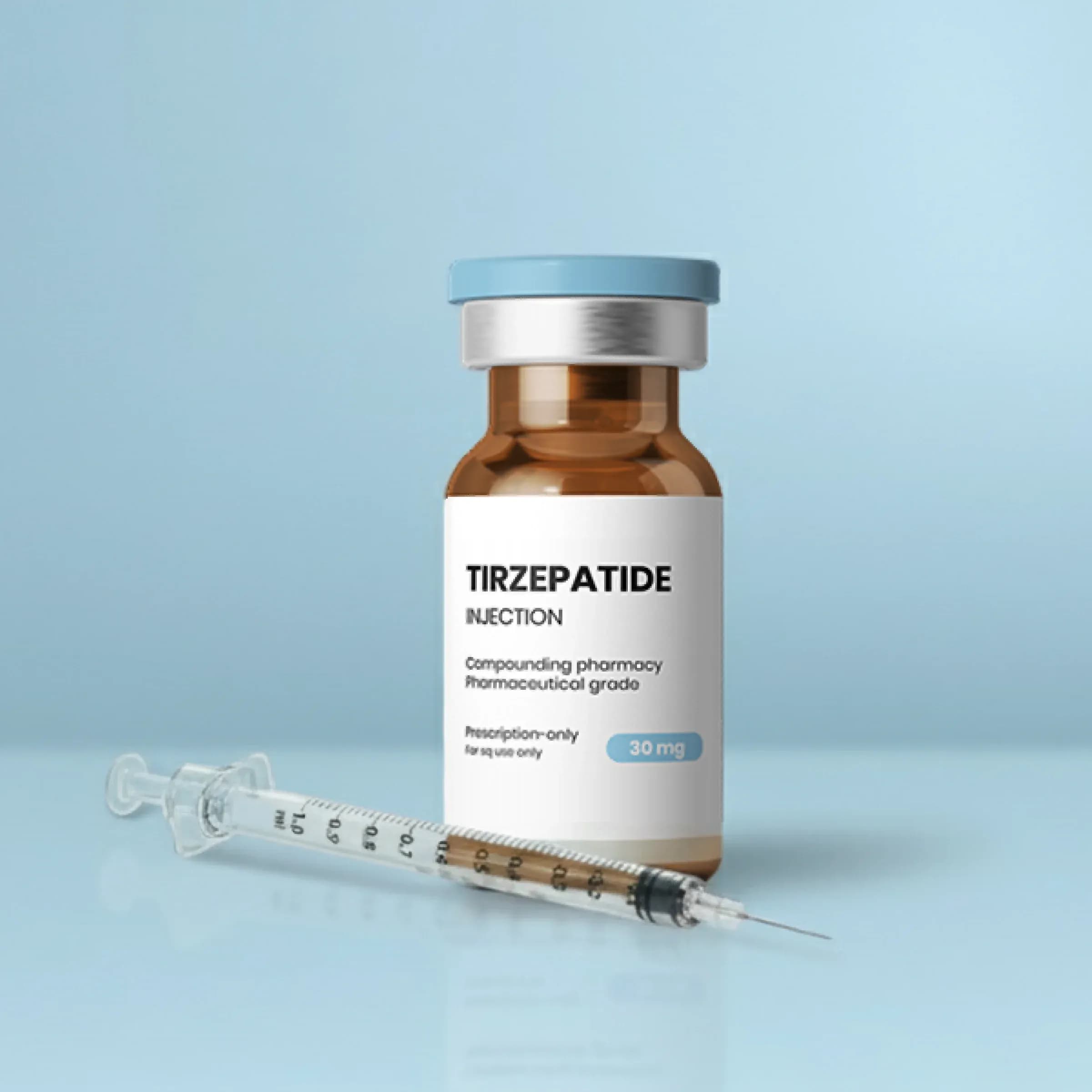
Protein Shakes on a GLP-1: Do They Cause Weight Gain, and How Much Protein Do You Need?
Pricing is accurate as of November 2026 and subject to change.
Key Takeaways
- Protein shakes cause weight gain only when they push total calories above what you burn; in a 2012 JAMA trial, overfed adults gained about the same body fat on low-, normal- and high-protein diets.
- On a GLP-1 such as Wegovy, Ozempic, Zepbound or Mounjaro, the more common problem is eating too little protein, because the medicine lowers how much you eat.
- The protein RDA is 0.8 g per kg of body weight a day, MaxLife's starting point; a 2025 joint advisory proposes 1.2 to 1.6 g per kg during weight loss, and your provider sets your target.
- In body scans from the Zepbound trial SURMOUNT-1, about 25% of the weight lost was lean mass; in STEP 1, the Wegovy trial, about 38%. These results have not been shown for compounded medicines.
- Look for at least 15 g of protein per serving, added sugars at 5% of the Daily Value or less, and calories you count as food; the FDA doesn't approve dietary supplements before sale.
- Protein alone isn't enough to protect muscle: pair it with regular strength training.
No. Protein shakes don't make you gain weight unless they push your total calories above what your body burns. In a 2012 JAMA trial, adults overfed by about 950 calories a day for 8 weeks gained about the same amount of body fat whether their diet was low, normal or high in protein; the extra protein added lean mass, not fat. If you take a GLP-1 such as Wegovy®, Ozempic®, Zepbound® or Mounjaro®, the more common problem is eating too little protein. The protein RDA is 0.8 g per kg of body weight a day, MaxLife's starting point, and your provider sets your target.
Here is the short version, checked November 2026:
| Question | Short answer | Source |
|---|---|---|
| Do protein shakes cause weight gain? | Only through extra calories | JAMA 2012 trial |
| Protein RDA for adults | 0.8 g per kg a day (MaxLife's starting point) | National Academies |
| Higher targets during weight loss | 1.2 to 1.6 g per kg, proposed | 2025 joint advisory |
| Protein in a shake | At least 15 g; 20 to 30 g per meal | MaxLife protein guide |
| Added sugars in a shake | 5% Daily Value or less is "low" | FDA |
If you get your GLP-1 through MaxLife, your provider can help you set a protein target as part of your follow-up, which is included in the price: compounded semaglutide is $89/mo flat and compounded tirzepatide is $120/mo flat, if a licensed provider decides one is right for you. Compounded medicines are not FDA-approved.
Do Protein Shakes Make You Gain Weight?
Protein shakes make you gain weight only when the calories they add put you above what you burn. A shake is food in liquid form: every gram of protein carries 4 calories, the same as carbohydrate, and every gram of fat carries 9, the factors the FDA uses for Nutrition Facts labels. Your body doesn't treat shake calories differently from the calories in a chicken breast or a bowl of pasta.
The best test of the question is the overfeeding trial by Bray and colleagues, published in JAMA in 2012. Twenty-five healthy adults lived in a metabolic ward and ate about 40% more calories than they needed (about 954 extra calories a day) for 8 weeks. Their diets got 5%, 15% or 25% of calories from protein:
| Diet during overeating | Weight gained | Lean mass change |
|---|---|---|
| Low protein (5%) | 3.16 kg (about 7 lb) | No increase |
| Normal protein (15%) | 6.05 kg (about 13 lb) | +2.87 kg (about 6 lb) |
| High protein (25%) | 6.51 kg (about 14 lb) | +3.18 kg (about 7 lb) |
Body fat rose by a similar amount in all three groups. The authors concluded that "calories alone account for the increase in fat"; protein changed how much lean mass people stored, not how much fat. The higher-protein groups weighed more on the scale because they added lean tissue.
Protein also costs your body more energy to process. A review in Nutrition & Metabolism puts the energy used to digest and store protein at 20% to 30% of its calories, compared with 5% to 10% for carbohydrate and 0% to 3% for fat. That helps, but it doesn't cancel the calories.
So when do shakes lead to weight gain? When they are added on top of everything you already eat. One 160-calorie shake a day adds 1,120 calories a week (our arithmetic). If you were eating at maintenance before, that surplus shows up over time. Shakes mixed with whole milk, juice, nut butter or sweeteners can also carry far more calories than the powder alone, so read the label for the whole drink, not only the scoop.
Does Protein Powder Make You Gain Weight?
Protein powder follows the same rule as a ready-to-drink shake: it adds weight only if it adds more calories than you burn. Count the powder and whatever you mix it with. A scoop stirred into water adds only the powder's calories; the same scoop blended with milk, fruit and nut butter can turn into a full meal's worth.
Does Protein Make You Fat?
Not in itself. Extra calories from any source can be stored as fat. The 2025 joint advisory on nutrition with GLP-1 therapy notes that protein above what your muscles need for repair or growth "can be converted to fat by the liver." In the JAMA trial, though, the amount of fat people gained tracked their total calories, not their protein.
Can Protein Shakes Cause Weight Gain on a GLP-1?
It's unlikely, because a GLP-1 lowers how much you eat. The Zepbound label and the Wegovy label both say the medicine "decreases calorie intake." In a study of semaglutide 2.4 mg, the Wegovy dose, people ate 35% less at an all-you-can-eat lunch after 20 weeks than people on placebo. With an appetite that small, a shake is more likely to fill a gap than to tip you into a surplus.
Are protein shakes OK on tirzepatide or semaglutide? For most people, yes. Neither label mentions protein shakes or protein supplements. Both labels say the medicines are for use "in combination with a reduced-calorie diet and increased physical activity," and the 2025 joint advisory says "some individuals can meet protein targets by supplementing with high-protein shakes, bars, and other fortified products." The practical rule is to count a shake as part of your day's food, not as a free extra.
If the scale moves up while you're adding shakes, look at your total calories first, and talk to your provider rather than cutting protein on your own.
Why Does Protein Matter More on a GLP-1?
When you lose weight fast, part of what you lose is lean mass. The Zepbound and Wegovy labels both say the medicine "lowers body weight with greater fat mass loss than lean mass loss," which means some lean mass is still lost. Two brand-trial body scans show how much:
- In a body-composition substudy of SURMOUNT-1, the trial behind Zepbound, 160 adults had DXA scans. After 72 weeks, about 75% of the weight lost was fat and 25% was lean mass, for both tirzepatide and placebo. The substudy was funded by Eli Lilly.
- In STEP 1, the trial behind Wegovy, 62% of the weight lost in the scan substudy was fat and 38% was lean mass, as summarized in the 2025 joint advisory.
These results come from Zepbound and Wegovy; they have not been shown for compounded tirzepatide or semaglutide. Lean mass isn't all muscle, either. It also includes organs, bone and water, and a 2024 review notes that reported lean-mass shares vary widely between studies.
Eating more protein while you eat fewer calories helps you keep more of it. A meta-analysis of 24 trials with 1,063 adults on calorie-reduced diets found that higher-protein diets led to 0.79 kg more weight loss and 0.87 kg more fat loss, and kept 0.43 kg more fat-free mass, than standard-protein diets of the same calories. A 2020 meta-analysis found that protein above the RDA kept 0.36 kg more lean mass during calorie restriction, and that the RDA is enough when you aren't dieting or training.
Protein alone isn't enough. The joint advisory says more protein "is likely inadequate to support the preservation of muscle mass in the absence of structured resistance/strength training." Our guide to exercise on a GLP-1 covers simple strength work you can start at home.
How Much Protein Do You Need on a GLP-1?
The starting point is the Recommended Dietary Allowance: 0.8 g of protein per kilogram of body weight a day, set by the National Academies as enough for nearly all healthy adults. MaxLife's protein guide starts from this number, and MaxLife's protein calculator adjusts your range for your goal and how active you are. Your provider sets your own target.
Several groups recommend more during weight loss. As of November 2026, this is what each one says:
| Who recommends it | Daily protein | When it applies |
|---|---|---|
| National Academies RDA (MaxLife's starting point) | 0.8 g per kg | Healthy adults |
| 2025 joint advisory, four obesity and nutrition societies | 1.2 to 1.6 g per kg, "proposed" | During active weight loss |
| Dietary Guidelines for Americans, 2025-2030 | 1.2 to 1.6 g per kg | General guidance |
| 2026 expert consensus on GLP-1 nutrition | 1.2 to 1.5 g per kg; at least 0.8 g per kg | Weight-loss phase; maintenance |
The joint advisory comes from the American College of Lifestyle Medicine, the American Society for Nutrition, the Obesity Medicine Association and The Obesity Society. It also notes that the RDA "is currently undergoing review" by the National Academies, and that for people with obesity it's unclear whether targets should use actual, adjusted or ideal body weight, because actual weight "can significantly overestimate protein requirements." The Dietary Guidelines for Americans, 2025-2030, released in January 2026, list a protein target of 1.2 to 1.6 g per kg and ask Americans to prioritize protein at every meal. The 2026 consensus statement came from an international expert panel whose project was funded by a nutrition-products company.
Here is what the numbers look like for a 200-pound adult (90.7 kg; our arithmetic):
- At the RDA of 0.8 g per kg: about 73 g of protein a day, or about 24 g at each of three meals.
- At 1.2 to 1.6 g per kg of actual weight: about 109 to 145 g a day.
MaxLife's protein guide suggests roughly 20 to 30 g at each meal, spread through the day. To see your own range, enter your weight, goal and activity in the protein calculator, then confirm the number with your provider. If you have kidney disease, are pregnant or breastfeeding, or follow a diet your doctor set, ask before you raise your protein.
How MaxLife fits. MaxLife is a telehealth patient management platform, not a pharmacy, and MaxLife does not produce medication. A licensed provider reviews your online intake, health history and clinical records, usually within 24 hours, can follow up with questions, and you can ask for a video visit. If the provider decides a prescription is right for you, licensed partner pharmacies prepare it. Compounded semaglutide is $89/mo flat and compounded tirzepatide is $120/mo flat, the same price at every dose, with provider follow-up and ongoing medical support included, so you can ask about protein, shakes and side effects along the way. MaxLife's compounded semaglutide is for weight management only. Compounded semaglutide and tirzepatide are prepared by a licensed pharmacy for one patient's prescription and are not FDA-approved, which means the FDA hasn't reviewed them for safety, effectiveness or quality.
What Should You Look For in a Protein Shake?
Look for enough protein per serving, little or no added sugar, and calories that fit the job the shake is doing. There is no "GLP-1 protein shake" you need, and no single best brand. These checks come from the Nutrition Facts or Supplement Facts panel:
| What to check | What to look for | Why |
|---|---|---|
| Protein per serving | At least 15 g; 20 to 30 g if it stands in for a meal | Matches MaxLife's protein guide and per-meal range |
| Protein per 100 calories | About 10 g or more | Means at least 40% of calories from protein (our arithmetic) |
| Added sugars | 5% DV or less (2.5 g or less) | FDA: 5% DV is low, 20% DV (10 g) is high |
| Total calories | Snack size or meal size, on purpose | Shake calories count like food calories |
| Dietary fiber | About 3 g or more if you're constipated | 10% DV (2.8 g) is a "good source" |
| Sweeteners ending in "-ol" | Few or none if you get gas | Sorbitol, xylitol and similar can cause gas |
| Protein source | Whey, milk, soy or pea | Dairy can bother people who don't digest lactose |
| "Dietary supplement" on the label | Know what it means | The FDA doesn't approve supplements before sale |
A few notes on the table:
- The %DV rule. The FDA's guide to the Nutrition Facts label says 5% DV or less of a nutrient per serving is low and 20% DV or more is high. The Daily Value for added sugars is 50 g and for fiber 28 g. Under FDA rules, 10% to 19% of the Daily Value is a "good source" and 20% or more is "high."
- Added sugars. The official site of the Dietary Guidelines for Americans, 2025-2030 says added sugars "are not recommended." The FDA doesn't count sugars found naturally in milk as added sugars.
- Protein %DV. A protein %DV appears only when the label makes a protein claim, and it must be adjusted for protein quality, so it can be lower than the grams suggest.
- Supplements. Some powders are sold as dietary supplements, labeled "dietary supplement" with a Supplement Facts panel. The FDA says that by law it "does not approve dietary supplements or their labeling," and that makers are responsible for making sure their products are safe.
- Gas and bloating. The NIDDK lists sweeteners ending in "-ol" (sorbitol, mannitol, xylitol, erythritol, maltitol) and dairy among foods that can cause gas. If a shake bothers you, try one without them.
How Do You Fit Protein Shakes In With a Small Appetite?
Use food first and let shakes fill the gaps. MaxLife's protein guide says you don't necessarily need protein shakes, but they can help when your appetite is very low. These habits make shakes easier on a GLP-1:
- Don't go long without eating. The joint advisory notes that nausea on a GLP-1 "often occurs in the morning or after longer periods without eating," and that smaller, more frequent meals help. A small shake can bridge a long gap.
- Split it. Drink half a shake, and the rest an hour or two later, if a full serving feels like too much.
- Go light when you start or step up a dose. Stomach side effects are most likely then, and the advisory suggests smaller meals and avoiding fatty or high-fiber foods during the first few days of treatment. A lower-fat shake may sit better than a rich blended one.
- Count it inside a meal. Pair a shake with a piece of fruit or a slice of toast and call it breakfast, rather than adding it after a full meal.
- Boost food you already eat. The protein guide suggests stirring non-fat dry milk powder into milk, which adds protein without adding volume. Greek yogurt, cottage cheese, eggs, fish, tofu and beans are compact options.
- Keep drinking fluids. The Zepbound and Wegovy labels advise taking precautions to avoid fluid loss when stomach side effects hit, because dehydration can harm the kidneys.
If you can't eat or drink enough, tell your provider. Our GLP-1 diet guide has meal ideas for small appetites and tips for nausea and constipation.
Can a Protein Shake Replace a Meal?
Sometimes, but a protein shake and a meal replacement aren't the same thing. A shake built for protein may have little fiber or carbohydrate. The 2026 consensus statement says nutritionally complete meal-replacement products can replace one or two meals a day during weight loss. If you want to replace meals often, check the label for what the product is designed to be and ask your provider how it fits your plan.
Who Should Check With a Provider Before Adding Protein Shakes?
Most healthy adults can add a shake without a problem, but check with your provider first if any of these apply:
- Kidney disease. The National Kidney Foundation says very large amounts of protein, "especially in the form of unnecessary supplements, can be stressful on the kidneys," and that your dietitian or provider should set your amount. The joint advisory adds that prolonged intake above 2 g per kg a day should be avoided.
- Pregnancy or breastfeeding, or a diet your doctor set for another condition.
- Allergies or intolerances to milk, soy or other protein sources in the shake.
- Trouble eating or drinking because of nausea, vomiting or diarrhea. A shake can help, but your provider may also want to adjust your plan.
If your weight changes in a way you don't expect, whether up or down, raise it at your next follow-up rather than changing your protein or your medicine on your own. Our post on why you might not be losing weight on tirzepatide covers the common reasons.
The Bottom Line
Protein shakes don't cause weight gain on their own; extra calories do. On a GLP-1 such as Wegovy, Ozempic, Zepbound or Mounjaro, the bigger risk is eating too little protein while your appetite is low, which can mean losing more lean mass. Start from the RDA of 0.8 g per kg a day, MaxLife's starting point; know that the 2025 joint advisory proposes 1.2 to 1.6 g per kg during weight loss and the 2025-2030 Dietary Guidelines list the same range; and let your provider set your target. Pick shakes with at least 15 g of protein and little added sugar, count them as food, and pair protein with strength training.
Frequently Asked Questions
Semaglutide $89/mo Flat or Tirzepatide $120/mo Flat
MaxLife compounded semaglutide $89 a month and tirzepatide $120 a month, flat. All-inclusive, no membership fee, the same price at every dose. A licensed provider decides.
Check Your EligibilityThis article is for informational purposes only and is not a substitute for professional medical advice, diagnosis, or treatment. Individual results vary. Pricing, insurance coverage, and compounding regulations described here are subject to change; verify current details with your insurance provider, the manufacturer, or your prescriber before making treatment decisions. Compounded medications are not FDA-approved.
Why trust our experts

April Foster, DO MPH
Reviewer
Board Certified Family Medicine Physician licensed nationwide providing collaborative oversight to NPs, PAs, and RN. Also specializing in telemedicine services nationwide.
Sources
- Bray GA et al. Effect of dietary protein content on weight gain, energy expenditure, and body composition during overeating: a randomized controlled trial. JAMA. 2012
- Mozaffarian D et al. Nutritional priorities to support GLP-1 therapy for obesity: a joint advisory (ACLM, ASN, OMA, TOS). Obesity Pillars, 2025 (corrigendum 2026)
- Dietary Guidelines for Americans, 2025-2030 (USDA and HHS, January 2026)
- Institute of Medicine. Dietary Reference Intakes for Energy, Carbohydrate, Fiber, Fat, Fatty Acids, Cholesterol, Protein, and Amino Acids. National Academies Press. 2005
- Sievenpiper JL et al. Nutritional and lifestyle supportive care recommendations for management of obesity with GLP-1-based therapies: an expert consensus statement using a modified Delphi approach. Obesity Pillars. 2026
- Look M et al. Body composition changes during weight reduction with tirzepatide in the SURMOUNT-1 study of adults with obesity or overweight. Diabetes Obes Metab. 2025
- Wilding JPH et al. Once-Weekly Semaglutide in Adults with Overweight or Obesity (STEP 1). N Engl J Med. 2021
- Neeland IJ et al. Changes in lean body mass with glucagon-like peptide-1-based therapies and mitigation strategies. Diabetes Obes Metab. 2024
- Wycherley TP et al. Effects of energy-restricted high-protein, low-fat compared with standard-protein, low-fat diets: a meta-analysis of randomized controlled trials. Am J Clin Nutr. 2012
- Hudson JL et al. Protein Intake Greater than the RDA Differentially Influences Whole-Body Lean Mass Responses to Purposeful Catabolic and Anabolic Stressors. Adv Nutr. 2020
- Westerterp KR. Diet induced thermogenesis. Nutr Metab (Lond). 2004
- Friedrichsen M et al. The effect of semaglutide 2.4 mg once weekly on energy intake, appetite, control of eating, and gastric emptying in adults with obesity. Diabetes Obes Metab. 2021
- Zepbound (tirzepatide) prescribing information, DailyMed (revised September 2026)
- Wegovy (semaglutide) injection and tablets prescribing information, DailyMed (revised June 2026)
- FDA: How to Understand and Use the Nutrition Facts Label
- FDA: Added Sugars on the Nutrition Facts Label
- 21 CFR 101.9, Nutrition labeling of food (calorie factors; protein %DV)
- 21 CFR 101.54, Nutrient content claims for "good source" and "high"
- FDA: Questions and Answers on Dietary Supplements
- NIDDK: Eating, Diet, and Nutrition for Gas in the Digestive Tract
- National Kidney Foundation: Nutrition and Kidney Disease, Stages 1-5 (Not on Dialysis)
Why Am I Not Losing Weight on Tirzepatide?
November 9, 202613 min
Does Tirzepatide Make You Tired? Why It Happens and How Long It Lasts
September 30, 202612 min
Does Semaglutide Make You Tired? Ozempic and Wegovy Fatigue Explained
November 14, 202613 min
Does Tirzepatide Cause Hair Loss? Zepbound, Mounjaro, Ozempic and Wegovy
November 14, 202612 min