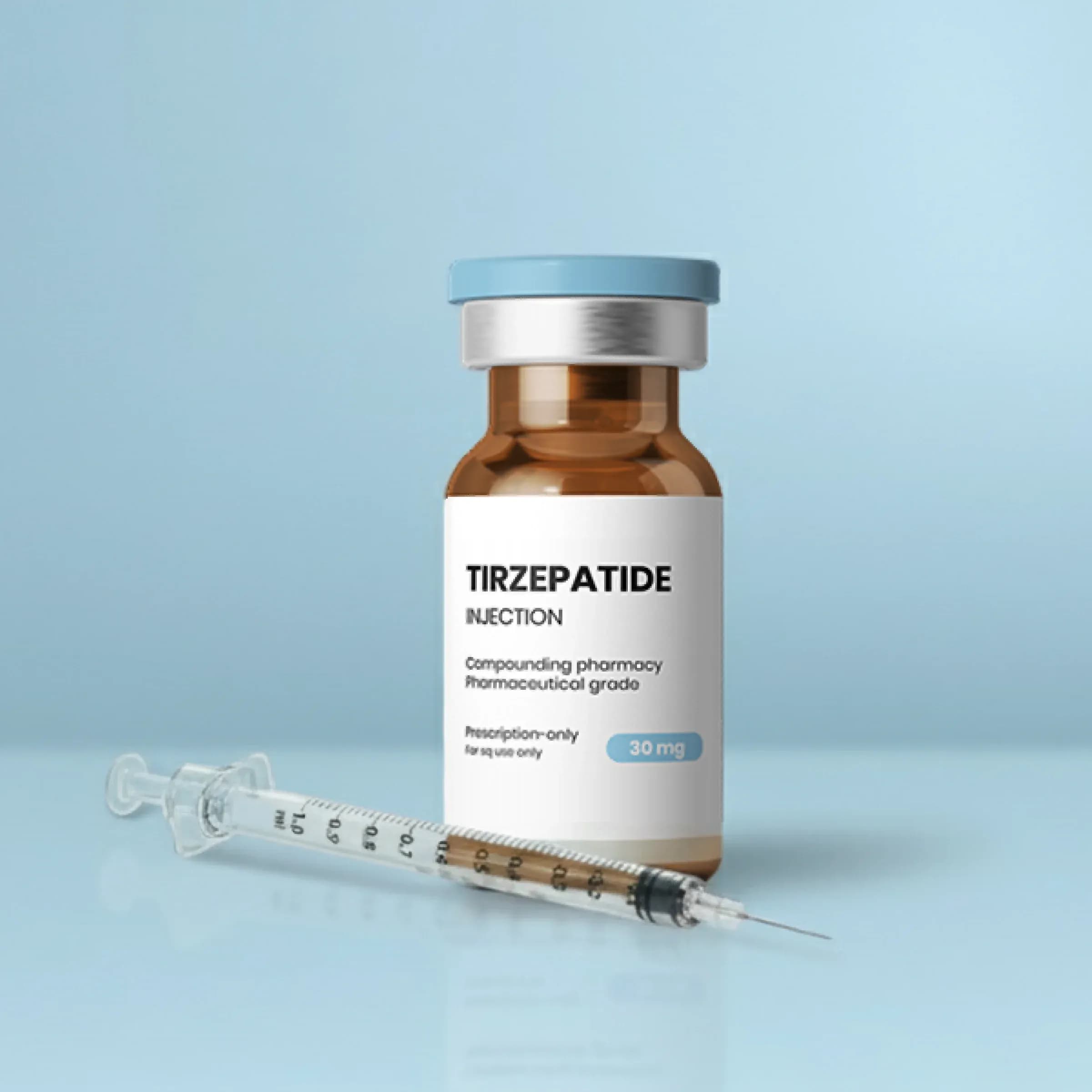
Tirzepatide and semaglutide dosage calculator
Convert a compounded tirzepatide or semaglutide dose from mg to units on a 100-unit (U-100) insulin syringe, or check how many mg you're drawing. Pick your pharmacy and your vial's label: compounded vials come in different strengths, so the same mg dose can be a different number of units.
For education only, not medical advice. Always use the dose your provider prescribed and your pharmacy's instructions. If this result is different, contact your care team before you inject. Compounded medications are not FDA-approved and do not undergo FDA premarket review.
What do you want to do?, done
Which medication?, done
Which pharmacy is your medicine from?
Which label matches your vial?
What is your dose?
Reading the strength on your vial
Pharmacies write strengths in different ways. These are the formats people most often misread, and how to read each one.
01Strength given per half mL
Tirzepatide 10 mg /0.5 mL The amount is for 0.5 mL, so a full mL holds twice as much: 20 mg/mL.
02A second ingredient that reads like a volume
Tirzepatide 30 mg /0.5 mg / mL This is 30 mg/mL of tirzepatide plus 0.5 mg/mL of an add-in such as B12 or glycine. It does not mean 30 mg in half a mL.
03The add-in is named first
Niacinamide /Tirzepatide 2 mg / 17.65 mg / mL The numbers follow the order of the names. Tirzepatide is named second, so it is the second number: 17.65 mg/mL.
04The add-in has the bigger number
Tirzepatide /Pyridoxine 10 mg / 25 mg / mL Your medication is not always the largest number. Here tirzepatide is 10 mg/mL and the add-in is 25 mg/mL.
05Three ingredients on one line
Tirzepatide /Glycine / B12 10 mg / 5 mg / 500 mcg / mL Pair each number with its name, in order. Only the first, 10 mg/mL, is tirzepatide.
06The whole vial's amount beside the strength
Tirzepatide 72 mg /4 mL (18 mg/ mL) 72 mg is everything in the 4 mL vial. For your draw, use the per-mL number: 18 mg/mL.
07No “/mL” on the label
Tirzepatide 18 mg, 4 mL vialWith only a strength and a vial size, it could mean 18 mg in each mL (72 mg in the vial) or 18 mg in the whole vial. Check your prescription or ask your care team before you draw.
08A dash between two numbers
Tirzepatide /Glycine 8-5 mg/ mL (2.5 mL) (20 mg) The dash separates two ingredients; it is not a range. Tirzepatide is 8 mg/mL, and 8 mg/mL across 2.5 mL is the 20 mg total.
Common questions
How do I turn my mg dose into units?
Divide your dose in mg by your vial's strength in mg per mL, multiply by 100, then round down to a whole unit. For example, a 2.5 mg dose from a 20 mg/mL vial is 2.5 ÷ 20 × 100 = 12.5, so you draw 12 units.
How do I work out how many mg I am drawing?
Divide the units by 100 to get mL, then multiply by your vial's mg per mL. For example, 25 units from a 10 mg/mL vial is 25 ÷ 100 × 10 = 2.5 mg.
What is one unit on an insulin syringe?
One unit is a hundredth of a mL (0.01 mL). On most 1 mL syringes each small line is 2 units, so count the lines carefully to see where your dose lands.
Why are units rounded down?
The calculator rounds down to a whole unit so your draw never goes over the dose you were prescribed. When rounding changes your dose, the result shows the mg you are actually drawing. On a syringe marked every 2 units, an odd number such as 41 sits halfway between two lines.
Which syringe does the calculator assume?
A standard 100-unit (1 mL) insulin syringe. When a dose needs more than 100 units, the result shows how to split it between syringes.