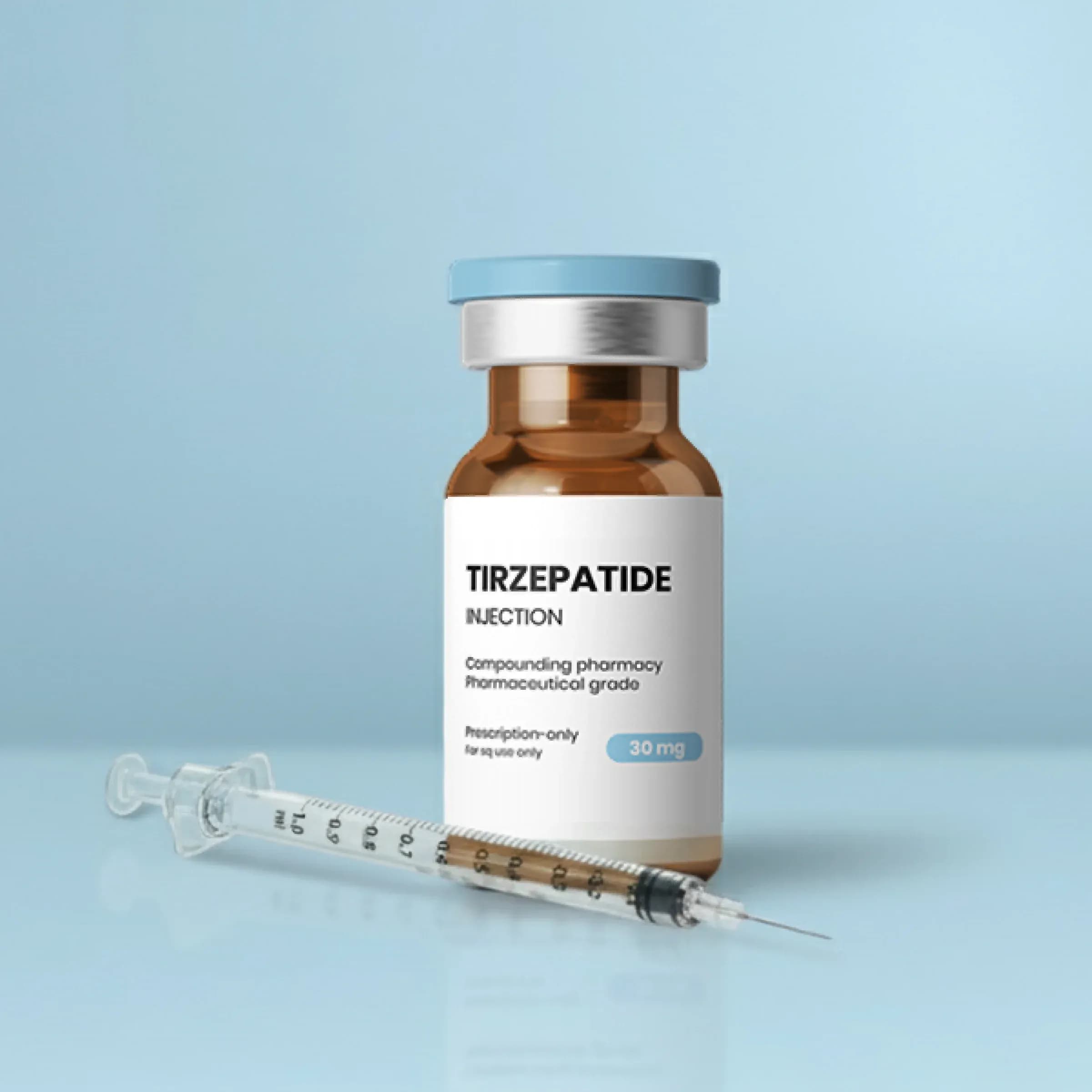
How Long Does Tirzepatide Take to Work? A Week-by-Week Timeline
Pricing is accurate as of November 2026 and subject to change.
Key Takeaways
- Tirzepatide reaches its peak level in the blood about 24 hours after a shot (range 8 to 72 hours), and steady levels after 4 weekly doses, according to the Zepbound label.
- In SURMOUNT-1, adults taking Zepbound had lost about 3% of their body weight by week 4, about 8% to 9% by week 12 and 15.0% to 20.9% by week 72, depending on the dose; the average curve leveled off around week 60.
- Two Lilly-funded studies measured people eating less at a test meal by week 3 (on a faster start than the label) and by week 8.
- In type 2 diabetes, A1c was about 0.8 points lower by week 4 on Mounjaro, and the median time to an A1c under 7% was 8.1 weeks.
- On the trial averages, losing 20 pounds took about 12 to 15 weeks for someone starting at 231 pounds; it takes longer at a lower starting weight.
- These are brand trial results; they have not been shown for compounded tirzepatide, which is not FDA-approved.

Tirzepatide starts working within a day or two, but weight loss builds over months. After a shot, it reaches its highest level in your blood about 24 hours later (range 8 to 72 hours), and it slows stomach emptying most after the first dose, according to the Zepbound® label. In the SURMOUNT-1 trial, adults taking Zepbound had lost about 3% of their body weight by week 4 and about 8% to 9% by week 12, and the average kept dropping until about week 60. In type 2 diabetes, the median time to an A1c under 7% on Mounjaro® was about 8 weeks. These are brand trial results; they have not been shown for compounded tirzepatide.
Here is the timeline at a glance, as of November 2026:
| When | What happens | Source |
|---|---|---|
| 8 to 72 hours | Blood level peaks (median 24 hours) | Zepbound label |
| Weeks 1 to 4 | 2.5 mg starting dose; blood levels steady after 4 weekly doses | Zepbound label |
| Week 3 | People ate less at a test meal | 6-week Lilly study |
| Week 4 | Weight about 3% lower on average | SURMOUNT-1 (FDA review) |
| Week 8 | Median time to an A1c under 7% | SURPASS-2 and -3 |
| Week 12 | Weight about 8% to 9% lower | SURMOUNT-1 (FDA review) |
| Week 20 | Highest trial dose (15 mg) reached | SURMOUNT-1 |
| Weeks 24 to 36 | Median time to a weight plateau | SURMOUNT-1 analysis |
| Weeks 60 to 72 | Average curve levels off; 15.0% to 20.9% lost | FDA review, Zepbound label |
If you're starting compounded tirzepatide, no trial has measured its timeline, and it is not FDA-approved. One thing that won't change as your dose steps up is the price at MaxLife: compounded tirzepatide is $120 a month, flat, the same price at every dose, and a licensed provider decides whether it's right for you.
How Long Does It Take for Tirzepatide to Start Working?
Tirzepatide starts acting on the first day: the Zepbound label says it reaches its peak level in the blood a median of 24 hours after an injection, with a range of 8 to 72 hours. About 80% of each dose reaches your bloodstream, and the label says exposure is similar whether you inject it in the abdomen, thigh or upper arm.
Tirzepatide is built to last. Its half-life is about 5 to 6 days in people with overweight or obesity, which is why you take it once a week. Levels build with each weekly shot, and the label says steady blood levels are reached after 4 weeks of once-weekly doses.
Two effects start early. The label says tirzepatide "decreases calorie intake," likely by affecting appetite, and it slows how fast your stomach empties. That slowing "is largest after the first dose" and fades over time. So feeling full sooner, or some nausea, can show up in the first days, while the scale takes longer to move.
What Happens After Your First Tirzepatide Shot?
After your first shot, the medicine peaks in your blood within 8 to 72 hours, usually about a day, and you may notice that smaller meals fill you up. Side effects such as nausea, diarrhea or constipation can start after the first dose or after any dose increase; the label says most nausea, vomiting and diarrhea in the trials happened while the dose was being raised and decreased over time. Our guide to tirzepatide side effects lists each one with the label rates and what helps.
Don't expect big weight changes in the first days. The label calls the 2.5 mg dose a starting dose that "is not approved as a maintenance dosage," and its job is to let your body adjust.
How Long Does It Take for Tirzepatide to Suppress Appetite?
Less hunger can show up within the first few weeks, and trials measured people eating less by week 3. No trial has measured appetite in week 1 on the label's 2.5 mg starting dose, so treat any day count you read online as a guess.
Two Lilly-funded studies measured it directly:
- Week 3: in a 6-week study of 114 adults without diabetes, people on tirzepatide ate about 525 fewer calories than people on placebo at an all-you-can-eat test lunch at week 3. They also reported less hunger, fewer food cravings and less urge to overeat. This study started at 5 mg, which is faster than the label's schedule.
- Weeks 8 and 28: in a study of adults with type 2 diabetes who stepped up to 15 mg, people on tirzepatide ate about 185 fewer calories than placebo at a test lunch at week 8 and about 310 fewer at week 28. Their weight was already lower than placebo's at week 5.
Appetite changes vary from person to person. The trials judged tirzepatide by weight over months, not by hunger in the first week, so a quiet first week doesn't tell you much.
How Long Does It Take to Lose Weight on Tirzepatide?
Weight loss on tirzepatide shows up within the first month and keeps building for more than a year. In the FDA's clinical review of Zepbound, the reviewer noted that in SURMOUNT-1, "separation of the weight curves is apparent as early as Week 4," and the tirzepatide curves leveled off "around Week 60."
Here is the average weight change by week in SURMOUNT-1, a 72-week trial of 2,539 adults with obesity or overweight and without diabetes, who weighed 231 pounds (104.8 kg) on average at the start:
| Week | 5 mg group | 10 mg or 15 mg group |
|---|---|---|
| 4 | About 3% | About 3% |
| 8 | About 6% | About 6% |
| 12 | About 8% | About 8% to 9% |
| 16 | About 9% | About 11% |
| 20 | About 10% to 11% | About 13% |
| 24 | About 12% | About 14% to 15% |
| 36 | About 14% | About 18% |
| 48 | About 15% | About 19% to 21% |
| 60 | About 16% | About 21% to 22% |
| 72 | 16.0% | 21.4% (10 mg), 22.5% (15 mg) |
These are the observed averages at each visit, read from the chart in the FDA's review and rounded. The label's headline 72-week results, which also count people who stopped treatment, are 15.0% at 5 mg, 19.5% at 10 mg and 20.9% at 15 mg, compared with 3.1% on placebo. The placebo group lost about 1% by week 4 and about 2% to 3% from week 8 on. Everyone in the trial also got counseling to eat about 500 fewer calories a day and stay active.
All three groups followed nearly the same curve for the first 12 weeks, while their doses were still equal or close. The FDA review notes that the 5 mg, 10 mg and 15 mg groups reached their final doses at weeks 4, 12 and 20. After that, higher doses brought more weight loss on average.
These results come from brand Zepbound and have not been shown for compounded tirzepatide. Individual results vary: in every trial, some people lost much more than the average and some much less. Our BMI calculator for weight loss gives a trial-based estimate for your starting weight, not a prediction.
How Much Weight Can You Lose on Tirzepatide in the First Month?
About 3% of your body weight on average, based on SURMOUNT-1: that's about 7 to 8 pounds for someone starting at 231 pounds. The first month is the 2.5 mg starting dose, so the first-month result is not what the medicine does at a full dose.
People with type 2 diabetes tend to lose less. In SURPASS-2, adults with type 2 diabetes taking Mounjaro had lost an average of 1.7 to 1.8 kg (about 4 pounds) by week 4, according to a Lilly-funded analysis of the trial.
Weekly weigh-ins jump around, so look at the trend over the month. For what each stage looks like, including photos and measurements, see tirzepatide before and after: results by month.
How Much Weight Can You Lose on Zepbound in 3 Months?
About 8% to 9% of your body weight on average by week 12 in SURMOUNT-1, or roughly 18 to 20 pounds for someone starting at 231 pounds. Most people were on their way by then:
- By week 8: 62% of people taking tirzepatide had lost at least 5% of their weight, in a week-8 analysis of SURMOUNT-1. This early group averaged 7.9%, and everyone else 3.1%.
- By week 12: 82% of people who took at least 75% of their doses had lost at least 5%, in a week-12 analysis.
- By week 20: people on 10 mg or 15 mg had lost an average of 12.8 kg (about 28 pounds), compared with 2.7 kg on placebo, in the FDA's statistical review.
If you're behind those numbers at 3 months, it isn't a verdict. In the week-12 analysis, 18% had lost less than 5% at week 12. Of them, 70% reached 5% by week 24 and 90% by week 72; those who got there took 24.8 weeks on average. Our guide on why you might not be losing weight on tirzepatide walks through the common reasons to review with your provider.
How Long Does It Take to Lose 20 Pounds on Tirzepatide?
On the SURMOUNT-1 averages, about 12 to 15 weeks, or roughly 3 to 3.5 months, for someone starting near the trial's average weight of 231 pounds. It's sooner if you weigh more, because 20 pounds is a smaller share of your weight, and later if you weigh less:
| Starting weight | 20 pounds is | When the trial average got there |
|---|---|---|
| 200 pounds | 10% | About weeks 15 to 19 |
| 231 pounds | 8.7% | About weeks 12 to 15 |
| 300 pounds | 6.7% | About weeks 9 to 10 |
The earlier week is for the 10 mg and 15 mg groups and the later week for the 5 mg group. This is rough math on trial averages, not a prediction for you. People with type 2 diabetes tend to take longer: in SURPASS-2, the average loss at week 24 was 6.8 kg to 9.7 kg (about 15 to 21 pounds), depending on the dose.
How Much Weight Do You Lose per Week on Tirzepatide?
About 1.7 pounds a week on average in the first 12 weeks for someone starting at 231 pounds, slowing to about half a pound a week between months 6 and 11. Here is the pace in the SURMOUNT-1 10 mg and 15 mg groups, worked out from the averages above:
| Weeks | Average loss per week | At 231 pounds, about |
|---|---|---|
| 0 to 12 | 0.7% of body weight | 1.7 pounds |
| 12 to 24 | 0.5% | 1.1 pounds |
| 24 to 48 | 0.2% | 0.5 pounds |
| 48 to 72 | 0.1% | 0.2 pounds |
So a pace of 2 to 4 pounds a week, which some websites call typical, is faster than these trial averages. Slowing down is expected. In a SURMOUNT analysis of weight plateaus, the median time to reach a plateau (less than 5% further loss over 12 weeks) was 24 to 36 weeks, depending on starting BMI. People on higher doses, younger people and women tended to plateau later, and a later plateau came with more weight lost.
How Long Does It Take for Mounjaro to Lower Blood Sugar?
Blood sugar starts to drop within the first weeks. In SURPASS-2, adults with type 2 diabetes who added Mounjaro to metformin had an A1c about 0.8 points lower by week 4, and the median time to an A1c under 7% was 8.1 weeks for each of the three doses, in a Lilly-funded analysis of SURPASS-2 and SURPASS-3. The median time to 6.5% or lower was 12.1 weeks.
| Week | A1c change | Weight change |
|---|---|---|
| 4 | -0.8 points | -1.7 to -1.8 kg |
| 12 | -1.8 to -2.0 points | -4.7 to -5.2 kg |
| 24 | -2.1 to -2.4 points | -6.8 to -9.7 kg |
| 40 | -2.0 to -2.3 points | -7.6 to -11.2 kg |
People started at an average A1c of about 8.3%. Weeks 4 to 24 come from that analysis and week 40 from the Mounjaro label, where 82% to 86% of people reached an A1c under 7% and fasting blood sugar fell by 55 to 60 mg/dL.
Your A1c reflects your average blood sugar over the past 3 months, with the last 30 days counting most, according to the NIDDK. That's why an A1c check soon after starting won't show the full effect. If you also take insulin or a sulfonylurea, tirzepatide raises the risk of low blood sugar, and your provider may change those doses. Mounjaro is FDA-approved for type 2 diabetes, and Zepbound for weight management and for obstructive sleep apnea in adults with obesity.
How Long Does Zepbound Take to Help Sleep Apnea?
Breathing during sleep can start to improve within weeks, but the difference from placebo took longer to show. In a SURMOUNT-OSA analysis, the apnea-hypopnea index (breathing pauses and shallow breaths per hour) had improved from the start as early as week 4, but the difference from placebo wasn't significant until week 20. The size of the improvement tracked the weight lost. See Zepbound for sleep apnea for the full trial results.
Why Does Tirzepatide Take Months to Reach Its Full Effect?
Because the dose starts low and rises slowly. The Zepbound label starts everyone at 2.5 mg once a week for 4 weeks, then 5 mg, and allows increases in 2.5 mg steps "after at least 4 weeks on the current dose." The maintenance dose is 5 mg, 10 mg or 15 mg a week. So on the label schedule, the earliest anyone reaches 15 mg is week 20, which is when SURMOUNT-1's 15 mg group got there. Mounjaro also starts at 2.5 mg, with 2.5 mg steps after at least 4 weeks if more blood sugar control is needed, up to 15 mg.
The slow climb is there "to reduce the risk of gastrointestinal adverse reactions," the label says. It works as intended: most nausea, vomiting and diarrhea in the trials happened during the step-up period and decreased over time. Going faster than prescribed doesn't fit the label and can make side effects worse. The label tells prescribers to "consider treatment response and tolerability when selecting the maintenance dosage," so your provider decides when, or whether, to step up. Our tirzepatide dosage chart shows every step.
Higher doses brought more weight loss on average in SURMOUNT-1, but they also brought more stomach side effects for some people. The best dose is the one you tolerate and can keep taking.
Why Does Tirzepatide Work Slower for Some People?
Starting weight, sex, diabetes, dose and missed doses were all linked to the pace in the trials. In the SURMOUNT-1 week-12 analysis, people who had lost less than 5% at week 12 were more often men (45% vs 30%), weighed more at the start (110.2 vs 103.6 kg) and more often had high blood pressure.
- Type 2 diabetes: in SURMOUNT-2, adults with type 2 diabetes lost 12.8% at 10 mg and 14.7% at 15 mg over 72 weeks, less than in SURMOUNT-1.
- Dose: the 5 mg group lost less than the 10 mg and 15 mg groups from about week 16 on.
- Missed doses: of the 28 people in that analysis who never reached 5%, 4 had missed 3 or more doses in a row and had to restart the step-up.
If you're losing less than you expected, or you can't keep your doses because of side effects, talk to your provider rather than changing your dose yourself. Diet, sleep, other medicines and some medical conditions can also slow weight loss, and the not-losing-weight guide linked above covers what to check.
Does Compounded Tirzepatide Take Longer to Work?
Nobody knows, because compounded tirzepatide has not been studied in trials like SURMOUNT or SURPASS. Compounded tirzepatide is prepared by a licensed pharmacy for one patient's prescription and is not FDA-approved, which means the FDA hasn't reviewed it for safety, effectiveness or quality. Every timeline in this article comes from brand Zepbound or Mounjaro, and these results have not been shown for compounded tirzepatide.
Measuring your dose matters. In an August 12, 2026 letter to state medical boards, the FDA warned that compounded GLP-1 medicines "often have different concentrations than FDA approved products," so dose volumes are not interchangeable. Ask your provider for your dose in milligrams, and follow your pharmacy label for the volume.
Here is how MaxLife works. MaxLife is a telehealth patient management platform, not a pharmacy or drug maker. A licensed provider reviews your online intake, health history and clinical records, usually within 24 hours, can follow up with questions, and you can ask for a video visit. The provider decides whether a prescription is right for you and when to change your dose, and licensed partner pharmacies prepare and dispense it. Compounded tirzepatide is $120 a month, flat, the same price at every dose, so stepping up over the months doesn't change what you pay. It includes the provider's review and follow-up, the medicine if prescribed, supplies, free expedited shipping and free ongoing medical support, with no membership fee. No insurance is needed, HSA and FSA funds may be eligible, and MaxLife serves all 50 states, has a Spanish-speaking team and is LegitScript certified.
If your insurance covers Zepbound or Mounjaro, the brand may cost you less. Our tirzepatide cost guide compares every route.
The Bottom Line
Tirzepatide peaks in your blood about a day after each shot and reaches steady levels after 4 weekly doses. Appetite can drop within the first few weeks, and in the Zepbound trial weight was about 3% lower at week 4, 8% to 9% lower at week 12 and kept falling until about week 60. In type 2 diabetes, A1c fell within weeks, with a median of about 8 weeks to an A1c under 7% on Mounjaro. These are brand results that have not been shown for compounded tirzepatide, and your own pace depends on your dose, your starting point and your provider's plan.
Frequently Asked Questions
Compounded Tirzepatide: $120/mo Flat, All-Inclusive
MaxLife compounded tirzepatide: $120 a month, flat. All-inclusive, no membership fee, the same price at every dose. A licensed provider decides.
Check Your EligibilityThis article is for informational purposes only and is not a substitute for professional medical advice, diagnosis, or treatment. Individual results vary. Pricing, insurance coverage, and compounding regulations described here are subject to change; verify current details with your insurance provider, the manufacturer, or your prescriber before making treatment decisions. Compounded medications are not FDA-approved.
Why trust our experts

April Foster, DO MPH
Reviewer
Board Certified Family Medicine Physician licensed nationwide providing collaborative oversight to NPs, PAs, and RN. Also specializing in telemedicine services nationwide.
Sources
- Zepbound (tirzepatide) prescribing information, DailyMed (revised August 2026)
- Mounjaro (tirzepatide) prescribing information, DailyMed (revised August 2026)
- FDA clinical review of Zepbound, NDA 217806 (weight change over time in SURMOUNT-1, Figure 25)
- FDA statistical review of Zepbound, NDA 217806 (week 20 results, Table 13)
- Jastreboff AM et al. Tirzepatide Once Weekly for the Treatment of Obesity (SURMOUNT-1). N Engl J Med. 2022
- Kokkinos A et al. Tirzepatide efficacy and tolerability according to early weight response (SURMOUNT-1 and -2). Diabetes Obes Metab. 2026
- Ard J et al. Weight reduction over time by early weight loss response: post hoc analysis in SURMOUNT-1. Diabetes Obes Metab. 2025
- Horn DB et al. Time to weight plateau with tirzepatide treatment in SURMOUNT-1 and SURMOUNT-4. Clin Obes. 2025
- Viljoen A et al. Time to reach glycaemic and body weight loss thresholds with tirzepatide (SURPASS-2 and -3). Diabetes Ther. 2023
- Martin CK et al. Tirzepatide on ingestive behavior in adults with overweight or obesity: a randomized 6-week phase 1 trial. Nat Med. 2025
- Heise T et al. Tirzepatide reduces appetite, energy intake, and fat mass in people with type 2 diabetes. Diabetes Care. 2023
- Malhotra A et al. Tirzepatide for sleep-disordered breathing in SURMOUNT-OSA: time course and association with body weight. Sleep Med. 2025
- NIDDK: The A1C test and diabetes
- FDA letter to the Federation of State Medical Boards on compounded GLP-1 multi-dose vials (August 12, 2026)

Tirzepatide Before and After: Weight Loss Results and What to Expect
September 18, 202610 min
Why Am I Not Losing Weight on Tirzepatide?
November 9, 202613 min
Tirzepatide Dosage Chart for Weight Loss: Doses, Schedule and Units
October 21, 202612 min
Tirzepatide Side Effects: What's Common, What's Serious, What Helps
November 12, 202615 min