Zepbound KwikPen Explained: Doses, Price and How to Use It
Pricing is accurate as of November 2026 and subject to change.
Key Takeaways
- The Zepbound KwikPen is a multi-dose, single-patient-use pen with 4 fixed weekly doses of one strength (2.5 mg to 15 mg per dose), a 28-day supply; Lilly announced its FDA approval on February 23, 2026.
- Before every weekly shot you attach a new pen needle (not included) and prime the pen; then you turn the dose knob until it stops. Don't count clicks.
- Throw the pen away after 4 doses or 30 days after first use, even if medicine is left; the pen blocks a fifth full dose.
- Unopened pens go in the fridge; once in use, a pen can stay in the fridge or at room temperature up to 86°F (30°C). Never freeze it.
- As of November 2026, LillyDirect sells the KwikPen self-pay for $299 to $449 a month if you refill within 45 days; Lilly's KwikPen Self-Pay Savings Card offers the same prices at other pharmacies until December 31, 2026.
- The Medicare GLP-1 Bridge ($50 copay, July 2026 to December 2027) covers Zepbound only as the KwikPen and only for weight management.
- Compounded tirzepatide is not a KwikPen and is not FDA-approved; at MaxLife it is $120/mo flat if a licensed provider prescribes it.
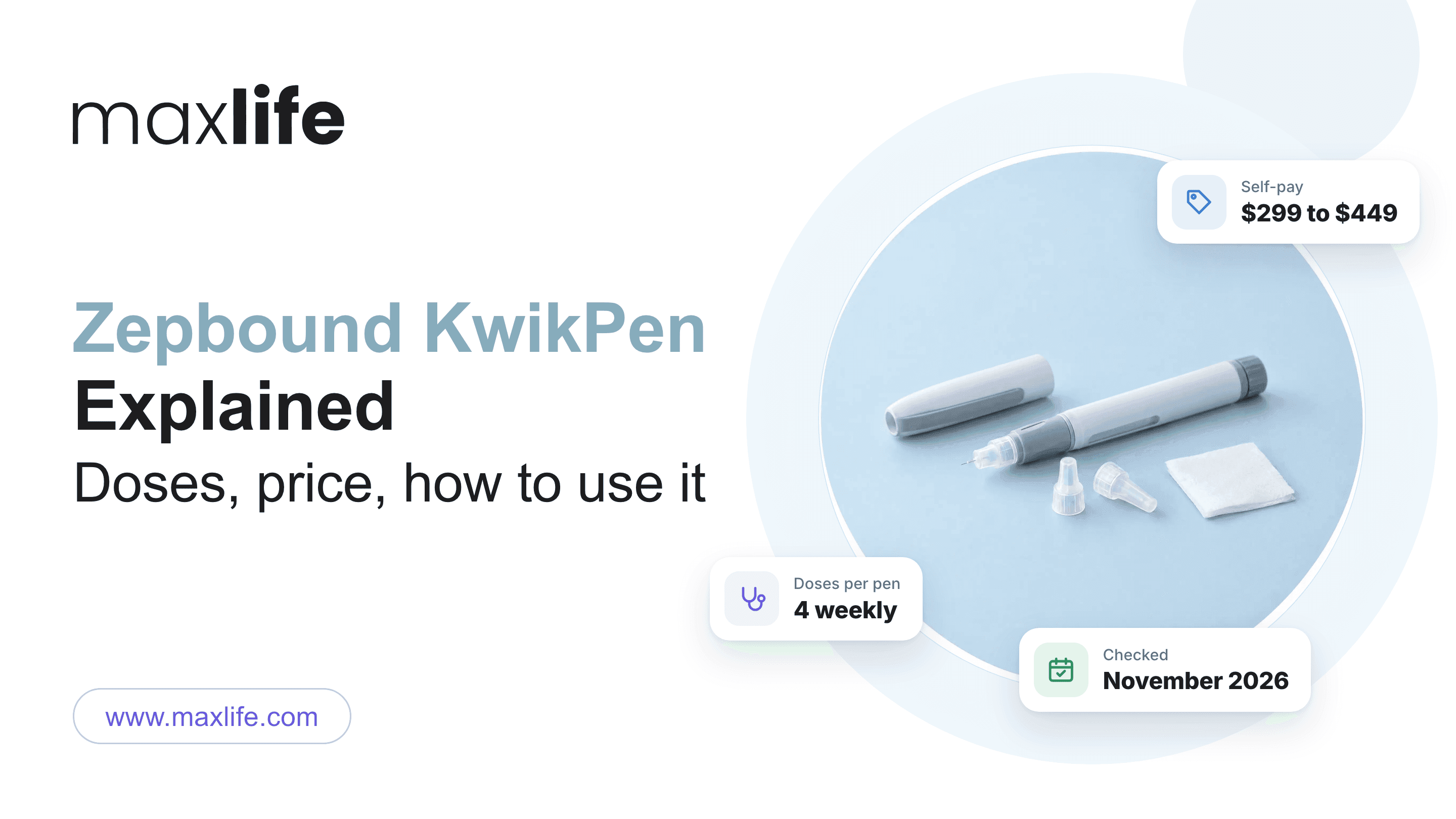
The Zepbound® KwikPen® (often searched as the Zepbound "quick pen") is a multi-dose prefilled pen that holds four fixed weekly doses of tirzepatide, one month of treatment, in a single device. Each pen comes in one of six strengths, from 2.5 mg to 15 mg per dose. You attach a new pen needle and prime the pen before every weekly shot, and you throw the pen away after 4 doses or 30 days, whichever comes first, according to the Zepbound label and Instructions for Use. Eli Lilly announced the FDA's approval of the KwikPen on February 23, 2026 (Lilly).
As of November 2026, a KwikPen costs $299 to $449 a month when you pay cash through LillyDirect, depending on the strength, if you refill within 45 days. Our guide to Zepbound without insurance has every price by dose and device. If you're comparing cash options, compounded tirzepatide at MaxLife is $120/mo flat; it is not a KwikPen, it is not Zepbound, and it is not FDA-approved.
What Is the Zepbound KwikPen?
The Zepbound KwikPen is a disposable, multi-dose, single-patient-use injection pen that delivers one fixed dose of Zepbound once a week for 4 weeks. Zepbound is Lilly's brand of tirzepatide. Along with a reduced-calorie diet and more physical activity, it is FDA-approved to reduce excess weight and keep it off in adults with obesity, or with overweight and at least one weight-related condition, and to treat moderate to severe obstructive sleep apnea in adults with obesity.
Here is how it differs from the original Zepbound pen:
- One pen, four doses. The single-dose pen is an autoinjector you use once and throw away, so a month takes four pens. A KwikPen lasts the month.
- You handle a needle. The single-dose pen has a hidden, built-in needle. With the KwikPen, you screw on a new pen needle each week and remove it after the shot.
- You prime it and dial it. Before each dose you prime the pen, then turn the dose knob until it stops. The pen gives the same dose every time; you can't change it.
- One strength per pen. When your provider changes your dose, you get a new pen in the new strength.
KwikPen is Lilly's name for a pen design it already uses for other medicines. Mounjaro®, Lilly's tirzepatide for type 2 diabetes, also has a 4-dose KwikPen on its US label. This guide covers the Zepbound KwikPen.
How Many Doses Are in a Zepbound KwikPen?
Each Zepbound KwikPen holds 4 weekly doses of one strength, a 28-day supply. The pen comes in six strengths, according to the label (as of November 2026):
| Strength (per weekly dose) | Doses per pen | Tirzepatide in the pen |
|---|---|---|
| 2.5 mg | 4 | 10 mg in 2.4 mL |
| 5 mg | 4 | 20 mg in 2.4 mL |
| 7.5 mg | 4 | 30 mg in 2.4 mL |
| 10 mg | 4 | 40 mg in 2.4 mL |
| 12.5 mg | 4 | 50 mg in 2.4 mL |
| 15 mg | 4 | 60 mg in 2.4 mL |
Each KwikPen dose is 0.6 mL, while a single-dose pen or vial dose is 0.5 mL. The dose in milligrams is what matters, and the pen measures it for you. The dose schedule is the same whichever device you use: the label starts at 2.5 mg for 4 weeks and raises the dose in steps, and 2.5 mg is not a maintenance dose. Our tirzepatide dosage chart walks through the schedule. Your provider decides your dose.
Can you get a fifth dose or split a dose?
No. The Instructions for Use say the pen will prevent you from dialing a full dose after 4 weekly doses, and that you should throw it away even if medicine is left. Trying to inject leftover medicine could give you an incomplete dose. The instructions also say:
- Don't count clicks as you select the dose. Turn the dose knob all the way until it stops.
- Don't transfer Zepbound from the pen into a syringe.
- Don't redial after a dose; a drop of medicine on the needle tip is normal and doesn't affect your dose.
Some people ask about using clicks for a smaller "microdose." The KwikPen isn't designed for that, and the label doesn't support it. Our article on tirzepatide microdosing explains what the evidence says.
How Do You Use the Zepbound KwikPen?
You use the Zepbound KwikPen once a week: attach a new pen needle, prime the pen, dial the dose until the knob stops, inject, and hold for a slow count of 5. Your provider or pharmacist should show you how before your first dose, and the label says to read the Instructions for Use each time you get a new pen. Here are the steps, condensed from Lilly's January 2026 Instructions for Use:
- Check the pen. Wash your hands and pull off the pen cap. Make sure the name and strength match your prescription and the pen isn't expired or damaged. The medicine should be clear and colorless to slightly yellow; don't use it if it froze, is cloudy, discolored or has particles.
- Clean the seal. Wipe the red inner seal with an alcohol swab.
- Attach a new needle. Pull the paper tab off a new pen needle, push it straight onto the pen and twist until tight. Pull off the outer needle shield and keep it; pull off the inner shield and throw it away.
- Prime the pen. Slowly turn the dose knob until you hear 2 clicks and the prime line shows in the dose window. Hold the pen needle up, tap the cartridge holder so air bubbles rise, then push the knob in until it stops and count slowly to 5. A drop of medicine at the needle tip means the pen is primed.
- Choose a site. Inject into your stomach area, at least 2 inches from your belly button, or your thigh. Another person can inject into the back of your upper arm. Use a different spot each week; see where to inject tirzepatide.
- Dial your dose. Turn the dose knob all the way until it stops and the dose symbol shows in the dose window. That is your full weekly dose.
- Inject. Insert the needle, push the knob in until it stops, and hold it while you count slowly to 5. Check the dose window as your Instructions for Use show before you remove the needle.
- Finish. Pull the needle out; if you see blood, press lightly with gauze, without rubbing. Replace the outer needle shield, unscrew the needle and put it in a sharps container, then put the pen cap back on.
Never store the pen with a needle attached. The instructions say that can cause leaks, block the needle and let air into the pen.
Why do you prime the KwikPen every week?
Priming removes air from the cartridge and checks that the pen works. The Zepbound KwikPen instructions say to prime before each weekly injection, not only the first one. If no drop appears, repeat the priming step up to 2 more times. If there is still no drop, change the needle and try once more. If that fails, call Lilly at 1-800-545-5979.
What if you think you didn't get the full dose?
If the dose window doesn't show a finished dose when you pull the needle out, the instructions say to put the needle back into your skin and finish the injection. Don't dial the dose again or repeat the injection. If you still aren't sure you got the full dose, call your provider or Lilly before your next dose.
Who shouldn't use the KwikPen alone?
The label says the KwikPen isn't recommended for people with vision problems unless someone trained to use it helps. Never share a KwikPen with anyone, even with a new needle, because that can spread blood-borne infections. If you switch from vials or single-dose pens to the KwikPen, ask for training on the new device, as the label advises.
What Needles Do You Need for the Zepbound KwikPen?
The Zepbound KwikPen needs a KwikPen-compatible pen needle, and needles aren't included in the box. Use a new needle for every weekly injection to help prevent infections and blocked needles. KwikPen needles are different from the needle and syringe used with Zepbound vials, according to LillyDirect.
Where to get them:
- LillyDirect lets you add pen needles at checkout when you order the KwikPen.
- A pharmacy can sell you compatible pen needles. Ask the pharmacist which needle length suits you and whether you need a prescription for pen needles where you live.
Put each used needle in an FDA-cleared sharps container right away. If you don't have one, the instructions describe a heavy-duty plastic household container with a tight, puncture-resistant lid. The empty pen, with the needle removed, can go in household trash or a sharps container.
How Do You Store a Zepbound KwikPen?
Keep unopened KwikPens in the refrigerator at 36°F to 46°F (2°C to 8°C), in the carton, and they last until the expiration date. Once you start a pen, you can keep it in the fridge or at room temperature up to 86°F (30°C). The label's limits, as of November 2026:
- Unopened at room temperature: throw it away after 30 days.
- Opened (in use): throw it away 30 days after first use, after a total of 30 days at room temperature, or after 4 weekly doses, whichever comes first, even if medicine is left.
- Never freeze it. Don't use a pen that has frozen. Keep it away from heat and light.
That 30-day room-temperature window is longer than the 21 days allowed for a single-dose pen or vial, which makes the KwikPen easier to travel with. Our guide to tirzepatide storage and shelf life covers travel, heat and how to tell if tirzepatide has gone bad.
How Much Does the Zepbound KwikPen Cost?
As of November 2026, the Zepbound KwikPen costs $299 a month at 2.5 mg, $399 at 5 mg and $449 at 7.5 mg to 15 mg when you pay cash through LillyDirect, as long as you refill within 45 days. If you refill later, the price is $499 at 7.5 mg or $699 at 10 mg to 15 mg. A month means 28 days and one KwikPen. Single-dose vials cost the same at LillyDirect. Pen needles cost extra. Lilly says it can change these prices at any time.
How you pay matters:
- Paying cash at another pharmacy: Lilly's KwikPen Self-Pay Savings Card brings the KwikPen to the same $299, $399 or $449 at other pharmacies, for up to 11 fills a year. The card ends December 31, 2026, and if the pharmacy can't apply the price, you may have to claim the difference back from Lilly by March 31, 2027 (Lilly terms).
- Commercial insurance that doesn't cover the KwikPen: the savings card can bring it to as low as $299 to $449 a month.
- Commercial insurance that covers Zepbound: the "as little as $25" savings card applies to the single-dose pen, not the KwikPen. If your plan covers Zepbound, the single-dose pen may cost you less.
- Medicare Part D: the Medicare GLP-1 Bridge, a CMS program that runs from July 1, 2026 to December 31, 2027, has a $50 copay for eligible people. For Zepbound, it covers only the KwikPen and only for weight management, not sleep apnea, with prior authorization (LillyDirect).
- HSA or FSA: LillyDirect lists the KwikPen as HSA and FSA eligible, depending on your plan. The self-pay card's terms say you won't seek reimbursement for card purchases from any insurer or healthcare reimbursement account, so read them before you combine the two.
For the full price picture, including list prices and Mounjaro, see tirzepatide cost.
KwikPen vs Single-Dose Pen vs Vial: Which Is Right for You?
All three forms of Zepbound come in the same six strengths and follow the same dose schedule; they differ in how you inject, what they cost and where you can buy them. Here is what one month looks like in each form, as of November 2026:
| Zepbound form | One month's supply | Needle |
|---|---|---|
| KwikPen | 1 pen with 4 fixed weekly doses | New pen needle each week (sold separately) |
| Single-dose pen | 4 pens, one dose each | Built in and hidden |
| Single-dose vial | 4 vials, one dose each | New needle and syringe each week (sold separately) |
How to choose, with your provider:
- Paying cash: the KwikPen and the single-dose vial cost the same at LillyDirect, $299 to $449 a month. The KwikPen measures the dose for you; with a vial you draw it into a syringe. Vials are sold only through LillyDirect; the KwikPen is also available at other pharmacies with the self-pay card.
- Insurance that covers Zepbound: the single-dose pen is usually the route, with the $25 savings card through December 31, 2026.
- Medicare, for weight management: the KwikPen is the only Zepbound form in the Medicare GLP-1 Bridge.
- Comfort with needles: the single-dose pen hides its needle. The KwikPen and vial need you to handle one.
- Room temperature: the KwikPen gets 30 days, single-dose pens and vials 21 days.
The label also lists a 4-dose multi-dose vial. As of November 2026, LillyDirect sells the KwikPen, single-dose vials and single-dose pens.
Is There a Lower-Cost Alternative to the Zepbound KwikPen?
For people paying cash, compounded tirzepatide usually costs less than self-pay Zepbound, but it is a different product. It is not a KwikPen: MaxLife's compounded tirzepatide comes in a multi-dose vial that you draw into a syringe, and you follow the pharmacy's label for storage and its beyond-use date. Compounded tirzepatide is prepared by a licensed pharmacy for one patient's prescription and is not FDA-approved, which means the FDA hasn't reviewed it for safety, effectiveness or quality. It is not Zepbound, and there is no FDA-approved generic of Zepbound. Zepbound's trial results come from studies of Zepbound; these results have not been shown for compounded tirzepatide. Our comparison of compounded tirzepatide and Zepbound covers the differences.
At MaxLife, compounded tirzepatide is $120/mo flat: all-inclusive, with the medicine if prescribed, syringes and other supplies, and free expedited shipping. It is the same price at every dose, with no membership fee. A licensed provider reviews your online intake, health history and clinical records, usually within 24 hours, can follow up with questions, and you can ask for a video visit. If the provider decides compounded tirzepatide is right for you, licensed partner pharmacies prepare and dispense it; MaxLife does not produce medication.
The brand is the better route for some people: if your insurance covers Zepbound, if you qualify for the $50 Medicare GLP-1 Bridge, if you need Zepbound's sleep apnea approval, or if you prefer an FDA-approved pen.
The Bottom Line
The Zepbound KwikPen is a four-dose pen that holds a month of Zepbound in one strength, from 2.5 mg to 15 mg per weekly dose. Lilly announced its approval on February 23, 2026. Each week you attach a new pen needle, prime the pen, turn the dose knob until it stops and inject; after 4 doses or 30 days, you throw it away, even with medicine left. As of November 2026 it costs $299 to $449 a month self-pay through LillyDirect or with Lilly's KwikPen Self-Pay Savings Card, which ends December 31, 2026, and eligible Medicare Part D members may pay $50 through the Medicare GLP-1 Bridge. If you want a lower monthly cost and a licensed provider decides it's right for you, compounded tirzepatide at MaxLife is $120/mo flat, but it is not FDA-approved and it is not Zepbound.
Frequently Asked Questions
Compounded Tirzepatide: $120/mo Flat, All-Inclusive
MaxLife compounded tirzepatide: $120 a month, flat. All-inclusive, no membership fee, the same price at every dose. A licensed provider decides.
Check Your EligibilityThis article is for informational purposes only and is not a substitute for professional medical advice, diagnosis, or treatment. Individual results vary. Pricing, insurance coverage, and compounding regulations described here are subject to change; verify current details with your insurance provider, the manufacturer, or your prescriber before making treatment decisions. Compounded medications are not FDA-approved.
Why trust our experts

April Foster, DO MPH
Reviewer
Board Certified Family Medicine Physician licensed nationwide providing collaborative oversight to NPs, PAs, and RN. Also specializing in telemedicine services nationwide.
Sources
- Zepbound (tirzepatide) prescribing information, Medication Guide and KwikPen Instructions for Use (revised January 2026), DailyMed
- Mounjaro (tirzepatide) prescribing information, DailyMed (KwikPen presentation)
- Eli Lilly and Company: Zepbound (tirzepatide) now available in multi-dose KwikPen (press release, February 23, 2026)
- LillyDirect: Zepbound KwikPen, single-dose vial and single-dose pen prices (as of November 2026)
- Lilly: Zepbound coverage and savings, KwikPen Self-Pay Savings Card terms (card ends December 31, 2026)
- Lilly: How to use Zepbound (KwikPen, vial and pen)
- CMS: Medicare GLP-1 Bridge
- LillyDirect: Medicare GLP-1 Bridge
- FDA: Safely Using Sharps (Needles and Syringes) at Home, at Work and on Travel
How Much Is Zepbound Without Insurance? Prices and Savings Card Rules
November 14, 202613 min
Where to Inject Tirzepatide: Best Sites and How to Inject
November 7, 202611 min
Tirzepatide Dosage Chart for Weight Loss: Doses, Schedule and Units
October 21, 202612 min
Does Tirzepatide Go Bad? How Long It Lasts In and Out of the Fridge
October 16, 202614 min