Tirzepatide vs Zepbound: Brand and Compounded Explained
Medically reviewed by Dr. Kavya Patel, MD. Pricing is accurate as of November 2026 and subject to change.
Key Takeaways
- Zepbound is Eli Lilly's FDA-approved brand of tirzepatide for weight management and sleep apnea, and Mounjaro is Lilly's tirzepatide brand for type 2 diabetes.
- Compounded tirzepatide is prepared by a licensed pharmacy for one patient's prescription and is not FDA-approved, which means the FDA hasn't reviewed it for safety, effectiveness or quality. It is not Zepbound and not a generic.
- As of November 2026, the FDA has approved no generic of Zepbound or Mounjaro. The main tirzepatide patent runs to May 13, 2036, and the first generic applications were accepted for review in June 2026.
- In SURMOUNT-1, adults taking Zepbound lost 15% to 21% of body weight over 72 weeks, depending on dose. These results have not been shown for compounded tirzepatide.
- Self-pay, Zepbound costs $299 to $449 per 28 days from LillyDirect and Mounjaro $499 a month; compounded tirzepatide at MaxLife is $120 a month, flat.
- Compounded vials can differ in concentration from Zepbound (the FDA cites 17 mg/mL), so dose volumes are not interchangeable. Follow your pharmacy's written instructions.
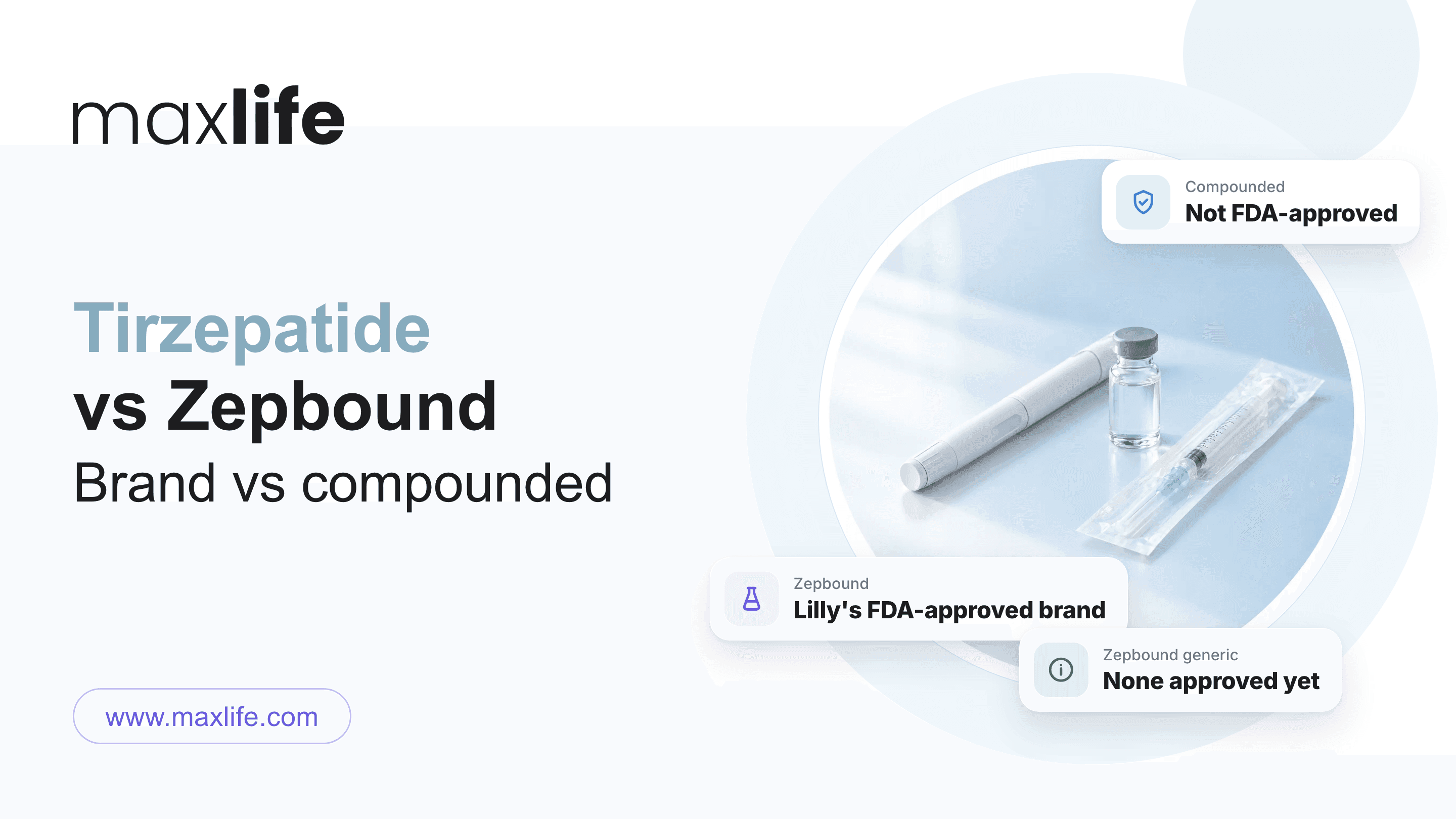
Is tirzepatide the same as Zepbound? Zepbound is a brand of tirzepatide, but not every product sold as tirzepatide is Zepbound. Zepbound is Eli Lilly's FDA-approved tirzepatide injection for weight loss and sleep apnea, and Mounjaro is Lilly's tirzepatide brand for type 2 diabetes. Compounded tirzepatide is a different product: it is prepared by a licensed pharmacy for one patient's prescription, is not FDA-approved and is not a generic. As of November 2026, the FDA has approved no generic of Zepbound or Mounjaro. Zepbound costs $299 to $449 per 28 days self-pay from LillyDirect, and compounded tirzepatide costs $120 a month, flat, at MaxLife. Below: uses, differences, generics, legal status, prices and switching.
Is Zepbound Tirzepatide?
Yes. Zepbound is the brand name of Eli Lilly's tirzepatide injection, and tirzepatide is the medicine's nonproprietary name. The FDA approved Zepbound on November 8, 2023 for chronic weight management.
According to its prescribing information, Zepbound is approved, with a reduced-calorie diet and more physical activity:
- to reduce excess body weight and keep it off in adults with obesity, or adults with overweight and at least one weight-related condition;
- to treat moderate to severe obstructive sleep apnea in adults with obesity.
Tirzepatide acts on two hormone receptors, GIP and GLP-1, which is why it is called a dual agonist. It is taken as an injection once a week.
People often search for the "Zepbound generic name." That name is tirzepatide, but a generic name is not a generic drug. A generic drug is a separate FDA-approved product, and none exists for Zepbound yet (see below).
What are the brand names for tirzepatide injections? There are two, both made by Eli Lilly: Zepbound and Mounjaro. The FDA's drug database lists no other approved tirzepatide product as of November 2026 (Drugs@FDA).
Is Tirzepatide the Same as Zepbound?
It depends on which tirzepatide you mean. Three kinds of products are sold under the name tirzepatide in the US, and they are not interchangeable:
- Zepbound: Lilly's FDA-approved brand for weight management and sleep apnea.
- Mounjaro: Lilly's FDA-approved brand for type 2 diabetes.
- Compounded tirzepatide: a preparation made by a compounding pharmacy for one patient. It is not FDA-approved, which means the FDA hasn't reviewed it for safety, effectiveness or quality.
The table compares Zepbound with compounded tirzepatide. Prices are as of November 2026.
| Question | Zepbound | Compounded tirzepatide |
|---|---|---|
| Who makes it | Eli Lilly | A state-licensed compounding pharmacy |
| FDA-approved | Yes | No |
| FDA-approved uses | Weight management; sleep apnea in adults with obesity | None |
| Form | Single-dose pen or vial, or a 4-dose KwikPen | Usually a multi-dose vial drawn with a syringe |
| Strength | Fixed: 2.5 mg to 15 mg per 0.5 mL (single-dose) | Set by each pharmacy |
| Ingredients | Listed on the FDA label | Vary by pharmacy; ask for the full list |
| Clinical trials | SURMOUNT trials | None |
| Self-pay price | $299 to $449 per 28 days (LillyDirect) | $120 a month, flat, at MaxLife |
| Insurance | Covered by some plans | Not covered |
So if your prescription says Zepbound, you are taking Lilly's FDA-approved tirzepatide. If an online program offers "tirzepatide," ask which of the three it is.
Is Tirzepatide the Same as Mounjaro?
Mounjaro is tirzepatide too: it is Eli Lilly's other tirzepatide brand, approved for type 2 diabetes. Zepbound and Mounjaro both contain tirzepatide and come in the same strengths, but they carry different FDA approvals, different prices and, often, different insurance rules.
| Zepbound | Mounjaro | |
|---|---|---|
| FDA-approved for | Weight management; sleep apnea in adults with obesity | Blood sugar control in type 2 diabetes (age 10 and up); lowering heart attack and stroke risk in adults with type 2 diabetes |
| First approved | November 8, 2023 | May 13, 2022 |
| Self-pay price (LillyDirect) | $299 to $449 per 28 days | $499 a month |
| Medicare | Part D for sleep apnea; KwikPen in the $50 GLP-1 Bridge for weight loss | Part D for type 2 diabetes |
Sources: the Zepbound and Mounjaro labels, LillyDirect and CMS.
Mounjaro is not approved for weight loss, so prescribing it only for weight is off-label, and it costs more self-pay. Never use the two together: the Zepbound label advises against combining it with any other tirzepatide product or GLP-1 medicine. Whether moving from one brand to the other makes sense for you is a decision for your prescriber and, if you have coverage, your insurer.
What Is Compounded Tirzepatide?
Compounded tirzepatide is prepared by a licensed pharmacy for one patient's prescription and is not FDA-approved, which means the FDA hasn't reviewed it for safety, effectiveness or quality. It is not made by Eli Lilly, and it is not Zepbound or Mounjaro.
Compounding means a pharmacist prepares a medicine for an individual patient. The FDA's compounding Q&A gives examples such as a patient who is allergic to a dye in an approved drug. Two kinds of compounders exist:
- 503A pharmacies are licensed by a state and prepare drugs for individual patients with a prescription. State boards of pharmacy oversee them day to day.
- 503B outsourcing facilities register with the FDA and are inspected by it. For tirzepatide, they can't currently compound from bulk ingredient, because tirzepatide is neither on the FDA's 503B bulks list nor in shortage.
Compounded tirzepatide usually comes in a multi-dose vial that you draw with a syringe, at a concentration set by the pharmacy. The FDA says compounded drugs should only be used in patients whose medical needs cannot be met by an FDA-approved drug, and a licensed provider decides that for each patient. MaxLife's compounded tirzepatide page explains how its program works.
Is Compounded Tirzepatide the Same as Zepbound?
No. They are different products. On February 6, 2026, the FDA said that companies cannot claim compounded products are generics or "the same as drugs approved by FDA," cannot make "same active ingredient" claims, and cannot call them "clinically proven." Any seller that tells you otherwise is making a claim the FDA has rejected.
These are the differences that matter in practice:
- Approval and review. Zepbound's manufacturing, labeling and results were reviewed by the FDA. Compounded tirzepatide was not.
- Where the ingredient comes from. The FDA set up an import alert to stop GLP-1 ingredients with potential quality concerns, and it is aware of fraudulent compounded tirzepatide whose labels name pharmacies that don't exist or didn't make the product (FDA).
- Concentration. Zepbound comes in fixed strengths of 2.5 mg to 15 mg per 0.5 mL. In an August 12, 2026 letter to state medical boards, the FDA noted that compounded tirzepatide may come at 17 mg/mL in a 4 mL vial, so the volumes "are not interchangeable" with the approved product.
- Added ingredients. Zepbound's label lists tirzepatide and its inactive ingredients. Some compounded products add others, such as vitamin B12. Ask the pharmacy for the full list and check it against your allergies.
- Handling. The FDA says to throw a multi-dose vial away 28 days after first use, even if some is left, and not to use a GLP-1 that arrives warm.
Is There a Generic for Zepbound?
No. As of November 2026, the FDA has not approved a generic of Zepbound or Mounjaro, and compounded tirzepatide is not one.
A generic drug must be FDA-approved and shown to match the brand in active ingredient, strength, dosage form and performance, according to the FDA's generic drug facts. The FDA's compounding Q&A asks directly whether compounded drugs and generic drugs are the same, and answers: "No. A generic drug is approved by FDA... while a compounded drug is not approved by FDA."
When could a generic arrive? The FDA's Orange Book lists the main tirzepatide patent through May 13, 2036, other Zepbound patents through 2039, and new-chemical exclusivity through May 13, 2027. On June 29, 2026, Sandoz announced that the FDA had accepted two of its applications for a tirzepatide autoinjector for review. Acceptance is not approval, and patents still stand in the way, so no launch date is known. Products advertised today as a cheap Zepbound generic are not FDA-approved generics.
Does Compounded Tirzepatide Work as Well as Zepbound?
No one knows, because compounded tirzepatide has not been tested in clinical trials. The weight-loss numbers you see online come from trials of Zepbound:
- In SURMOUNT-1, 2,539 adults without diabetes taking Zepbound lost an average of 15.0%, 19.5% and 20.9% of body weight at 5 mg, 10 mg and 15 mg over 72 weeks, compared with 3.1% on placebo.
- In SURMOUNT-5, a 72-week trial funded by Lilly, people taking Zepbound lost 20.2%, compared with 13.7% on Wegovy. Our tirzepatide vs Wegovy comparison covers it.
These results belong to Zepbound. They have not been shown for compounded tirzepatide, and trial averages don't predict how any one person will respond.
Safety data are thinner too. As of May 31, 2026, the FDA had received more than 730 reports of adverse events tied to compounded tirzepatide and says such events are likely underreported, because state-licensed pharmacies that aren't outsourcing facilities don't have to report them. Some reports may be related to doses beyond those on the approved label.
Is Compounded Tirzepatide Still Legal in 2026?
Yes, in limited circumstances, but the shortage rules that once allowed wide compounding are gone. The FDA declared the tirzepatide shortage resolved on December 19, 2024, and its grace period for compounders ended in March 2025.
What remains is compounding for an individual patient. Federal law limits pharmacies from regularly compounding what the FDA calls "essentially a copy" of an approved drug, unless a prescriber determines and documents that a specific change makes a significant difference for an identified patient. Outsourcing facilities can't compound tirzepatide from bulk ingredient, and on April 30, 2026 the FDA proposed to keep tirzepatide off their bulks list for good; the Federal Register shows no final decision as of November 2026. In February 2026 the FDA also said it intends to restrict GLP-1 ingredients used in mass-marketed compounded drugs.
These rules have changed several times since 2024, and states add their own. Ask any provider which pharmacy fills your prescription and on what basis it is compounded.
How Much Does Zepbound Cost Compared With Compounded Tirzepatide?
Zepbound costs $299 to $449 per 28 days self-pay, and compounded tirzepatide at MaxLife costs $120 a month, flat, as of November 2026.
- Zepbound, self-pay. LillyDirect charges $299 for the 2.5 mg starting dose, $399 for 5 mg and $449 for 7.5 mg to 15 mg when you refill within 45 days ($499 or $699 if late). Vials are sold only through LillyDirect.
- Zepbound's list price is about $1,087 a month, as shown on TrumpRx.gov. With commercial coverage, Lilly's savings card can bring it to as little as $25 a month through December 31, 2026, and eligible Medicare Part D members can get the KwikPen for $50 through the GLP-1 Bridge.
- Mounjaro, self-pay, is $499 a month whatever the dose.
- Compounded tirzepatide at MaxLife is $120 a month, flat, billed every 3 months ($360), with no membership fee. Higher doses are available when a provider prescribes them, at the same price.
Over a first year, 13 fills of Zepbound come to about $5,637 if you step up to 7.5 mg or more and refill on time; 12 months at MaxLife's flat $120 come to $1,440. Be clear about what the difference buys: you pay less, and you give up FDA approval, insurance coverage and a prefilled pen. Compare total monthly costs, including membership and visit fees, in our cheapest tirzepatide online guide, and see every route in our tirzepatide cost breakdown.
Can You Switch Between Zepbound and Compounded Tirzepatide?
Yes, with a licensed provider, but each switch is a new prescription for a different product, not a refill.
From compounded tirzepatide to Zepbound (for example, if your insurance starts covering Zepbound):
- Your prescriber writes a Zepbound prescription and chooses the dose. The label's schedule starts at 2.5 mg once a week and rises by 2.5 mg no sooner than every 4 weeks, up to 15 mg.
- You move from drawing doses out of a vial to a prefilled pen or single-dose vial, so there is no volume to measure.
- Self-pay prices rise with the dose, and insurance may need prior authorization first.
From Zepbound to compounded tirzepatide:
- Your provider sets the dose in milligrams. Because compounded vials differ in concentration, a Zepbound dose doesn't translate into a fixed number of syringe units. Use only your pharmacy's written instructions.
- Insurance won't pay for it, so check what you'd lose before you cancel a covered prescription.
In both directions, don't overlap products. Your provider sets the timing between your last dose of one and your first dose of the other.
How to Check a Compounded Tirzepatide Offer
A legitimate offer starts with a licensed provider's review and names a licensed pharmacy. The FDA lists these red flags for telehealth sellers: claims that a compounded drug is the same as an FDA-approved drug, prices that seem too good to be true, no screening or prescription by a licensed doctor, no doctor to answer questions afterward, and labels with spelling errors or wrong pharmacy addresses.
Ask any program, in writing:
- Which pharmacy prepares my medication, and is it licensed in my state?
- What else is in the vial, and what is its concentration in milligrams per milliliter?
- Do I get written dosing instructions for my specific vial?
- What is the full monthly price after the first month, with every fee included?
MaxLife is a telehealth patient management platform, not a pharmacy or drug maker. Independent licensed providers decide whether a prescription is right for you, and licensed partner pharmacies prepare and dispense it, including Dirx Pharmacy, Southend Pharmacy, Hallandale Pharmacy, Red Rock Pharmacy, Advanced Pharmacy, Perfect Rx Pharmacy, Health Wealth Pharmacy, Quaker Community Pharmacy, VLS Pharmacy and NewLife Rx Pharmacy. To see how 24 online programs compare on real cost, read our guide to the best tirzepatide providers.
Get Compounded Tirzepatide With Medical Guidance
Compounded tirzepatide only makes sense with real medical oversight: a licensed provider who reviews your health history and follows up, a named and licensed pharmacy, and written instructions for your vial.
At MaxLife, the online intake takes about 2 minutes. A licensed provider reviews it, usually within 24 hours, and you can ask for a video visit. The flat price includes the provider's review and follow-up, the medicine if prescribed, supplies and free expedited shipping. No insurance is needed, and HSA and FSA funds may be eligible. MaxLife serves all 50 states, has a Spanish-speaking team and is LegitScript certified. Start on the compounded tirzepatide page to see whether you qualify.
Conclusion
Zepbound is Eli Lilly's FDA-approved brand of tirzepatide for weight management and sleep apnea, and Mounjaro is its tirzepatide brand for type 2 diabetes. Compounded tirzepatide is a different product: prepared by a licensed pharmacy for one patient, not FDA-approved and not a generic. No generic of Zepbound has been approved as of November 2026, and the main patent runs to 2036. The trade-off is specific: compounded tirzepatide costs less, $120 a month, flat, at MaxLife versus $299 to $449 for Zepbound, and you give up FDA approval, insurance coverage and a prefilled pen. Whether tirzepatide is right for you, and in which form, is a decision for a licensed provider. For the semaglutide side of the same question, see is semaglutide the same as Ozempic.
Frequently Asked Questions
Compounded Tirzepatide: $120/mo Flat, All-Inclusive
Compounded medications are not FDA-approved and are not covered by insurance. Pricing and availability are subject to change.
Check Your EligibilityThis article is for informational purposes only and is not a substitute for professional medical advice, diagnosis, or treatment. Individual results vary. Pricing, insurance coverage, and compounding regulations described here are subject to change; verify current details with your insurance provider, the manufacturer, or your prescriber before making treatment decisions. Compounded medications are not FDA-approved.
Sources
- FDA: FDA approves new medication for chronic weight management (Zepbound), November 8, 2023
- Zepbound (tirzepatide) prescribing information (DailyMed)
- Mounjaro (tirzepatide) prescribing information (DailyMed)
- Drugs@FDA (openFDA): tirzepatide applications
- FDA Orange Book: Zepbound patent and exclusivity information
- Sandoz media release (June 29, 2026): FDA accepts Sandoz applications for a proposed tirzepatide autoinjector
- FDA: Generic drug facts
- FDA: Compounding and the FDA, questions and answers
- FDA: FDA intends to take action against non-FDA-approved GLP-1 drugs (February 6, 2026)
- FDA: What to know when promoting compounded drugs (telehealth companies)
- FDA: Concerns with unapproved GLP-1 drugs used for weight loss
- FDA: Clarifies policies for compounders as national GLP-1 supply begins to stabilize
- FDA: Proposes to exclude semaglutide, tirzepatide and liraglutide from the 503B bulks list (April 30, 2026)
- FDA letter to the Federation of State Medical Boards on compounded GLP-1 vials (August 12, 2026)
- LillyDirect: Zepbound self-pay pricing
- LillyDirect: Mounjaro self-pay pricing
- TrumpRx.gov: Zepbound list and self-pay price
- CMS: Medicare GLP-1 Bridge information for providers
- New England Journal of Medicine: Tirzepatide Once Weekly for the Treatment of Obesity (SURMOUNT-1)
- New England Journal of Medicine: Tirzepatide as Compared with Semaglutide for the Treatment of Obesity (SURMOUNT-5)