How to Inject Tirzepatide: Step by Step, With a Vial or a Pen
Reviewed by the MaxLife operations team. Steps checked against the Zepbound label and FDA guidance in November 2026.
Key Takeaways
- A Zepbound 4-dose vial gives 0.6 mL each week, not the 0.5 mL of a single-dose vial, so check which vial you have before you draw.
- The FDA advises throwing away a compounded multi-dose vial 28 days after first use, even if medicine is left, and using a new, sterile needle and syringe for every dose.
- When a sharps container is about three-quarters full, it goes to your community's disposal program; loose needles never go in the trash.
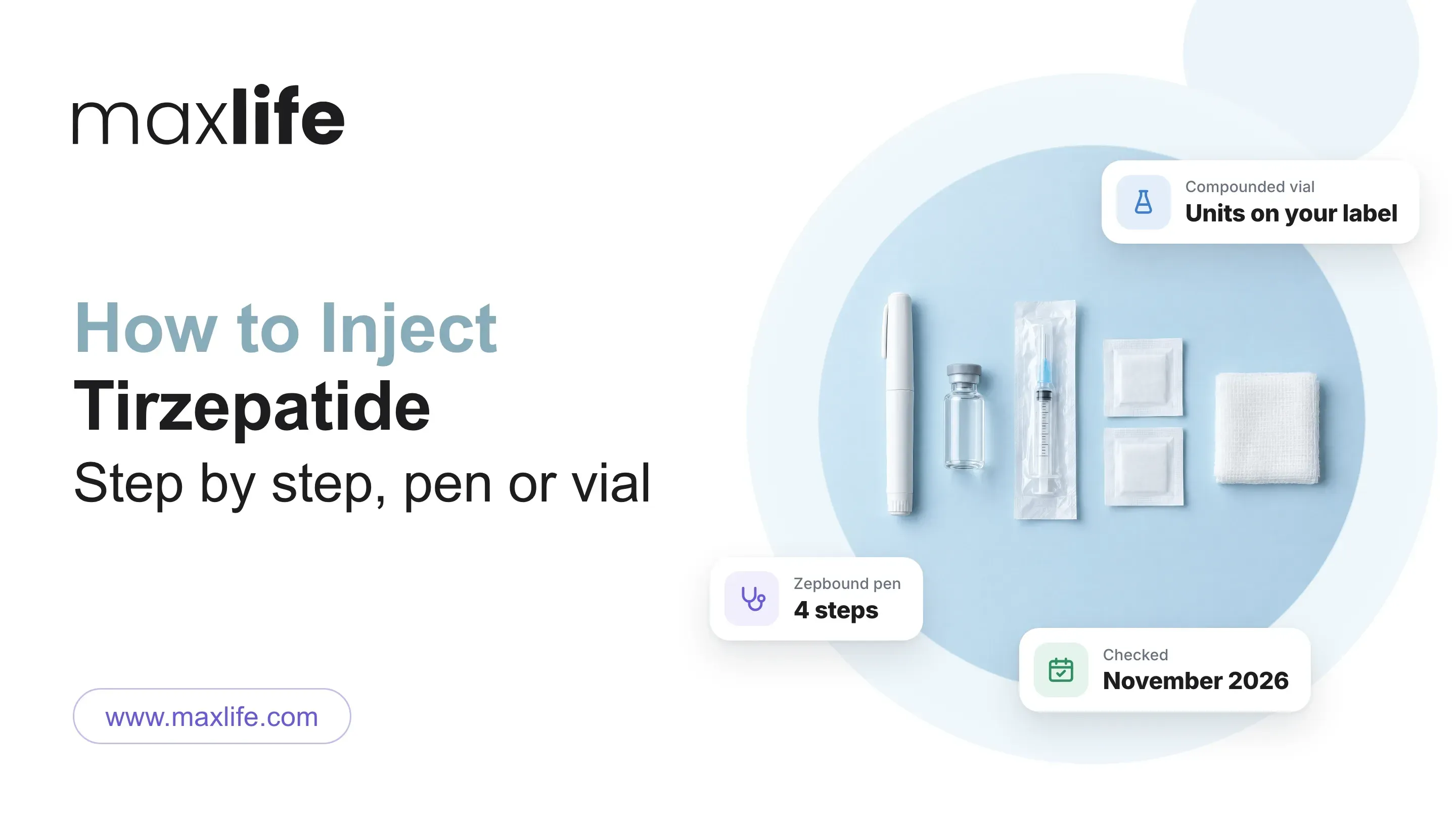
To inject tirzepatide, you put it under the skin once a week, and the steps depend on what you were prescribed. With a Zepbound® single-dose pen, you place the pen flat on your skin, unlock it and hold the button for up to 10 seconds, until the second click. With a Zepbound vial, you draw 0.5 mL (single-dose vial) or 0.6 mL (4-dose vial) into a new syringe and inject it. With compounded tirzepatide, you draw the number of units on your pharmacy label into a new insulin syringe. These steps follow Lilly's Instructions for Use in the Zepbound label and FDA guidance, checked in November 2026.
Compounded tirzepatide is prepared by a licensed pharmacy for one patient's prescription and is not FDA-approved, which means the FDA hasn't reviewed it for safety, effectiveness or quality. Its pharmacy label and your prescriber's directions come first. For where on your body to inject and how to rotate spots, see where to inject tirzepatide.
Step by step
How to inject tirzepatide, by device
Find what you were prescribed and follow its steps. Every path ends the same way: the used needle or pen goes straight into a sharps container.
- FDA-approved brandZepbound® single-dose penYou measure nothing: the pen gives the whole dose.
- Check the label, the date and the liquid: clear, colorless to slightly yellow. Wash your hands.
- Pull off the gray base cap. Keep the pen locked until it is on your skin.
- Place the clear base flat on your skin, then turn the lock ring to unlock.
- Press and hold the purple button, up to 10 seconds. First click: started. Second click: done.
- Look for the gray plunger. If you see it, the dose is in. The whole pen goes into a sharps container.
- FDA-approved brandZepbound® vial and syringeYou measure 0.5 mL (single-dose vial) or 0.6 mL (4-dose vial).
- Check the label and the liquid. Wash your hands and wipe the rubber stopper with an alcohol swab.
- Fill a new syringe with air up to your line: 0.5 mL or 0.6 mL.
- Push the air into the vial through the stopper.
- Turn it upside down and draw past the line. Tap the bubbles up and push back to the line.
- Inject, then keep the needle in your skin for at least 5 seconds.
- Don't recap. The syringe and needle go straight into a sharps container.
- CompoundedCompounded vial and insulin syringeNot FDA-approved. You measure the units (or mL) printed on your pharmacy label.
- Read the label: strength, your units, the beyond-use date. Write the first-use date on the vial.
- Wash your hands. Swab the stopper and your skin, and let them dry.
- Fill a new insulin syringe with air up to your units and push the air into the vial.
- Turn it upside down and draw your units. Tap out the bubbles, then check the line again.
- Pinch the skin and inject, the way your pharmacy or prescriber shows you.
- Sharps container next. The FDA says to throw the vial away 28 days after first use.
Sources: Zepbound® Instructions for Use for the single-dose pen and single-dose vial (revised April 2026) and the multi-dose vial (revised January 2026); MedlinePlus, National Library of Medicine, on drawing from a vial and injecting under the skin; FDA advice on multi-dose vials (October 2026). Your own product's instructions, pharmacy label and prescriber come first.
What Do You Need Before You Inject?
Your healthcare provider should show you how to inject before your first dose, the Zepbound Medication Guide says, and the label asks for new training whenever your device changes. Then set out what your device needs:
| You have | What to set out |
|---|---|
| Zepbound single-dose pen | The pen, gauze or a cotton ball, a sharps container |
| Zepbound vial | The vial, a new syringe and needle (not in the box), an alcohol swab, gauze, a sharps container |
| Compounded vial | The vial and its label, a new insulin syringe, alcohol swabs, gauze, a sharps container |
Before every injection, make four quick checks:
- The label. Right medicine, right dose, and not past its expiration date (or the beyond-use date on a compounded label).
- The liquid. Zepbound should be clear and colorless to slightly yellow, not cloudy, with no particles, and never frozen. Compounded tirzepatide should look the way its pharmacy label describes.
- Your hands. Wash them with soap and water.
- The sharps container. Keep it within reach, so the used needle goes straight in.
A Zepbound pen doesn't need to warm up first: its instructions say "It is not necessary to warm the pen to room temperature." If the medicine looks wrong, has frozen or was left somewhere hot, don't inject it; our guide on whether tirzepatide goes bad explains the storage limits.
How to Inject Tirzepatide With the Zepbound Pen
The single-dose pen hides its needle and gives the whole dose, so there is nothing to measure. Lilly's pen Instructions for Use (revised April 2026) has four steps:
- Choose your site, and leave the gray base cap on until you are ready.
- Pull off the gray base cap while the pen is still locked. Throw the cap in your household trash. Don't put it back on, and don't touch the needle. A drop of liquid on the needle tip is normal.
- Place the clear base flat on your skin, then unlock the pen by turning the lock ring.
- Press and hold the purple button for up to 10 seconds. The first click means the injection has started; the second click means it's done. Keep the pen on your skin until the second loud click. A softer click just before it is normal.
The dose went in when the gray plunger is visible. If you don't see it, Lilly asks you to call 1-800-545-5979 and to store the pen safely until then. Air bubbles in the pen are normal. If you drop the pen on a hard surface, use a new one. If you pressed the button before taking off the base cap, throw that pen away and use a new one.
How to Inject From a Zepbound Vial
Zepbound vials come without a syringe or needle. The label gives the example of "a 1 mL syringe capable of measuring a 0.5 mL or 0.6 mL dose," and you need a new one every week. A single-dose vial holds one 0.5 mL dose; the 4-dose (multi-dose) vial gives 0.6 mL each week. Condensed from Lilly's vial Instructions for Use:
- Prepare the vial. Pull off the plastic cap (only on a new vial) and leave the rubber stopper in place. Wipe the stopper with an alcohol swab.
- Fill the syringe with air. Attach the needle if it isn't already attached and pull the needle shield straight off. With the needle pointing up, pull the plunger down to your line: 0.5 mL, or 0.6 mL for the 4-dose vial.
- Push the air into the vial. Push the needle through the stopper and press the plunger all the way in. This makes the liquid easier to draw.
- Draw your dose. Turn the vial and syringe upside down, keep the needle tip in the liquid and slowly pull the plunger past your line. Tap the syringe so air bubbles rise, then push the plunger back up to exactly 0.5 mL or 0.6 mL. Pull the syringe out of the vial.
- Inject. Insert the needle at your chosen site the way your provider showed you; they will tell you whether to pinch the skin. Push the plunger down and keep the needle in your skin for at least 5 seconds.
- Finish. Pull the needle out. If you see blood, press gauze on the spot without rubbing. Don't recap the needle: put the syringe straight into a sharps container.
Throw away a single-dose vial after one use, even if medicine is left. A 4-dose vial goes after 4 weekly doses, 30 days after first use or 30 days in total at room temperature, even if medicine is left. If you have the Zepbound KwikPen® instead, it has its own steps, with a new pen needle and priming every week: see our Zepbound KwikPen guide.
How to Inject Compounded Tirzepatide From a Vial
Compounded tirzepatide usually comes in a multi-dose vial that you draw with an insulin syringe. Your prescriber writes your dose in milligrams (mg), and your pharmacy label gives the amount to draw from that vial, in units or milliliters (mL). Follow that label and your prescriber. The technique below is the standard one for drawing from a vial and injecting under the skin, from MedlinePlus, the National Library of Medicine's health site (drawing from a vial, injecting under the skin). If your pharmacy's instructions differ, follow them.
- Read the label. Check the medicine, its strength, your dose in units or mL and the beyond-use date. The first time you open a vial, write the date on it.
- Get clean. Wash your hands. Wipe the rubber stopper with an alcohol swab, then wipe the spot where you will inject and let it air-dry.
- Push air in. With a new insulin syringe, pull the plunger back to your number of units to fill it with air. Push the needle through the stopper and push the air into the vial.
- Draw your units. Turn the vial upside down, keep the needle tip in the liquid and pull the plunger to your number of units. Tap the syringe so bubbles rise, push them back into the vial, then check the line again. If there are many bubbles, push everything back and draw again slowly.
- Inject. Pinch about an inch of skin, insert the needle all the way at a 90-degree angle (45 degrees if there is little fat there), release the skin and push the plunger all the way in. Then pull the needle out.
- Finish. Press gauze on the spot without rubbing, and put the syringe straight into a sharps container.
Draw each dose right before you inject it rather than filling syringes ahead of time. The FDA advises using a new, sterile needle and syringe for every dose and throwing away a multi-dose vial 28 days after first use, even if medicine is left (FDA). Writing the date on the vial makes that easy to track.
How to Read Units on an Insulin Syringe
On a U-100 insulin syringe, the kind the FDA describes in its dosing reports, 100 units fill 1 mL, so 1 unit is 0.01 mL. Units measure volume, not medicine, and how much tirzepatide each unit holds depends on the vial's strength. In an August 12, 2026 letter to state medical boards, the FDA's example vial held 17 mg per mL, so a 2.5 mg dose was 0.15 mL, which is 15 units. From a vial of another strength, the same 2.5 mg is a different number of units, so read the label of every new vial instead of repeating last month's number.
Reading the syringe
Units on a 100-unit (1 mL) insulin syringe
One unit is 0.01 mL. The amount of tirzepatide in each unit depends on the strength of your vial.
The FDA's example vial, 17 mg per mL
15 units = 0.15 mL: a 2.5 mg dose
29 units = 0.29 mL: a 5 mg dose
A tenfold mix-up from the FDA's reports
5 units = 0.05 mL: the dose people were told to draw
50 units = 0.5 mL: what some drew instead: ten times the dose
These are the FDA's examples, not doses to follow. Your number of units is the one on your own pharmacy label, for the strength of the vial in front of you.
Sources: FDA letter to the Federation of State Medical Boards, August 12, 2026 (example vial: 17 mg per mL); FDA alert on dosing errors with compounded semaglutide, July 26, 2024 (5 units drawn as 50). On a U-100 syringe, 100 units = 1 mL.
Before the needle goes into the vial, find your number on the syringe and check how many units each small line stands for; it isn't always 1. In a 2024 alert about compounded semaglutide, the FDA described people who were told to draw 5 units (0.05 mL) on a 1 mL syringe and drew 50 units instead, ten times the dose. Our tirzepatide dosage chart explains why units depend on the vial, and the dosage calculator shows the math for the strength on your label. Neither replaces your label: if a number doesn't match, ask your pharmacy or care team before you inject.
Injecting Compounded Tirzepatide With MaxLife
When it comes to injecting, the question MaxLife members ask us most is how many units to draw for their prescribed dose, and the answer is always on the label of the vial in front of them. They also ask about syringes and technique, what the dose on the label means and what to do after a late dose. The tips our care team shares most:
- Follow the label on the vial you have. Your dose in mg is the one your provider prescribed; the units depend on that vial's concentration.
- Draw each dose when you're ready to inject it. Don't prefill syringes.
- After a long break, check in first. If it has been more than 2 weeks since your last injection, contact your care team before your next dose.
If a licensed provider prescribes compounded tirzepatide through MaxLife, a licensed partner pharmacy prepares it and ships the vial with syringes, alcohol swabs and printed instructions, packed with cold packs. Our pharmacy instructions page has injection guides from the partner pharmacies that publish them, with the units for their concentrations. MaxLife is a patient management platform, not a pharmacy. Compounded tirzepatide through MaxLife is $120 a month, flat: the same price at every dose, with no membership fee, and the medicine if prescribed, supplies and free expedited shipping included. If your insurance covers Zepbound, the FDA-approved brand may cost you less.
What If You Miss a Dose?
For Zepbound, the label's rule is: take the missed dose as soon as possible within 4 days (96 hours). If more than 4 days have passed, skip it and take your next dose on your usual day. Never take 2 doses within 3 days (72 hours) of each other.
For compounded tirzepatide, follow the missed-dose directions on your prescription, and ask your prescriber when you aren't sure. Don't double a dose to catch up. If it has been more than 2 weeks, contact your care team before you inject again, because your provider may adjust your dose. To move your injection day for good, see the best time to take tirzepatide.
Common Injection Mistakes
These slips can cost you a dose or give you the wrong one:
- Mixing up units, mL and mg. Read your number in the unit your label uses, and find it on the syringe before you draw. A 5 is not a 50.
- Repeating last month's units from a new vial. Units depend on the vial's strength, so check every new label.
- Using a syringe much bigger than your dose. The FDA asks prescribers and pharmacies to give patients a syringe size that fits the dose, after reports of syringes "significantly larger than the prescribed volume." If your dose is hard to read on your syringe, ask your pharmacy.
- Leaving air bubbles in the syringe. Air takes the place of medicine. Tap the bubbles out and bring the plunger back to your line.
- Pulling out too soon. With the pen, wait for the second click. With a Zepbound vial, keep the needle in for at least 5 seconds.
- Reusing a needle or syringe. Use a new one every time. The FDA says reuse can contaminate the medicine, and Lilly's vial instructions add infections and blocked needles.
- Recapping a used needle. Lilly's instructions say recapping can lead to a needle-stick injury. Put it straight into the sharps container.
- Repeating a dose you aren't sure about. Check first (on the pen, look for the gray plunger), then call your provider, your pharmacist or Lilly. Don't inject again on your own.
If you inject too much, the label says to call your healthcare provider or Poison Help at 1-800-222-1222, or go to the nearest emergency room right away.
How to Throw Away Needles, Syringes and Pens
The FDA recommends two steps:
- Right after the injection, put the used pen, or the needle and syringe together, into a sharps container. The FDA recommends an FDA-cleared container, sold by pharmacies and online. If you don't have one, use a heavy-duty plastic household container, such as a laundry detergent bottle, with a tight, puncture-resistant lid; it should stay upright, not leak and be labeled as hazardous waste.
- When it's about three-quarters full, follow your community's rules. Depending on where you live, that may be a drop-off site (some doctors' offices, hospitals, pharmacies, health departments, and police or fire stations), a household hazardous waste site, a mail-back program or a pickup service.
Don't put loose needles in the trash, don't recycle the container and don't reuse it. Carry a small travel container when you inject away from home. For your state's rules, see the FDA's safe sharps disposal page or call Safe Needle Disposal at 1-800-643-1643.
How we made this page: we researched it from the sources listed below and drafted it with the help of AI tools. The MaxLife operations team reviews every page before it goes live, and a licensed clinician also reviews our medical articles.
Frequently Asked Questions
Compounded Tirzepatide: $120/mo Flat, All-Inclusive
MaxLife compounded tirzepatide: $120 a month, flat. All-inclusive, no membership fee, the same price at every dose. A licensed provider decides.
Check Your EligibilityThis article is for informational purposes only and is not a substitute for professional medical advice, diagnosis, or treatment. Follow the instructions for your own product, your pharmacy label and your prescriber. Prices, coverage and compounding rules change; confirm current details before you decide. Compounded medications are not FDA-approved.
Sources
- Zepbound (tirzepatide) prescribing information, Medication Guide and Instructions for Use: single-dose pen and single-dose vial (revised April 2026), multi-dose vial (revised January 2026); DailyMed, label revised August 2026, checked November 20, 2026
- Eli Lilly and Company: How to use Zepbound, checked November 20, 2026
- FDA: FDA's Concerns with Unapproved GLP-1 Drugs Used for Weight Loss, content current as of October 1, 2026
- FDA: FDA alerts health care providers, compounders and patients of dosing errors associated with compounded injectable semaglutide products, July 26, 2024
- FDA: letter to the Federation of State Medical Boards on compounded GLP-1 drugs in multi-dose vials, August 12, 2026, posted by the Alabama Board of Medical Examiners
- MedlinePlus, National Library of Medicine: Drawing medicine out of a vial, reviewed January 14, 2026
- MedlinePlus, National Library of Medicine: Subcutaneous injections, reviewed October 19, 2025
- FDA: Best Way to Get Rid of Used Needles and Other Sharps
- FDA: Sharps Disposal Containers
Where to Inject Tirzepatide: Best Sites and How to Inject
November 7, 20268 min
Tirzepatide Dosage Chart for Weight Loss: Doses, Schedule and Units
October 21, 20268 min
Zepbound KwikPen Explained: Doses, Price and How to Use It
November 15, 20268 min
Does Tirzepatide Go Bad? How Long It Lasts In and Out of the Fridge
October 16, 20268 min