Medicare GLP-1 Bridge Explained: Who Qualifies and How to Use It
Reviewed by the MaxLife operations team. Medicare rules checked in November 2026 and subject to change.
Key Takeaways
- Medicare uses your BMI from when you first started a GLP-1, so a lower BMI today doesn't rule you out.
- Your prescriber can add the note "SEND TO BRIDGE FOR WEIGHT MANAGEMENT" so the pharmacy bills the Bridge, not your Part D plan.
- A GLP-1 fill through your Part D plan ends Bridge eligibility, and a denial can be resubmitted but not appealed.
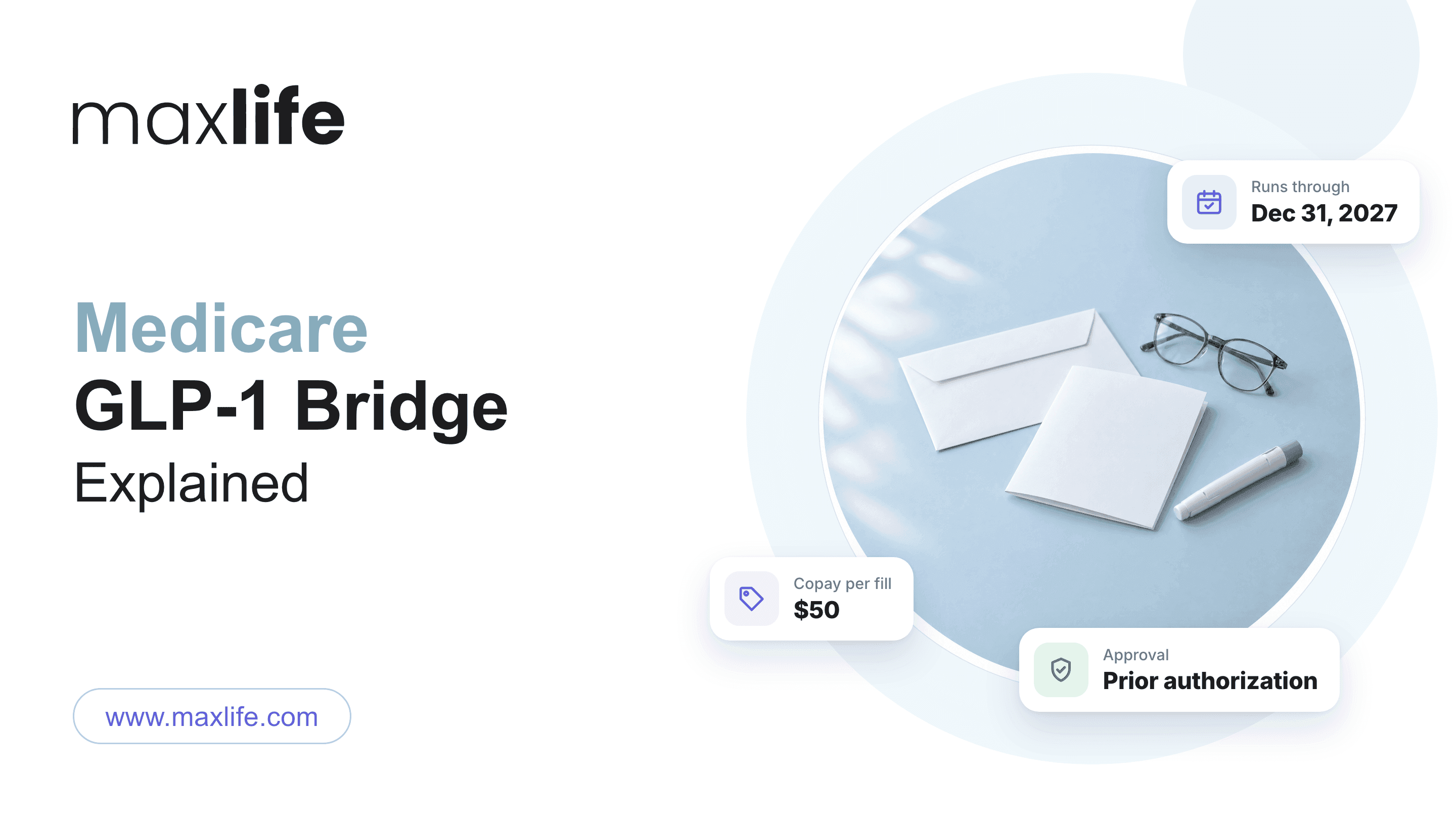
The Medicare GLP-1 Bridge is a temporary Medicare program that lets eligible people with Part D drug coverage get Wegovy®, Foundayo™ or the Zepbound® KwikPen® for weight management for a $50 copay per one-month fill. The Centers for Medicare & Medicaid Services (CMS) runs it from July 1, 2026 to December 31, 2027, outside your Part D plan. There is no sign-up form: your prescriber and your pharmacy start it for you. You must be 18 or older, meet a BMI rule, and not have type 2 diabetes, moderate to severe sleep apnea or MASH (a fatty liver disease). This is the program as CMS described it when we checked in November 2026.
What Is the Medicare GLP-1 Bridge Program?
The Medicare GLP-1 Bridge is a short-term CMS demonstration that gives eligible Part D members certain weight-management GLP-1 drugs for a flat $50 copay. It is not a Part D plan and not part of your plan's benefits. In 2026, CMS handles approvals and pharmacy payments through one central processor, Humana, which already runs Medicare's LI NET program, and drug makers supply the drugs at a net price of $245 per monthly supply (CMS).
| The Bridge at a glance | What CMS says |
|---|---|
| Dates | July 1, 2026 to December 31, 2027 |
| You pay | $50 per one-month fill (28 or 30 days, by drug) |
| Drugs | Wegovy pens and tablets, Foundayo tablets, Zepbound KwikPen |
| Who | Part D members 18 or older who meet a BMI rule |
| How it starts | Your prescriber and pharmacy; no sign-up form |
| Where | Every state and U.S. territory |
| Questions | 1-800-MEDICARE (1-800-633-4227), TTY 1-877-486-2048 |
How we made this page: we researched it from the sources listed below and drafted it with the help of AI tools. The MaxLife operations team reviews every page before it goes live, and a licensed clinician also reviews our medical articles. We read every CMS and Medicare.gov page and document cited here in November 2026.
How Much Does the Medicare GLP-1 Bridge Cost?
You pay $50 at the pharmacy for each one-month supply, whatever your income and whatever phase of your Part D benefit you are in (Medicare.gov). A year of fills comes to $600 or $650: some drugs come in 30-day supplies (12 fills a year) and others in 28-day supplies (13 fills).
Because the Bridge sits outside Part D, the $50 works differently from your plan's copays (CMS pharmacy FAQ):
- The Part D deductible doesn't apply.
- The $50 doesn't count toward your deductible or your yearly out-of-pocket limit, and it won't show on your Part D Explanation of Benefits.
- Extra Help, Medicare's low-income subsidy, can't lower it.
- The Medicare Prescription Payment Plan can't spread it over several months.
- Coupons, savings cards and discount programs can't be applied.
- Pen needles for the KwikPen aren't covered. You buy them separately.
Which Drugs Does the Medicare GLP-1 Bridge Cover?
Three brand-name drugs, when they are prescribed to lose weight or keep it off (CMS):
| Drug | Covered through the Bridge |
|---|---|
| Wegovy (semaglutide) | Pens, including Wegovy HD, and tablets |
| Foundayo (orforglipron) | Tablets |
| Zepbound (tirzepatide) | KwikPen only; vials and single-dose pens are not covered |
No other GLP-1 is on the list. Ozempic®, Mounjaro®, Rybelsus®, Saxenda® and compounded semaglutide or tirzepatide can't be filled through the Bridge. CMS says the list may change during the program; it added Foundayo on April 6, 2026, after the FDA approved it. Each fill is one month's supply, and the Bridge allows no 60- or 90-day fills and no partial fills.
Who Qualifies for the Medicare GLP-1 Bridge?
You qualify if all four of these are true, according to Medicare's fact sheet:
- You have Medicare drug coverage through an eligible plan type (see below).
- You haven't gotten a GLP-1 through your Part D plan.
- You don't have type 2 diabetes, moderate to severe obstructive sleep apnea, or MASH (fatty liver disease with moderate to advanced scarring).
- You are 18 or older and meet one of the BMI rules below.
Your prescriber must also be prescribing the drug to lose weight or keep it off, alongside a program of structured nutrition and physical activity (CMS).
| Your BMI when you started a GLP-1 | You also need one of these |
|---|---|
| 35 or higher | Nothing else |
| 30 or higher | Heart failure with preserved ejection fraction; blood pressure over 140/90 (either number) despite two blood pressure medicines; or chronic kidney disease stage 3a or higher |
| 27 or higher | Prediabetes; a past heart attack or stroke; or peripheral artery disease with symptoms |
Not sure of your number? Our BMI calculator works it out from your height and weight.
Your Starting BMI Is What Counts
CMS looks at your BMI when you first started a GLP-1, not your BMI today. In its own example, someone who started in September 2024 at a BMI of 37 and has a BMI of 34 in July 2026 still meets the BMI-35 rule (CMS). That includes people who started before they had Part D or before July 1, 2026. Medicare.gov adds that if you started through a self-pay program, you answer its eligibility questions based on your health when you started. Keep a record of your starting weight and BMI.
Who Doesn't Qualify for the Bridge?
- People without Part D. Original Medicare on its own doesn't count. You can join a drug plan during Open Enrollment, October 15 to December 7, and a plan you choose by December 7 starts on January 1 (Medicare.gov).
- Some plan types. Private fee-for-service plans, cost plans, PACE and a few rare plan types, such as fallback plans and religious fraternal benefit plans, are out, unless you also have a standalone drug plan (CMS).
- People with type 2 diabetes, moderate to severe sleep apnea or MASH. Part D plans can cover GLP-1s for these conditions, so CMS sends you to your plan, even if your plan doesn't cover the drug you want.
- Heart-risk prescriptions. If your prescriber wants Wegovy to lower your risk of heart attack and stroke, that request goes to your Part D plan, not the Bridge.
- Anyone who got a GLP-1 through Part D in 2026, for any reason. CMS checks fills of Zepbound, Mounjaro, Foundayo, Rybelsus, Ozempic, Wegovy, Saxenda, Victoza® and Trulicity®, including fills under a retiree plan's extra weight-loss coverage. CMS has not yet said what look-back period it will use in 2027.
Medicare Advantage, Part D Plans and Dual Eligibles
Medicare Advantage
Medicare Advantage plans with drug coverage qualify if they are HMO, HMO-POS, or local or regional PPO plans, and so do Special Needs Plans, including D-SNPs, C-SNPs and I-SNPs (Medicare.gov). The Bridge is still not part of your plan. Your plan doesn't approve Bridge requests, and CMS bars plans from advertising the Bridge as one of their benefits (CMS memo to plans, June 10, 2026). Plans also don't have to lower their own GLP-1 copays to $50. For one insurer's notes on this, see whether Aetna covers Zepbound.
Standalone Part D and Retiree Plans
Standalone drug plans qualify, and so do employer and union retiree plans (EGWPs) and Medicare's LI NET program. The one catch for retiree plans: if yours already paid for a GLP-1 for weight loss in 2026 and you filled it, you stay with your plan for 2026.
Dual Eligibles (Medicare and Medicaid)
If you have both Medicare and Medicaid and your drug coverage is an eligible plan type, you can use the Bridge (CMS). The $50 is yours to pay, though. Extra Help doesn't lower it, and state programs may not pick it up. Missouri's MORx program, for example, told pharmacies in July 2026 that it will not cover weight-loss drugs for dual-eligible members or help with the $50 Bridge copay; it still helps with Part D copays for GLP-1s prescribed for type 2 diabetes, heart risk or sleep apnea (MO HealthNet bulletin). Ask your state's Medicaid office what it does. For coverage rules where you live, see our state-by-state guides.
How Do You Use the Medicare GLP-1 Bridge? Step by Step
There is no application or enrollment. CMS's prescriber fact sheet lays out the steps:
- Check your plan. Make sure your drug coverage is an eligible type. Medicare's eligibility checker walks you through the questions, and 1-800-MEDICARE can tell you your plan type.
- Talk with a prescriber. Your prescriber doesn't need to be enrolled in Medicare, but can't be on Medicare's Preclusion List. Bring your starting BMI and a list of your diagnoses.
- The prescription goes to your pharmacy. CMS asks prescribers to add an obesity diagnosis code (the E66 family) and the note "SEND TO BRIDGE FOR WEIGHT MANAGEMENT." Without that note, the pharmacy may bill your Part D plan instead. You don't need a Part D denial first.
- The pharmacy checks your eligibility. It needs your Medicare Number, or the last four digits of your Social Security number to look it up. Pharmacies don't have to sign up to take part, so ask your usual pharmacy.
- Your prescriber completes a prior authorization. The pharmacy sends the request, usually within 24 to 72 hours. Your prescriber answers it online through CoverMyMeds or by fax and signs it under penalty of perjury. If nothing arrives within 72 hours, your prescriber can download CMS's form. Only prescribers can submit it.
- You get a decision within 72 hours of your prescriber's submission. Medicare mails you a letter, and your prescriber is told online or by fax.
- Pick up your medicine and pay $50. Refills don't need a new approval, even when your dose changes, as long as you stay on the same drug. Switching to another covered drug needs a new prior authorization. Approvals last through December 31, 2027.
What If the Bridge Says No?
There is no appeals process under the Bridge. Your prescriber can resubmit the form with corrected or new information (CMS). Under CMS's rules, the usual reasons for a no are a diagnosis Part D covers, a GLP-1 already filled through Part D, an ineligible plan type, or a starting BMI below the thresholds. CMS may check Medicare records, for example for a type 2 diabetes diagnosis.
If you have a condition Part D covers, ask your plan about coverage for that use. Your normal Part D appeal rights still apply there.
What Can End Your Bridge Coverage Early?
- A GLP-1 fill through your Part D plan. After that, the pharmacy's next Bridge claim is rejected.
- A move to an ineligible plan type, such as a private fee-for-service, cost or PACE plan. Keep this in mind if you change plans during Open Enrollment.
- Lost or stolen medicine. The Bridge has no early refill for it. Travel is different: your pharmacy can use a vacation override to fill early.
- The end date. The program and every approval end on December 31, 2027.
What Happens After December 31, 2027?
The Bridge is scheduled to end on December 31, 2027. CMS extended it through 2027 because its BALANCE model will not launch in Medicare in 2027, and it says the extra time lets it collect data on GLP-1 use "ahead of potential implementation of BALANCE in Part D" (CMS). As of November 2026, CMS had not announced what comes after the Bridge.
Outside the Bridge, Part D still excludes drugs used for weight loss (CMS memo to plans). Plans keep covering GLP-1s for type 2 diabetes, sleep apnea, MASH and heart-risk reduction under their own rules.
How Does the Bridge Relate to the BALANCE Model?
BALANCE (Better Approaches to Lifestyle and Nutrition for Comprehensive hEalth) is a separate, voluntary CMS model. Under it, CMS negotiates GLP-1 prices and coverage terms with drug makers on behalf of state Medicaid programs and Part D plans (CMS BALANCE page). What CMS has confirmed:
- Medicaid: state Medicaid agencies can join from May 2026 through January 1, 2027. Coverage depends on whether your state and the drug maker take part, and CMS says the model "will not guarantee coverage for any individual." Medicaid members covered under BALANCE also get a lifestyle support program from the drug maker at no cost.
- Medicare: BALANCE will not launch in Medicare in 2027. The Bridge covers that gap through December 31, 2027.
- Drugs: all forms of Mounjaro, Ozempic, Rybelsus and Wegovy, the Zepbound KwikPen and Foundayo, for weight management and for uses already covered, such as type 2 diabetes.
CMS's BALANCE page doesn't list which states have joined. If you have Medicaid without Medicare, the Bridge doesn't apply to you, so ask your state Medicaid program whether it covers GLP-1s for weight loss. Our guide to weight loss drugs covered by insurance explains Medicaid, employer plans and TRICARE.
What Doesn't Medicare Cover for Weight Loss?
Beyond the Bridge, Medicare pays for little weight-loss medicine. As of November 2026:
- Part D doesn't cover drugs used only for weight loss. It covers GLP-1s for other approved uses under each plan's rules.
- The Bridge doesn't cover Zepbound vials or single-dose pens, any GLP-1 not on its list, compounded medicines, pen needles, or 60- and 90-day supplies.
- Cash and discount-card purchases made instead of using your plan don't count toward your Part D deductible or out-of-pocket limit (Medicare.gov).
What Medicare does cover: Part B pays for obesity screening and diet and exercise counseling with your primary care provider if your BMI is 30 or more, at no cost to you when your provider accepts assignment (Medicare.gov).
Where MaxLife Fits
MaxLife is a cash-pay telehealth program. It doesn't bill Medicare, Medicaid or private insurance, and the compounded semaglutide and tirzepatide prescribed through MaxLife are not part of the Bridge. Compounded medicines are not FDA-approved, which means the FDA hasn't reviewed them for safety, effectiveness or quality.
If you qualify for the Bridge, its $50 fill of an FDA-approved brand costs less than any cash option, ours included. If you have type 2 diabetes, sleep apnea or MASH, ask your doctor about Part D coverage first.
If you don't qualify, or you don't have a Part D plan, MaxLife keeps it simple: compounded semaglutide is $89 a month and compounded tirzepatide is $120 a month, flat, the same price at every dose, with no membership fee. The price covers the medicine if prescribed, a free online consultation, ongoing medical support, supplies and free expedited shipping. A licensed provider reviews your intake and decides whether a prescription is right for you. Coverage is one of the questions people ask us before they start, and losing insurance coverage for a brand-name GLP-1 is one of the reasons people come to MaxLife. For brand-name self-pay prices, see our GLP-1 cost guide and Zepbound without insurance.
Frequently Asked Questions
Not Eligible for the Bridge? Semaglutide $89/mo, Tirzepatide $120/mo
MaxLife compounded semaglutide $89 a month and tirzepatide $120 a month, flat. All-inclusive, no membership fee, the same price at every dose. A licensed provider decides.
Check Your EligibilityThis article is for informational purposes only and does not constitute medical advice. Prices and coverage rules change; confirm current prices with the seller or your plan before you decide.
Sources
- CMS: Medicare GLP-1 Bridge, overview and FAQs (last modified July 13, 2026)
- CMS: Medicare GLP-1 Bridge, information for Part D plans (August 6, 2026)
- CMS: Medicare GLP-1 Bridge, information for pharmacies (August 17, 2026)
- CMS: Medicare GLP-1 Bridge, information for providers (August 6, 2026)
- CMS: Medicare GLP-1 Bridge, information for prescribers, fact sheet 12235 (June 2026)
- CMS: Medicare GLP-1 Bridge prior authorization request form
- CMS memo to Part D sponsors, June 10, 2026: Medicare GLP-1 Bridge expectations and FAQs
- Medicare.gov: Weight loss drugs, Medicare GLP-1 Bridge coverage, eligibility and costs
- Medicare.gov fact sheet 12234: Medicare GLP-1 Bridge, GLP-1 drugs for $50 a month (June 2026)
- Medicare.gov: Obesity behavioral therapy (Part B)
- Medicare.gov: Joining a plan, enrollment periods
- CMS Innovation Center: BALANCE Model (last modified September 29, 2026)
- CMS press release, July 1, 2026: CMS launches Medicare GLP-1 Bridge
- MO HealthNet Division provider bulletin Vol. 49 No. 01, July 8, 2026: MORx policy on the GLP-1 Bridge copay
Weight Loss Drugs Covered by Insurance: What to Know
August 20, 202610 min
GLP-1 Cost: What Every GLP-1 Costs Per Month, With and Without Insurance (2026)
November 17, 202610 min
How Much Is Zepbound Without Insurance? Prices and Savings Card Rules
November 14, 20268 min
Does Aetna Cover Zepbound? What Changed in 2026
November 15, 20268 min