Traveling With Tirzepatide: Flying, TSA Rules and Keeping It Cold
Reviewed by the MaxLife operations team. Pricing is accurate as of November 2026 and subject to change.
Key Takeaways
- TSA Cares, (855) 787-2227, can arrange a Passenger Support Specialist at the checkpoint if you contact it at least 72 hours before your flight.
- The CDC Yellow Book warns that mailing medicine ahead to a destination abroad is often illegal, so carry what you need.
- Coming home, U.S. Customs and Border Protection says buying drugs abroad to bring back for personal use is, in most cases, illegal for U.S. citizens.
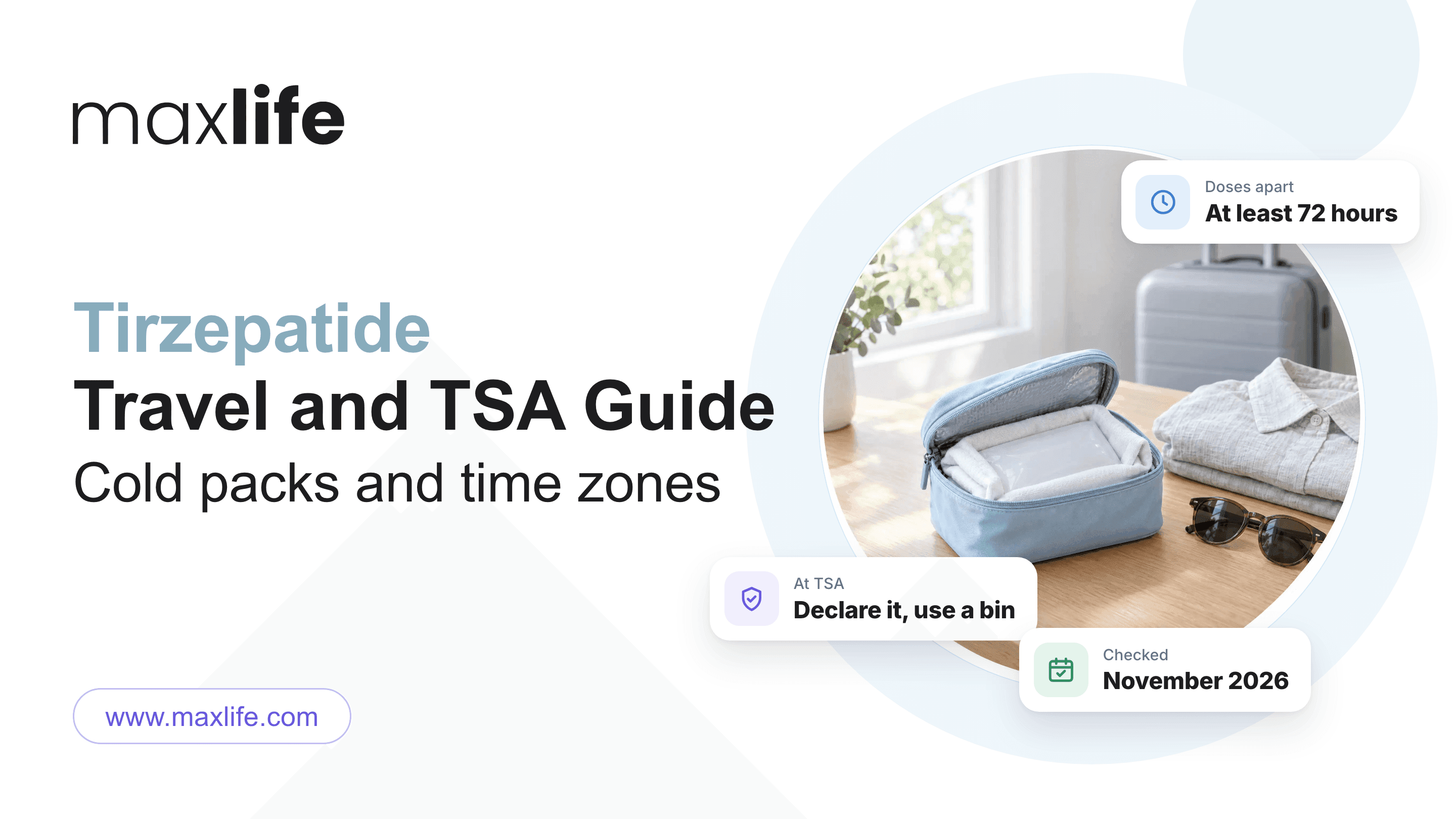
Yes, you can travel and fly with tirzepatide. Keep Zepbound®, Mounjaro® or compounded tirzepatide in your carry-on, tell the TSA officer you have medically necessary liquids and syringes before screening starts, and bring a cold pack: TSA accepts ice packs frozen, partly frozen or melted when they keep medicine cool. On the trip, brand single-dose pens and vials can stay out of the fridge at up to 86°F (30°C) for a total of 21 days, and KwikPens and multi-dose vials for up to 30 days, under the August 2026 labels. For compounded tirzepatide, follow the storage directions on your pharmacy's label.
The rules below come from TSA's own pages, the Zepbound prescribing information and Mounjaro prescribing information, the CDC and Lilly's travel advice, checked November 2026.
Can You Take Tirzepatide on a Plane?
Yes, in your carry-on or your checked bag, though the carry-on is the better choice (see below). TSA treats injectable medicine, like insulin, as a medically necessary liquid, so the 3.4-ounce limit doesn't apply to a Zepbound pen, a KwikPen or a vial. TSA "allows larger amounts of medically necessary liquids, gels, and aerosols in reasonable quantities for your trip, but you must declare them" at the checkpoint.
| What you pack | What TSA says |
|---|---|
| Pens, KwikPens and vials | Allowed in amounts reasonable for your trip. Declare them. |
| Unused syringes and needles | Allowed "when accompanied by injectable medication". Declare them. |
| Used syringes and needles | Allowed in a sharps disposal container or another hard-surface container. |
| Ice packs and gel packs | Allowed frozen, partly frozen or melted when they keep medicine cool. |
TSA recommends, but does not require, that your medicine be labeled. A pen in its carton or a vial with its pharmacy label makes screening faster. The final decision on any item rests with the officer at the checkpoint, so leave a little extra time.
How Do You Get Tirzepatide Through Airport Security?
Declare it, separate it, and let it be screened. These steps follow TSA's guidance for medications and medical conditions:
- Pack it to lift out. Keep the medicine, the cold pack, syringes or pen needles and swabs together in one pouch near the top of your carry-on.
- Tell the officer before screening begins that you have medically necessary liquids and syringes. Put them in a bin of their own, with the cold pack.
- Let it be screened. The officer may X-ray it, look at it or test it for traces of explosives. TSA says screening "will never include placing anything into the medically necessary liquid."
- Ask for a visual check if you prefer. You can tell the officer you don't want your medicine X-rayed or opened. TSA then takes other steps to clear it, which can include a pat-down and a closer look at your carry-on.
- Get help if you want it. You can tell the officer about your condition out loud, show the TSA Notification Card or show medical documentation. None of these is required. For a trained Passenger Support Specialist at the checkpoint, contact TSA Cares at (855) 787-2227 at least 72 hours before your flight.
Should Tirzepatide Go in Your Carry-On or Checked Bag?
Your carry-on. TSA allows medicine and syringes in checked bags, but Lilly's travel advice says not to pack tirzepatide there, because luggage hold areas can have wide changes in temperature that may be too cold or too hot for it. The CDC adds a practical reason: pack medicine in your carry-on in case your luggage is lost or delayed.
On a road trip, a bus or a train, the same rule applies: keep the medicine with you, not in the trunk, and never leave it in a parked car, which can pass 86°F within minutes. Our tirzepatide storage guide shows how fast a car heats up.
How Do You Keep Tirzepatide Cold While Traveling?
It depends on what you take.
Brand Zepbound and Mounjaro. Both labels (August 2026) say to keep them in the refrigerator at 36°F to 46°F (2°C to 8°C), in the original carton to protect them from light, and never to freeze them. When you need to, you can travel with them unrefrigerated, at up to 86°F (30°C):
- Single-dose pens and single-dose vials: up to a total of 21 days out of the fridge.
- KwikPens and multi-dose vials: up to 30 days at room temperature. Once opened, throw them away after a total of 30 days at room temperature, 30 days after first use or 4 weekly doses, whichever comes first.
The word "total" matters: under the current label, the days out of the fridge add up across your trip, so keep a note of them. Labels from before April 2026 said a single-dose pen or vial kept at room temperature "should not be returned to the refrigerator," and many travel guides still repeat that line. Our storage guide has the full table and what changed.
Compounded tirzepatide. Follow the storage directions on your pharmacy's label. The brand limits above don't apply to a compounded vial. If the label doesn't say how to travel with it, ask the pharmacy before you leave.
The cooler. Lilly doesn't test or recommend any particular travel cooler, but its medical team says that if you use one, make sure tirzepatide doesn't touch ice or frozen gel packs. Any insulated case works if a folded cloth or the carton sits between the cold pack and the medicine. When you arrive, put it in the refrigerator if your room has one, away from the freezer section and the back wall, where it could freeze.
Taking semaglutide instead? TSA screens it the way it screens tirzepatide, but the storage limits differ: see our guide to whether Ozempic® needs to be refrigerated.
What About Time Zones and Your Weekly Dose Day?
A weekly shot is forgiving: crossing time zones moves it by hours, while the label's rules are measured in days. The Zepbound and Mounjaro labels say you can change your dose day "as long as the time between the two doses is at least 3 days (72 hours)." A missed dose can still be taken within 4 days (96 hours) of your usual day; after that, skip it and take the next one on your usual day. The CDC's advice for any medicine is to time it by the time since your last dose, not the local time of day, and to ask your provider before you change your schedule.
Zepbound and Mounjaro labels
Your weekly dose window on a trip
Counted from your last shot. These limits matter far more than the hour on the clock.
- Days 0 to 3: too soonNever take a second dose within 72 hours of the last one, wherever the trip takes you.
- Days 3 to 7: moving your day earlier is allowedFlying on your dose day? The label lets you change the day as long as doses stay at least 72 hours apart.
- Days 7 to 11: late, still take itTake a missed dose as soon as you can within 4 days, or 96 hours, of your usual day.
- After day 11: skip itMore than 4 days late: skip that dose and take the next one on your usual day. Never double up.
Time zones A weekly shot taken on your usual day at local time moves by only as many hours as the time difference. The CDC advises timing medicine by the time since your last dose, not the local clock, and asking your provider before you change your schedule.
Zepbound and Mounjaro prescribing information, section 2.3, and Medication Guides, August 2026. CDC Travelers' Health, Traveling Abroad with Medicine. These are the brand labels' rules: for compounded tirzepatide, follow your prescriber's directions.
How that plays out on a trip, under the label's rules:
| Trip situation | What the label allows |
|---|---|
| You fly on your dose day | Take it before you leave or after you land. Either way, the gap from your last dose stays close to a week. |
| You cross many time zones | Keep your usual day at local time. The gap between doses changes by a few hours, not days. |
| You want a new dose day while away | Allowed if the two doses are at least 72 hours apart. Then keep the new day. |
| Your dose falls on a short trip without your medicine | Move your day earlier before you go, at least 72 hours after your last dose, or take it within 4 days of your usual day when you get home. |
| You'll be away for more than one dose | Plan with your provider before you go. |
If more than 2 weeks pass without a dose, message your provider or care team before you inject again. For the hour of day and other timing rules, see the best time to take tirzepatide. Compounded tirzepatide has no FDA label of its own, so your schedule comes from your prescriber: ask before you change it.
Can You Travel Internationally With Tirzepatide?
Usually, but every country sets its own rules for medicines. The CDC says a medicine commonly prescribed in the United States might be unlicensed or controlled somewhere else, and breaking a country's rules can mean having your medicine taken away, or penalties. Before you go, the CDC advises you to:
- Check with your destination's embassy, and the embassy of any country where you change planes, that your medicine is allowed.
- Ask your prescriber for a note, as the CDC suggests for injectable medicines, and bring copies of your prescriptions with the generic and brand names.
- Keep the medicine in its original, labeled packaging, with your full name, your provider's name and the exact dose.
- Pack enough for the whole trip plus extra for delays, and use only medicine you bring from home: counterfeit medicines are common in some countries.
The CDC Yellow Book adds that needles can draw extra attention at a destination, so keep them ready to show, and that mailing medicine to your destination is often illegal. Lilly suggests checking your airline's own policy on traveling with medicine too.
Coming home, U.S. Customs and Border Protection says to travel only with your own medicine, prescribed to you and legally obtained in the United States. In most cases it is illegal for a U.S. citizen to buy drugs abroad and bring them home for personal use.
What Should You Pack?
One small pouch covers most trips. Vials need syringes and needles, which aren't included with Zepbound vials, and a Zepbound KwikPen needs a new pen needle for every dose.
Packing list
What to pack when you travel with tirzepatide
Pens, KwikPens, brand vials and compounded vials alike.
Every trip
- Your medicine in its carton, or with its pharmacy label
- Enough doses for the whole trip, plus extra in case of delays
- An insulated case and a cold pack, wrapped so the medicine never touches the pack
- Supplies: syringes and needles for vials, new pen needles for a KwikPen, alcohol swabs
- A small travel sharps container for used needles
At the airport
- Everything in your carry-on, in one pouch you can lift out
- Tell the TSA officer before screening and use a separate bin
- Ask for a visual check instead of the X-ray if you prefer
- Optional: a TSA Notification Card or a note from your provider
Leaving the country
- A note from your prescriber for injectable medicine
- Copies of your prescriptions, with generic and brand names
- Your destination's rules, checked with its embassy, plus any layover country
- Medicine only from home: don't plan to buy it abroad or mail it ahead
TSA: medically necessary liquids, unused syringes, ice packs and screening options. CDC Travelers' Health and CDC Yellow Book 2026: carry-on, extra supply, labels, prescriber's note, embassy check, no mailing ahead. FDA: travel sharps container. Lilly: keep tirzepatide off ice and frozen gel packs. Checked November 2026.
Used needles go into a sharps container right away. The FDA suggests always carrying a small, travel-size sharps container and never putting loose needles in a hotel or public trash can. Once home, get rid of the container the way our injection guide explains.
Traveling With Compounded Tirzepatide From MaxLife
Compounded tirzepatide is prepared by a licensed pharmacy for one patient's prescription and is not FDA-approved, which means the FDA hasn't reviewed it for safety, effectiveness or quality. If an independent licensed provider prescribes it through MaxLife, a licensed partner pharmacy prepares it and ships it in a box packed with cold packs, with syringes, alcohol swabs and printed instructions, and you get tracking by email and text when it ships. The storage directions on that vial's pharmacy label are your rule at home and on the road. Draw each dose when you take it, rather than filling syringes ahead of a trip.
When members write to us about travel, they mostly ask how to keep the vial cold on the way and where a refill should go while they're away. Before each refill there is a short check-in that includes confirming your shipping address, so if you'll be somewhere else when a refill is due, tell your care team then.
Compounded tirzepatide through MaxLife is $120 a month, flat, the same price at every dose, with no membership fee. The price covers the medicine if prescribed, the online consultation, ongoing medical support, supplies and free expedited shipping. MaxLife is a patient management platform, not a pharmacy.
How we made this page: we researched it from the sources listed below. The MaxLife operations team reviews every page before it goes live, and a licensed clinician also reviews our medical articles.
Frequently Asked Questions
Compounded Tirzepatide: $120/mo Flat, All-Inclusive
MaxLife compounded tirzepatide: $120 a month, flat. All-inclusive, no membership fee, the same price at every dose. A licensed provider decides.
Check Your EligibilityThis article is for informational purposes only and is not a substitute for professional medical advice, diagnosis, or treatment. Individual results vary. Pricing, insurance coverage, and compounding regulations described here are subject to change; verify current details with your insurance provider, the manufacturer, or your prescriber before making treatment decisions. Compounded medications are not FDA-approved.
Sources
- TSA: Medications, Liquid (updated October 9, 2024)
- TSA: Unused Syringes
- TSA: Used Syringes
- TSA: Disabilities and Medical Conditions, medications, ice packs and screening
- TSA: Liquids, Aerosols, and Gels Rule
- TSA: Passenger Support and TSA Cares
- TSA Notification Card
- Zepbound prescribing information, Medication Guide and Instructions for Use, DailyMed, revised August 2026
- Mounjaro prescribing information, DailyMed, revised August 2026
- Lilly Canada: Travelling with Zepbound KwikPen
- Lilly Medical, UK: How should patients store the Mounjaro KwikPen during transport and travel?
- CDC Travelers' Health: Traveling Abroad with Medicine
- CDC Yellow Book 2026: Traveling with Prohibited or Restricted Medications
- U.S. Customs and Border Protection: Prohibited and Restricted Items, traveling with medication
- FDA: Best Way to Get Rid of Used Needles and Other Sharps
- FDA: Safely Using Sharps at Home, at Work and on Travel
Does Tirzepatide Go Bad? How Long It Lasts In and Out of the Fridge
October 16, 20268 min
Best Time to Take Tirzepatide: Morning, Night and Which Day
November 10, 20264 min
Zepbound KwikPen Explained: Doses, Price and How to Use It
November 15, 20268 min
How to Inject Tirzepatide: Step by Step, With a Vial or a Pen
November 20, 20268 min