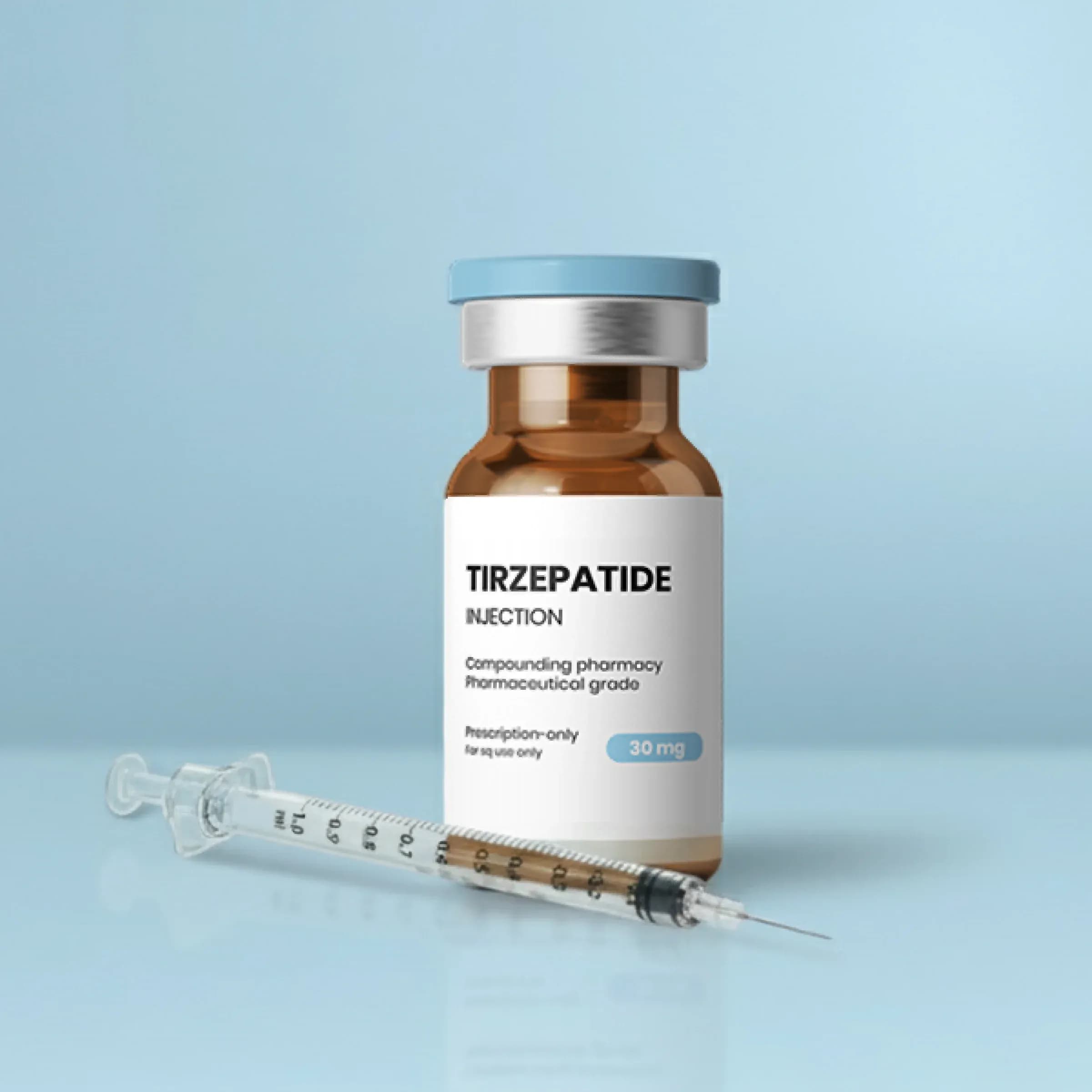
Zepbound Vials in 2026: LillyDirect Prices, Doses, and Vials vs Pens
Reviewed by the MaxLife operations team. Pricing is accurate as of November 2026 and subject to change.
Key Takeaways
- Lilly's savings cards cover only the single-dose pen and the KwikPen, so Zepbound vials are always self-pay; Lilly lists them as HSA/FSA eligible, depending on your plan.
- The Zepbound label also lists a 4-dose vial with 0.6 mL doses, but LillyDirect offered only single-dose vials when we checked in November 2026.
- If you pick up vials at a Walmart Pharmacy, Lilly says some states require a separate prescription for the syringes and needles.
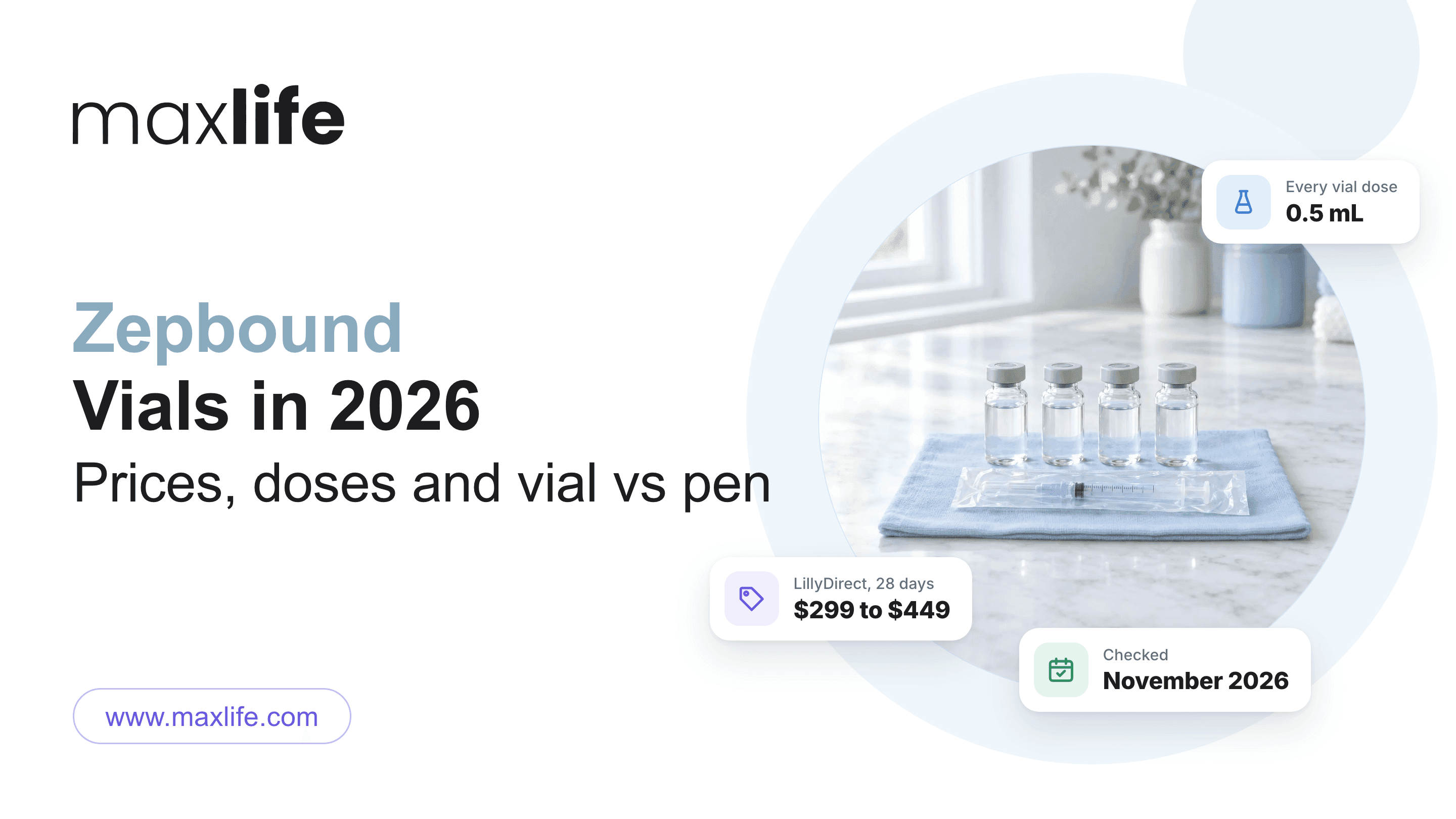
Zepbound® vials are small glass vials of tirzepatide that each hold one weekly dose. Eli Lilly sells them only through LillyDirect®, and only to people who pay cash. As of November 2026, a 28-day box of 4 vials costs $299 at the 2.5 mg starting dose, $399 at 5 mg and $449 at 7.5 mg to 15 mg if you refill within 45 days. Vials come in the same six strengths as the Zepbound pens. Every dose is 0.5 mL, and you draw it with your own syringe and needle, which are not in the box.
Zepbound is FDA-approved, with a reduced-calorie diet and more physical activity, for weight reduction and long-term maintenance in adults with obesity, or with overweight and at least one weight-related condition, and for moderate to severe obstructive sleep apnea in adults with obesity, according to the Zepbound label. It needs a prescription, and your provider decides which dose and device fit you.
How Much Do Zepbound Vials Cost?
Zepbound vials cost $299 to $449 for a 28-day supply at LillyDirect, depending on the strength, as long as you refill on time. That is $74.75 to $112.25 per weekly dose. These are the prices on Lilly's LillyDirect Zepbound page and in its full terms, read in November 2026:
| Vial strength | 4 vials (28 days) |
|---|---|
| 2.5 mg (starting dose) | $299 ($74.75 a dose) |
| 5 mg | $399 ($99.75 a dose) |
| 7.5 mg | $449 ($112.25 a dose) |
| 10 mg | $449 ($112.25 a dose) |
| 12.5 mg | $449 ($112.25 a dose) |
| 15 mg | $449 ($112.25 a dose) |
What changes what you pay:
- The 45-day refill rule. The $449 price at 7.5 mg to 15 mg is Lilly's Zepbound Self Pay Journey Program, which has applied since February 23, 2026. You keep it if you complete each refill purchase within 45 days of receiving your last box. Refill later and you pay the regular price: $499 at 7.5 mg ($124.75 a dose) or $699 at 10 mg to 15 mg ($174.75 a dose). New and existing patients qualify, and the 2.5 mg and 5 mg prices don't depend on timing.
- The starting dose is short. The label uses 2.5 mg for the first 4 weeks only and says it is not a maintenance dose. The maintenance doses for weight loss are 5 mg, 10 mg or 15 mg, so after the first box most people pay $399 or $449.
- A "month" is 28 days. A year of weekly doses takes 13 boxes, not 12. Our guide to Zepbound without insurance adds up a first year and compares every cash route.
- Supplies and fees are extra. Syringes, needles and your prescriber's fees are not in the price, and Lilly says taxes and fees may apply. Lilly can change or end these prices at any time.
- Insurance can't lower it. Lilly's savings cards, including the $25 card for people whose plan covers Zepbound, work only for the single-dose pen and the KwikPen®. Their terms say "Other methods of administration are not eligible for Program savings." Lilly does list the vials as HSA/FSA eligible, depending on your plan; see paying for GLP-1s with an HSA or FSA.
Who Can Buy Zepbound Vials?
Anyone with a valid Zepbound prescription can buy vials, but only from LillyDirect and only by paying cash. Lilly describes the vial as "exclusively available through LillyDirect" and "self-pay only." Having insurance doesn't stop you from buying them: Lilly's savings page offers the self-pay vial option to people with Medicare, to people with other government coverage such as Medicaid or TRICARE, and to people without insurance. You just can't bill the vials to a plan.
How an order works, according to LillyDirect:
- Your prescriber sends the prescription for Zepbound single-dose vials to LillyDirect Pharmacy.
- A dispensing pharmacy contacts you by text or email. LillyDirect works with four: Amazon Pharmacy, Fuze Health, Gifthealth and Walmart Pharmacy. They confirm your details and tell you when your order is ready for checkout.
- You pay the self-pay price and choose free home delivery or free pickup at a Walmart Pharmacy. Syringes and needles can be added at checkout.
For what Costco, Walmart, Kroger and Walgreens charge for Zepbound, see our guide to Zepbound retail prices.
Two groups may pay less with another Zepbound device. If you have Medicare Part D and take Zepbound for weight management, the Medicare GLP-1 Bridge has a $50 copay, but for Zepbound it covers only the KwikPen. If your commercial plan covers Zepbound, Lilly says the single-dose pen with its savings card "could be the most cost-effective option for you."
What Do You Need to Inject From a Zepbound Vial?
You need a new syringe and needle for every dose, because neither comes with the vial. The label's example is "a 1 mL syringe capable of measuring a 0.5 mL or 0.6 mL dose," and Lilly's vial instructions say to use the syringe and needle your healthcare provider recommends. For each weekly dose, set out:
- 1 Zepbound single-dose vial
- 1 new syringe and 1 new needle (some syringes come with the needle attached)
- 1 alcohol swab and a piece of gauze
- a sharps disposal container for the used needle and syringe (FDA)
LillyDirect sells injection supplies at checkout, or you can buy them at a local pharmacy or online. KwikPen pen needles are a different product and don't work with vials. If you pick up your vials at a Walmart Pharmacy, Lilly's prescribing guide says some states require a separate prescription for the syringes and needles, so ask your prescriber about it when the vials are prescribed.
Every dose is 0.5 mL. Each single-dose vial holds one 0.5 mL dose whatever its strength, so you draw to the 0.5 mL line whether the vial says 2.5 mg or 15 mg. The strength is printed on the vial label, which is why you check it every week. Syringes marked in units are usually U-100, where 100 units fill 1 mL, the scale the FDA describes, so 0.5 mL is the 50-unit line. Our tirzepatide injection guide walks through Lilly's steps for drawing and injecting from a Zepbound vial, and the label says your provider should show you before your first dose.
Zepbound Vial vs KwikPen vs Single-Dose Pen
All three hold the same medicine in the same six strengths, and the dose schedule is "the same, regardless of device," Lilly says. They differ in how much liquid you inject, how you measure it, how long they keep out of the refrigerator and how you can pay.
Zepbound label · LillyDirect
One weekly dose, three devices
Same medicine, same six strengths from 2.5 mg to 15 mg. What changes is how you measure, store and pay for each dose.
Single-dose vial
Zepbound vial
- Doses
- 1 per vial4 vials last 28 days
- Each dose
- 0.5 mLYou draw it into your own syringe
- Needle
- New syringe and needle every weekNot in the box; sold separately
- Out of the fridge
- Up to 21 days in totalAt up to 86°F; refrigerate otherwise
- Where to buy
- LillyDirect onlyHome delivery or Walmart Pharmacy pickup
- How you pay
- Self-pay only: $299 to $449 for 28 days*Lilly's savings cards don't cover vials
KwikPen®
Zepbound KwikPen
- Doses
- 4 per pen1 pen lasts 28 days
- Each dose
- 0.6 mLThe pen measures it when you dial
- Needle
- New pen needle every weekSold separately; prime before each dose
- Out of the fridge
- Up to 30 daysAt up to 86°F, opened or not
- Where to buy
- LillyDirect and other pharmaciesDelivery or pharmacy pickup
- How you pay
- Self-pay: $299 to $449 for 28 days*Lilly self-pay card elsewhere; Medicare GLP-1 Bridge $50
Single-dose pen
Zepbound single-dose pen
- Doses
- 1 per pen4 pens last 28 days
- Each dose
- 0.5 mLGiven automatically when you press
- Needle
- Built in and hiddenNothing to attach
- Out of the fridge
- Up to 21 days in totalAt up to 86°F; refrigerate otherwise
- Where to buy
- LillyDirect and other pharmaciesMainly with insurance
- How you pay
- As little as $25 with coverageWith Lilly's card; as low as $499 if your commercial plan doesn't cover it
*$449 at 7.5 mg to 15 mg when you refill within 45 days; $499 at 7.5 mg or $699 at 10 mg to 15 mg after that. Sources: Zepbound prescribing information and Instructions for Use, label revised August 2026; LillyDirect and Lilly's savings terms, read November 2026. Lilly's savings cards end December 31, 2026; the Medicare GLP-1 Bridge covers only the KwikPen, for weight management. Prices can change.
Which one fits depends mostly on how you pay:
- Paying cash at LillyDirect: the vial and the KwikPen cost the same. The vial needs a syringe and a few more steps each week; the KwikPen measures the dose for you and keeps longer out of the fridge. Our Zepbound KwikPen guide explains how it works.
- Paying cash at another pharmacy: the KwikPen. Vials are sold only through LillyDirect.
- Commercial insurance that covers Zepbound: usually the single-dose pen, which can cost as little as $25 with Lilly's savings card through December 31, 2026.
- Medicare, for weight management: the KwikPen, through the Medicare GLP-1 Bridge.
- Not comfortable handling needles: the single-dose pen, which hides its needle.
If your device changes, the label asks your provider to train you on the new one. Watch the volume: a single-dose vial dose is 0.5 mL, while a KwikPen dose is 0.6 mL.
Is There a Multi-Dose Zepbound Vial?
The Zepbound label lists one, but LillyDirect doesn't sell it. The current label (August 2026 revision) describes a multi-dose vial with 4 weekly doses: 2.4 mL of solution and 0.6 mL per dose, in the same six strengths (for example, 40 mg in 2.4 mL for four 10 mg doses). Unlike the single-dose vial, it contains benzyl alcohol, glycerin and phenol, and an opened one is thrown away after 4 doses, 30 days after first use or a total of 30 days at room temperature. When we checked in November 2026, LillyDirect's Zepbound page offered only the single-dose vial, the KwikPen and the single-dose pen. If you are ever prescribed a 4-dose vial, follow its own Instructions for Use, which draw 0.6 mL, not 0.5 mL.
How Long Does a Zepbound Vial Last?
One vial is one dose. You use it when you open it and then throw it away, even if liquid is left, and a box of 4 covers 28 days. Before it is opened, the label says:
- In the refrigerator at 36°F to 46°F (2°C to 8°C), in its carton to protect it from light, a vial keeps until the expiration date.
- Out of the refrigerator, at up to 86°F (30°C), each vial can be kept for up to a total of 21 days. After that, throw it away.
- Never freeze it. Don't use a vial that has frozen, looks cloudy or has particles. The liquid should be clear and colorless to slightly yellow.
Can you get an extra dose from a vial? No. Some people see liquid left after drawing 0.5 mL, but Lilly's instructions say to "throw away all opened vials after use, even if there is medicine left in the vial." Our tirzepatide storage guide covers heat, travel and what to do if a vial was left out.
Zepbound Vials or Compounded Tirzepatide?
For people paying cash, compounded tirzepatide usually costs less than Zepbound vials, but it is a different product. Compounded tirzepatide is prepared by a licensed pharmacy for one patient's prescription. It is not FDA-approved, which means the FDA does not review it for safety, effectiveness or quality before it is sold (FDA). It is not Zepbound, there is no FDA-approved generic of Zepbound, and Zepbound's trial results have not been shown for compounded tirzepatide. Our comparison of compounded tirzepatide and Zepbound explains the differences.
| Zepbound vials at LillyDirect | MaxLife compounded tirzepatide |
|---|---|
| Price: $299 to $449 for 28 days, by dose | Price: $120 a month, flat, the same at every dose |
| Covers: the medicine | Covers: the medicine if prescribed, an online consultation, ongoing medical support, supplies and free expedited shipping |
| Syringes: bought separately | Syringes: included, with alcohol swabs |
| FDA status: FDA-approved | FDA status: not FDA-approved |
| Prescriber: your own, plus any visit fees | Prescriber: a licensed provider from our network reviews your intake |
At MaxLife, compounded tirzepatide is $120 a month, flat, with no membership fee and no hidden fees. A licensed provider from our network reviews your online intake, which takes about 2 minutes, and decides whether it is right for you. Licensed partner pharmacies prepare and ship it, packed with cold packs; MaxLife is a patient management platform, not a pharmacy or a drug maker. If you already take Zepbound, you can send proof of your current prescription and the date of your last injection, so the provider can consider your current dose: keeping their dose is one of the things people switching to MaxLife ask about most. Compounded tirzepatide comes in a multi-dose vial, and the number of units you draw depends on the concentration printed on its pharmacy label, so you follow that label and your prescriber's instructions. Our tirzepatide dosage chart explains why.
Zepbound is the better route for some people: if your insurance covers it and the savings card brings it to $25, if you qualify for the Medicare GLP-1 Bridge, if you need its sleep apnea approval, or if you prefer an FDA-approved medicine. MaxLife offers compounded tirzepatide only, not Zepbound. If you are weighing other medicines, see our list of Zepbound alternatives.
How we made this page: we researched it from the sources listed below. The MaxLife operations team reviews every page before it goes live, and a licensed clinician also reviews our medical articles.
Frequently Asked Questions
Compounded Tirzepatide: $120/mo Flat, All-Inclusive
MaxLife compounded tirzepatide: $120 a month, flat. All-inclusive, no membership fee, the same price at every dose. A licensed provider decides.
Check Your EligibilityThis article is for informational purposes only and is not a substitute for professional medical advice, diagnosis, or treatment. Prices, coverage and compounding rules change; confirm current details with your prescriber, LillyDirect or your plan before you decide. Compounded medications are not FDA-approved.
Sources
- LillyDirect: Zepbound self-pay prices for the single-dose vial, KwikPen and single-dose pen (November 2026)
- LillyDirect: Zepbound full terms and conditions, including the Self Pay Journey Program (November 2026)
- Lilly: Zepbound coverage and savings options by insurance type (November 2026)
- Zepbound (tirzepatide) prescribing information, Medication Guide and Instructions for Use, label revised August 2026, DailyMed
- Lilly: LillyDirect Prescribing Guide for Zepbound, July 2026 (linked from LillyDirect)
- FDA: Best way to get rid of used needles and other sharps
- FDA: Dosing errors associated with compounded semaglutide, U-100 syringe units (2024 alert)
- FDA: FDA's concerns with unapproved GLP-1 drugs used for weight loss
- CMS: Medicare GLP-1 Bridge
How Much Is Zepbound Without Insurance? Prices and Savings Card Rules
November 14, 20268 min
Zepbound KwikPen Explained: Doses, Price and How to Use It
November 15, 20268 min
How to Inject Tirzepatide: Step by Step, With a Vial or a Pen
November 20, 20268 min
Tirzepatide vs Zepbound: Brand and Compounded Explained
November 5, 20268 min