Zepbound vs Mounjaro: What's the Difference?
Medically reviewed by Dr. Kavya Patel, MD. Pricing is accurate as of November 2026 and subject to change.
Key Takeaways
- Zepbound and Mounjaro both contain tirzepatide and are both made by Eli Lilly. They differ in FDA-approved uses, who can take them, the forms sold, price and insurance coverage.
- Zepbound is approved for weight management and, since December 20, 2024, for moderate to severe sleep apnea in adults with obesity. Mounjaro is approved for type 2 diabetes in adults and children 10 and older and, since August 27, 2026, for lowering heart attack and stroke risk in adults with type 2 diabetes.
- As of November 2026, LillyDirect sells Zepbound vials and KwikPens for $299 to $449 a month with on-time refills and Mounjaro pens for $499 a month. A late Zepbound refill at 10 mg or more costs $699.
- Medicare Part D can cover Mounjaro for type 2 diabetes and Zepbound for sleep apnea. The $50 Medicare GLP-1 Bridge covers only the Zepbound KwikPen for weight management, not Mounjaro.
- In SURMOUNT-1, adults taking Zepbound lost 15.0% to 20.9% of body weight over 72 weeks. Prescribing Mounjaro only for weight is off-label in the US, and neither brand is stronger at a given dose.
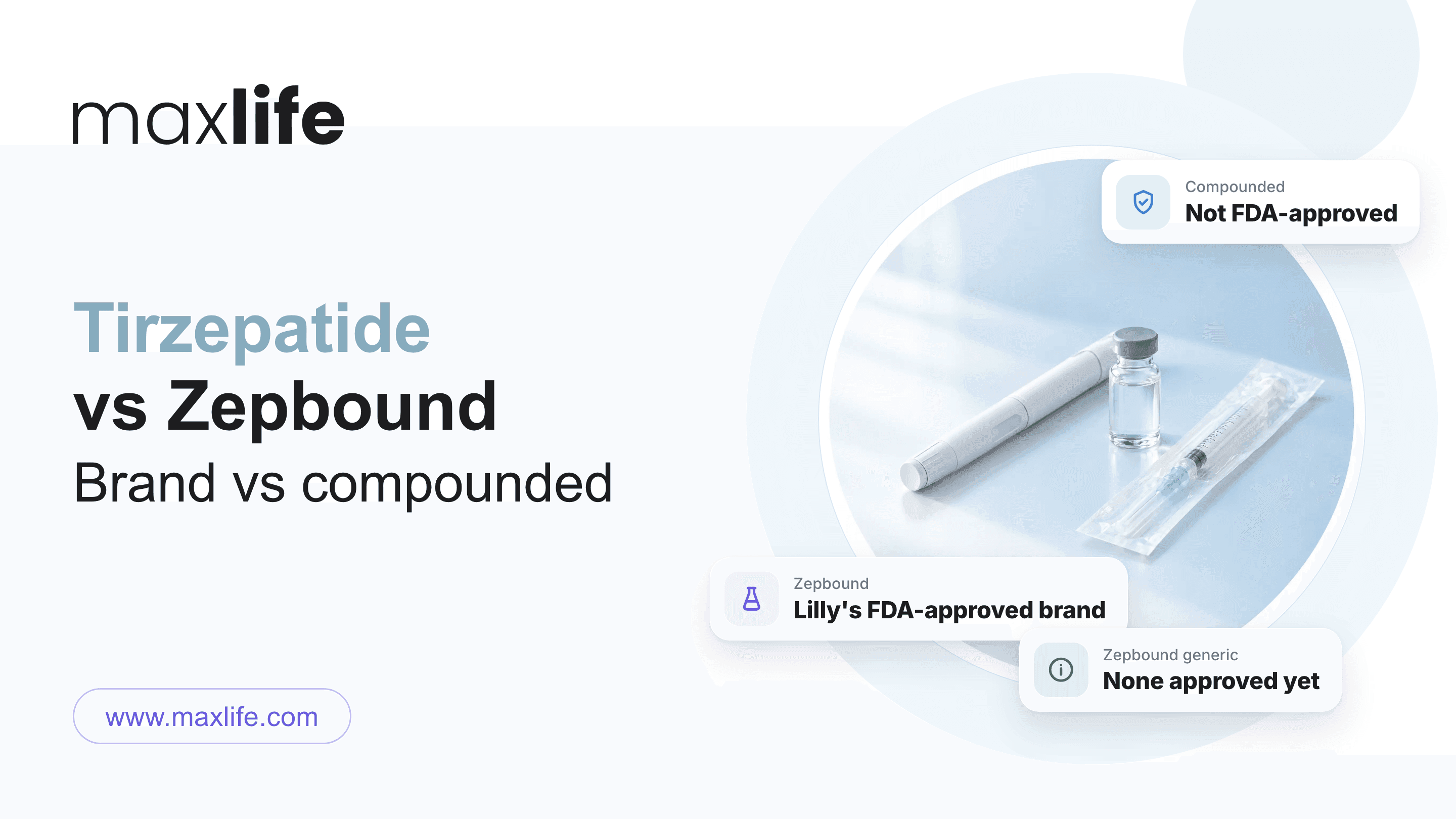
- Compounded tirzepatide is not FDA-approved and is not Zepbound or Mounjaro; no FDA-approved generic of either exists. At MaxLife it costs $120 a month, flat.
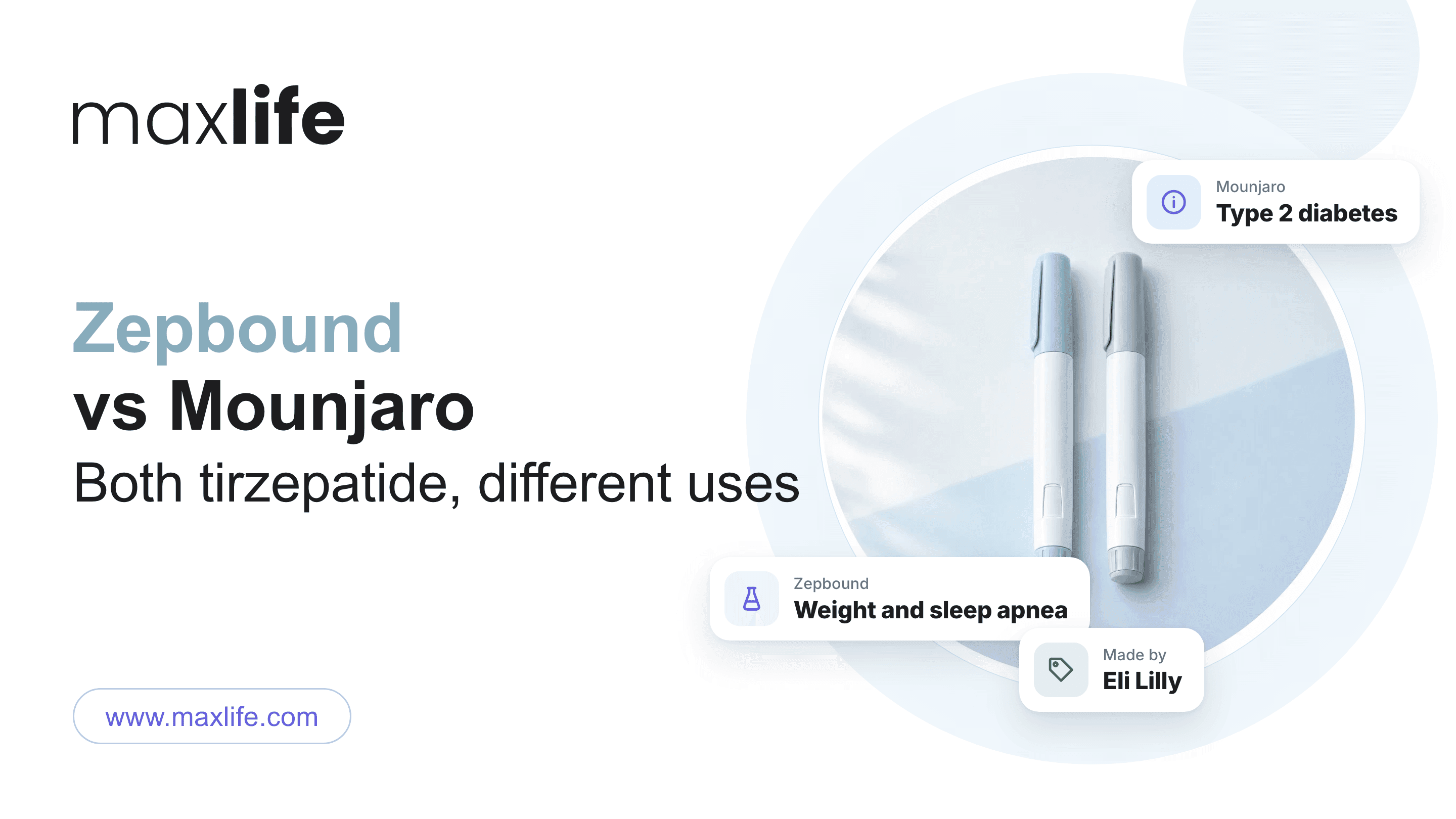
Zepbound and Mounjaro are both tirzepatide, made by Eli Lilly, and both are once-weekly injections from 2.5 mg to 15 mg. What differs is the FDA approval behind each brand, and with it the price and insurance coverage. As of November 2026, self-pay Zepbound costs $299 to $449 a month from LillyDirect and Mounjaro costs $499 a month. Zepbound is approved for weight management and, since December 20, 2024, for moderate to severe obstructive sleep apnea in adults with obesity. Mounjaro is approved for type 2 diabetes and, since August 27, 2026, for lowering the risk of heart attack, stroke and cardiovascular death in adults with type 2 diabetes (Drugs@FDA). Insurance and Medicare generally cover each brand for its own approved uses.
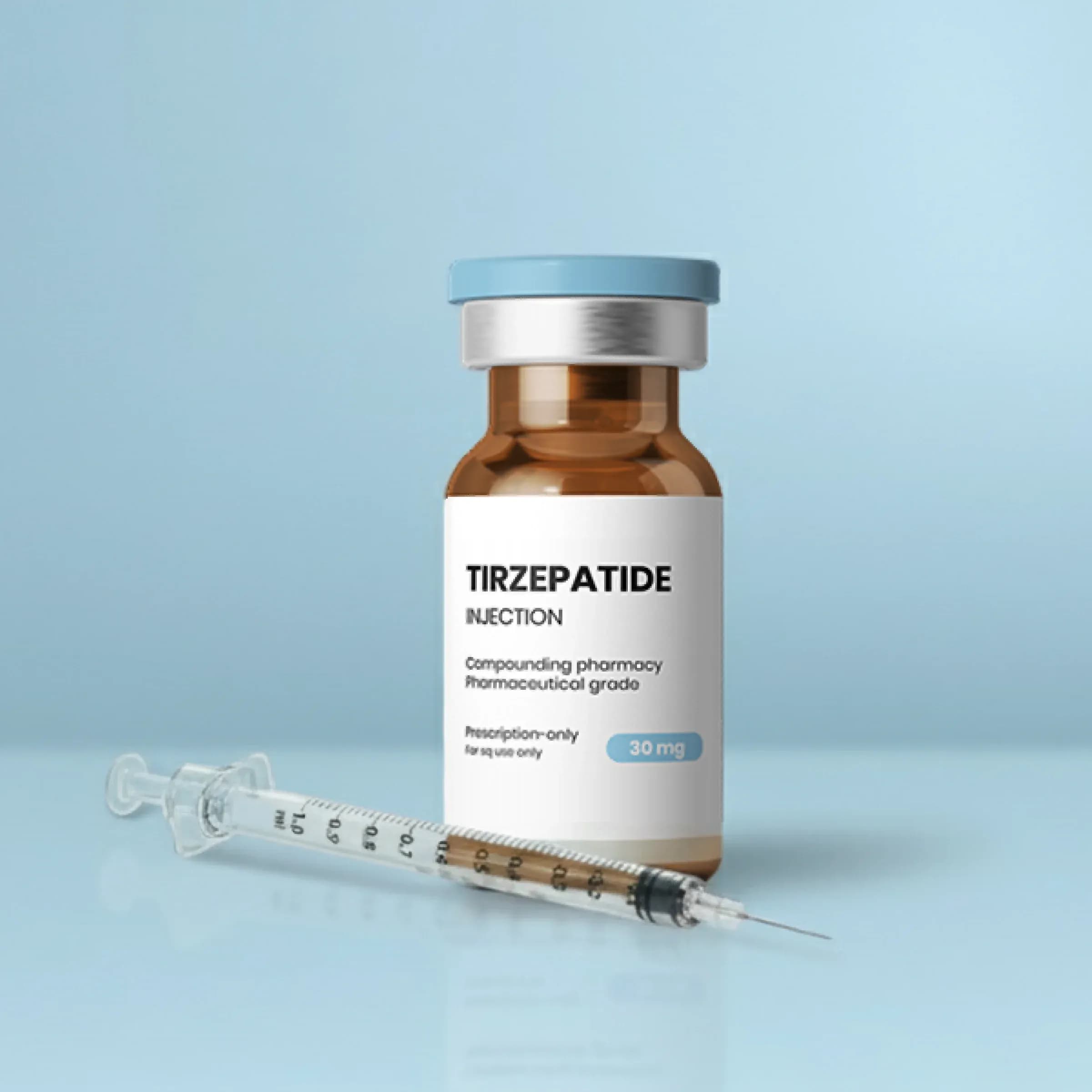
If you're paying cash for weight loss, there is a third route: compounded tirzepatide, $120 a month, flat, at MaxLife. It is not FDA-approved, and it is not Zepbound or Mounjaro; the compounded section below explains the difference.
Zepbound vs Mounjaro at a Glance
| Zepbound | Mounjaro | |
|---|---|---|
| Medicine and maker | Tirzepatide, Eli Lilly | Tirzepatide, Eli Lilly |
| FDA-approved for | Weight management; moderate to severe sleep apnea in adults with obesity | Blood sugar control in type 2 diabetes; lowering heart attack, stroke and cardiovascular death risk in adults with type 2 diabetes |
| First approved | November 8, 2023 | May 13, 2022 |
| Approved for weight loss | Yes | No (off-label for weight alone) |
| Who | Adults | Adults, and children 10 and older with type 2 diabetes |
| Weekly doses | 2.5 mg to 15 mg | 2.5 mg to 15 mg (children up to 10 mg) |
| Self-pay at LillyDirect | Vial or KwikPen: $299 to $449 a month | Single-dose pen: $499 a month |
| List price, 28 days | $1,087 | $1,112.16 |
| Medicare | Part D for sleep apnea; KwikPen in the $50 GLP-1 Bridge for weight | Part D for type 2 diabetes; not in the Bridge |
Sources: the Zepbound and Mounjaro labels (both revised August 2026), Drugs@FDA, LillyDirect, TrumpRx (Zepbound, Mounjaro) and CMS. Prices as of November 2026.
Is Mounjaro the Same as Zepbound?
Not exactly. Mounjaro and Zepbound both contain tirzepatide and are both made by Eli Lilly, but they are separate FDA-approved products, each with its own label, approved uses, prescription and price.
Tirzepatide was first approved as Mounjaro, for type 2 diabetes, on May 13, 2022. For weight management, Lilly filed a separate application, which the FDA's database lists as a new indication submitted as a distinct application, and the FDA approved it as Zepbound on November 8, 2023. Novo Nordisk sells semaglutide the way Lilly sells tirzepatide: Ozempic for diabetes, Wegovy for weight.
In practice, the brand name matters more than the shared medicine. Your prescription names one brand, insurers decide coverage brand by brand, and Lilly sells and prices the two differently. So the honest answer to "Is Zepbound exactly the same as Mounjaro?" is that the medicine inside is tirzepatide in both, and almost everything around it differs.
What Is the Difference Between Mounjaro and Zepbound?
Mounjaro and Zepbound differ in six ways that matter to patients:
- Approved uses. Zepbound's label covers weight loss and maintenance in adults with obesity, or with overweight and at least one weight-related condition, and moderate to severe sleep apnea in adults with obesity, both with diet and activity. Mounjaro's label covers blood sugar control in type 2 diabetes and lowering major heart-event risk in adults with type 2 diabetes at high risk.
- Who can take it. Zepbound is for adults. Since December 2025, Mounjaro is also approved for children 10 and older with type 2 diabetes, at up to 10 mg a week.
- How the dose is set. Both start at 2.5 mg once a week and rise in 2.5 mg steps no sooner than every 4 weeks, to a maximum of 15 mg. Zepbound's label names maintenance doses of 5 mg, 10 mg or 15 mg (10 mg or 15 mg for sleep apnea) and says 2.5 mg is only a starting dose. Mounjaro's label raises the dose "if additional glycemic control is needed." Our tirzepatide dosage chart lays out both schedules.
- The forms you can buy. Both labels list four forms: a single-dose pen, a single-dose vial, a 4-dose vial and a 4-dose KwikPen. As of November 2026, LillyDirect sells Zepbound self-pay as single-dose vials and as the KwikPen, with home delivery or pickup at Walmart Pharmacy, and sells Mounjaro self-pay only as the single-dose pen.
- Price. Self-pay Zepbound costs $299 to $449 a month; self-pay Mounjaro costs $499.
- Coverage. Private plans, Medicare and Medicaid cover each brand for its own approved uses, so one person can be covered for one brand and denied the other.
Is Zepbound or Mounjaro Better for Weight Loss?
Neither brand is stronger: a 10 mg dose of Zepbound and a 10 mg dose of Mounjaro are both 10 mg of tirzepatide. What differs is the evidence on each label. Zepbound is the brand approved for weight loss, so its label carries the weight-loss trials:
- In SURMOUNT-1, 2,539 adults without diabetes taking Zepbound lost an average of 15.0%, 19.5% and 20.9% of their body weight at 5 mg, 10 mg and 15 mg over 72 weeks, compared with 3.1% on placebo.
- In SURMOUNT-2, 938 adults with obesity or overweight and type 2 diabetes taking Zepbound lost 12.8% at 10 mg and 14.7% at 15 mg over 72 weeks, compared with 3.2% on placebo.
Mounjaro's trials were built to measure blood sugar. In SURPASS-2, adults with type 2 diabetes taking Mounjaro lowered their A1C by 2.01 to 2.30 percentage points over 40 weeks, more than with semaglutide 1 mg, and lost more weight too. Weight loss is a known effect of Mounjaro, but prescribing it only for weight is off-label in the United States.
In these studies, adults with type 2 diabetes lost less weight on average than adults without it, and trial averages don't predict how any one person will respond. For tirzepatide against semaglutide, including Mounjaro vs Wegovy, see our Zepbound vs Wegovy comparison.
Which Is Cheaper, Zepbound or Mounjaro?
Zepbound is cheaper for most people paying cash. As of November 2026, LillyDirect lists Zepbound vials and KwikPens at $299 to $449 a month and Mounjaro pens at $499 a month for each strength. List prices are close: $1,087 for 28 days of Zepbound and $1,112.16 for Mounjaro, as shown on TrumpRx.gov.
| Route (November 2026) | Zepbound | Mounjaro |
|---|---|---|
| List price, 28 days | $1,087 | $1,112.16 |
| LillyDirect self-pay, refill within 45 days | $299 (2.5 mg), $399 (5 mg), $449 (7.5 mg to 15 mg) | $499 for each strength |
| LillyDirect self-pay, late refill | $499 (7.5 mg) or $699 (10 mg to 15 mg) | $499 |
| Plan covers it, with Lilly's savings card | As little as $25 for 1 to 3 months | As little as $25 for 1 to 3 months |
| Plan doesn't cover it, with Lilly's savings card | KwikPen from $299; single-dose pen from $499 | Single-dose pen from $499 |
| Medicare | $50 a month for the KwikPen through the GLP-1 Bridge, if eligible | Your Part D copay, for type 2 diabetes |
Sources: LillyDirect, Lilly's savings terms (Zepbound, Mounjaro), TrumpRx and CMS. Savings cards require commercial insurance and exclude Medicare, Medicaid and other government coverage.
Why is Zepbound cheaper than Mounjaro? The medicine isn't what differs; Lilly's offers are. Lilly sells Zepbound self-pay in vials and KwikPens at dose-based prices, and Mounjaro self-pay only as the single-dose pen, at one price. Three details change the math:
- The $449 price needs on-time refills. If you refill Zepbound more than 45 days after your last fill, 10 mg to 15 mg costs $699, more than Mounjaro's $499.
- Over a year, the gap is about $850. Thirteen 28-day fills of Zepbound, stepping up from 2.5 mg to 5 mg to 7.5 mg or more with on-time refills, cost about $5,637. Thirteen fills of Mounjaro cost $6,487.
- Supplies are extra. Zepbound vials need syringes and the KwikPen needs pen needles; the single-dose pen of either brand has its needle built in.
Lilly's current savings-card terms for both brands end December 31, 2026, so check prices again in January. Every route, including insurance and compounded options, is in our tirzepatide cost breakdown.
Why Does Insurance Cover Mounjaro but Not Zepbound?
Coverage follows the approved use on the label. Diabetes medicines are a standard benefit, while many plans exclude drugs used for weight loss: in 2026, only 18% of firms with 200 or more workers covered GLP-1 drugs used mainly for weight loss, according to KFF's employer survey. So a plan can cover Mounjaro for type 2 diabetes and deny Zepbound for weight, and plans often require a type 2 diabetes diagnosis before they approve Mounjaro.
Medicare splits the two brands by condition:
- Part D plans can cover Mounjaro for type 2 diabetes and Zepbound for moderate to severe sleep apnea. Lilly says about 8 in 10 Medicare Part D patients pay $0 to $50 for a 28-day supply of Mounjaro.
- The Medicare GLP-1 Bridge, a CMS program that runs from July 1, 2026 to December 31, 2027, covers weight-management use for a $50 copay. It includes the Zepbound KwikPen, but not Zepbound vials or single-dose pens, and not Mounjaro (CMS). You need a BMI of 35 or more, or a lower BMI with certain conditions such as prediabetes, a past heart attack or uncontrolled high blood pressure (Medicare.gov).
- People with type 2 diabetes, moderate to severe sleep apnea or MASH liver disease can't use the Bridge. CMS says their Part D plan may cover a GLP-1 for those conditions instead.
Medicaid also goes by condition: programs must cover drugs for approved uses such as diabetes, and Zepbound for sleep apnea, while covering weight-loss drugs is each state's choice (KFF).
Your prescription and any prior authorization must match the conditions you actually have. If you're denied, the options are the brand your diagnosis supports, an appeal or a self-pay route. Our guide to weight-loss drugs covered by insurance explains coverage by plan type.
Which One Is Approved for Sleep Apnea, Diabetes or Heart Risk?
Zepbound is the only one approved for sleep apnea. Mounjaro is the only one approved to treat type 2 diabetes and to lower heart risk.
- Sleep apnea. The FDA approved Zepbound for moderate to severe obstructive sleep apnea in adults with obesity on December 20, 2024, calling it "the first drug treatment option for certain patients" with the condition. The label's sleep apnea maintenance dose is 10 mg or 15 mg. The sleep apnea trials didn't include people with type 2 diabetes.
- Type 2 diabetes. Mounjaro is approved to improve blood sugar in adults and, since December 2025, in children 10 and older. Zepbound isn't approved to treat diabetes, but its weight-management approval includes adults with type 2 diabetes, who were studied in SURMOUNT-2. An adult with both conditions may be a candidate for either brand, and coverage often decides.
- Heart risk. Since August 27, 2026, Mounjaro is approved to lower the risk of heart attack, stroke and cardiovascular death in adults with type 2 diabetes at high risk. The approval rests on SURPASS-CVOT, which followed 13,299 adults with type 2 diabetes and heart or blood vessel disease for a median of about 4 years. Mounjaro was non-inferior to dulaglutide (Trulicity), with a hazard ratio of 0.92, but did not prove superior. Zepbound has no heart indication.
MaxLife does not diagnose or treat sleep apnea. If you have sleep apnea or type 2 diabetes, ask the doctor who treats it which brand fits.
Can You Switch From Mounjaro to Zepbound?
Yes, with a new prescription, but neither label describes how to move from one brand to the other, so your prescriber decides the dose and the timing. Some online answers, including Google's AI summary, say you never need to restart at 2.5 mg. That is your prescriber's call, based on your current dose, the time since your last injection and how well you have tolerated it.
The label rules that apply to any switch:
- Don't overlap. The Zepbound label says not to use it with other tirzepatide products or any GLP-1 medicine. You can't take Mounjaro and Zepbound together; one replaces the other.
- Keep the timing rules. Both labels say to take a missed dose within 4 days (96 hours), or skip it after that, and to keep at least 3 days (72 hours) between doses if your injection day changes.
- Learn the new device. Both labels call for training whenever the form changes, for example from a single-dose pen to a vial or KwikPen. Single-dose pens and vials hold 0.5 mL; each KwikPen or 4-dose vial dose is 0.6 mL.
- Check coverage first. A new brand usually means a new insurance review, and the Medicare GLP-1 Bridge covers only the Zepbound KwikPen.
Moving the other way, from Zepbound to Mounjaro, works by these rules too, and it usually comes up after a type 2 diabetes diagnosis.
Do Zepbound and Mounjaro Have Different Side Effects?
Zepbound and Mounjaro have the side effects of tirzepatide, but their labels report different rates, because the trials behind each label enrolled different people. Nausea, diarrhea, vomiting and constipation are common with both.
| Side effect (label trials) | Zepbound vs placebo | Mounjaro vs placebo |
|---|---|---|
| Nausea | 25% to 29% vs 8% | 12% to 18% vs 4% |
| Diarrhea | 19% to 23% vs 8% | 12% to 17% vs 9% |
| Vomiting | 8% to 13% vs 2% | 5% to 9% vs 2% |
| Constipation | 11% to 17% vs 5% | 6% to 7% vs 1% |
The Zepbound figures come from two 72-week weight-loss trials; the Mounjaro figures come from two diabetes trials, one of them in people also using insulin. As the labels note, rates from different trials can't be compared directly.
Both labels carry a boxed warning about thyroid C-cell tumors seen in rats, and neither brand should be used by people with a personal or family history of medullary thyroid carcinoma or MEN 2. Both warn about pancreatitis, gallbladder problems, kidney problems from dehydration, severe stomach problems and low blood sugar when combined with insulin or a sulfonylurea. Both say oral birth control may work less well: switch to a non-oral method or add a barrier method for 4 weeks after starting and after each dose increase.
One label difference is pregnancy. Zepbound's label says "weight loss offers no benefit to a pregnant patient" and to stop Zepbound when a pregnancy is recognized. Mounjaro's label says to use it in pregnancy only if the benefit justifies the risk, because poorly controlled diabetes carries risks too.
Storage now matches: both current labels let you keep a single-dose pen or vial out of the fridge, at up to 86°F, "for up to a total of 21 days." In April 2026, Zepbound's label dropped its older instruction not to return a pen or vial to the refrigerator. Talk to your provider about any side effect that worries you.
Why Do UK Articles Call Mounjaro a Weight-Loss Drug?
In the United Kingdom, tirzepatide for weight loss is sold under the Mounjaro name. The UK regulator, the MHRA, authorized Mounjaro for weight management in adults on November 8, 2023, the day the FDA approved Zepbound in the US.
So when a British site discusses "Mounjaro for weight loss," it describes the use Americans get as Zepbound. Its prices, pharmacy rules and NHS criteria don't apply in the US, where Mounjaro is approved for type 2 diabetes and prescribing it only for weight is off-label.
UK and US pages also quote different trial numbers. For the 15 mg dose in SURMOUNT-1, the MHRA cites 22.5% weight loss, an estimate for people who kept taking the medicine as directed; the US Zepbound label reports 20.9%, counting everyone assigned to that dose. Both figures come from one trial, so a page showing both isn't contradicting itself.
Where Does Compounded Tirzepatide Fit?
Compounded tirzepatide is neither Zepbound nor Mounjaro. Compounded tirzepatide is prepared by a licensed pharmacy for one patient's prescription and is not FDA-approved, which means the FDA hasn't reviewed it for safety, effectiveness or quality. It is not made by Eli Lilly, and it is not a generic: as of November 2026, the FDA has approved no generic of Zepbound or Mounjaro, and the FDA's compounding Q&A says a compounded drug is not an FDA-approved generic.
It also differs in practice. Compounded tirzepatide usually comes in a multi-dose vial at a concentration the pharmacy sets. In an August 12, 2026 letter to state medical boards, the FDA noted that some come at 17 mg/mL, so dose volumes are not interchangeable with Lilly's products. The SURMOUNT and SURPASS results above belong to Zepbound and Mounjaro; these results have not been shown for compounded tirzepatide. The FDA says compounded drugs should only be used when an FDA-approved drug can't meet a patient's medical needs, and a licensed provider makes that call for each patient.
Price is the reason people ask. At MaxLife, compounded tirzepatide costs $120 a month, flat, billed every 3 months ($360), with no membership fee. Be clear about the trade: you pay less than for self-pay Zepbound or Mounjaro, and you give up FDA approval, insurance coverage and a prefilled pen. Our guide to tirzepatide vs Zepbound explains the brand and compounded differences in detail.
Zepbound or Mounjaro: Which Should You Ask About?
Your diagnosis and how you'll pay decide which brand to ask about. Use this as a starting point with your prescriber:
- Type 2 diabetes with insurance: ask about Mounjaro, the brand approved for diabetes. With commercial coverage, Lilly's savings card can bring it to as little as $25.
- Type 2 diabetes with heart or blood vessel disease: Mounjaro is the tirzepatide brand with a heart-risk indication.
- A child 10 or older with type 2 diabetes: only Mounjaro is approved for children.
- Moderate to severe sleep apnea with obesity: ask about Zepbound, the only one approved for it. Medicare Part D and Medicaid can cover it for that use.
- Weight loss, and your plan covers weight-loss drugs: ask about Zepbound, usually with prior authorization.
- Weight loss on Medicare: ask whether you qualify for the Zepbound KwikPen through the $50 Medicare GLP-1 Bridge. Mounjaro isn't part of it.
- Weight loss with no coverage: compare LillyDirect's Zepbound vials or KwikPen ($299 to $449 a month) with compounded tirzepatide ($120 a month, flat, at MaxLife, not FDA-approved). Self-pay Mounjaro costs $499 and is off-label for weight alone.
If you choose the cash route, here is how MaxLife works. MaxLife is a telehealth patient management platform, not a pharmacy or drug maker. You complete an online intake in about 2 minutes, and an independent licensed provider reviews it, usually within 24 hours; you can ask for a video visit. The provider considers everything in your record, including diabetes, sleep apnea and your other medicines, and decides case by case whether a prescription is right for you. Licensed partner pharmacies prepare and dispense it. The flat price includes the provider's review and follow-up, the medicine if prescribed, supplies and free expedited shipping. No insurance is needed, HSA and FSA funds may be eligible, and MaxLife serves all 50 states, has a Spanish-speaking team and is LegitScript certified. MaxLife doesn't sell pills or oral forms. See whether you qualify on the compounded tirzepatide page.
The Bottom Line
Zepbound and Mounjaro are both tirzepatide from Eli Lilly, in matching weekly doses from 2.5 mg to 15 mg. Zepbound is approved for weight management and sleep apnea; Mounjaro is approved for type 2 diabetes, including in children 10 and older, and since August 2026 for lowering heart risk in adults with type 2 diabetes. As of November 2026, self-pay Zepbound costs $299 to $449 a month and Mounjaro $499, and only the Zepbound KwikPen is part of Medicare's $50 GLP-1 Bridge. Neither brand is stronger, never take both, and your diagnosis and coverage decide which one to ask about.
Frequently Asked Questions
Compounded Tirzepatide: $120/mo Flat, All-Inclusive
Compounded medications are not FDA-approved and are not covered by insurance. Pricing and availability are subject to change.
Check Your EligibilityThis article is for informational purposes only and is not a substitute for professional medical advice, diagnosis, or treatment. Individual results vary. Pricing, insurance coverage, and compounding regulations described here are subject to change; verify current details with your insurance provider, the manufacturer, or your prescriber before making treatment decisions. Compounded medications are not FDA-approved.
Sources
- Zepbound (tirzepatide) prescribing information, revised August 2026 (DailyMed)
- Mounjaro (tirzepatide) prescribing information, revised August 2026 (DailyMed)
- Drugs@FDA (openFDA): tirzepatide applications and approval history
- FDA: FDA approves new medication for chronic weight management (Zepbound), November 8, 2023
- FDA: FDA approves first medication for obstructive sleep apnea, December 20, 2024
- LillyDirect: Zepbound self-pay pricing
- LillyDirect: Mounjaro self-pay pricing
- TrumpRx.gov: Zepbound
- TrumpRx.gov: Mounjaro
- Lilly: Zepbound coverage and savings
- Lilly: Mounjaro savings and resources
- CMS: Medicare GLP-1 Bridge information for providers
- Medicare.gov: Weight loss drugs (Medicare GLP-1 Bridge)
- KFF: 2026 Employer Health Benefits Survey
- KFF: Medicaid coverage of and spending on GLP-1s
- New England Journal of Medicine: Tirzepatide Once Weekly for the Treatment of Obesity (SURMOUNT-1)
- The Lancet: Tirzepatide once weekly for the treatment of obesity in people with type 2 diabetes (SURMOUNT-2)
- New England Journal of Medicine: Tirzepatide versus Semaglutide Once Weekly in Patients with Type 2 Diabetes (SURPASS-2)
- New England Journal of Medicine: Cardiovascular Outcomes with Tirzepatide versus Dulaglutide in Type 2 Diabetes (SURPASS-CVOT)
- GOV.UK (MHRA): MHRA authorises diabetes drug Mounjaro (tirzepatide) for weight management and weight loss, November 8, 2023
- FDA: Compounding and the FDA, questions and answers
- FDA: Concerns with unapproved GLP-1 drugs used for weight loss
- FDA letter to the Federation of State Medical Boards on compounded GLP-1 vials (August 12, 2026)