Tirzepatide vs Wegovy: 7 Differences to Know
Medically reviewed by Dr. Kavya Patel, MD. Pricing is accurate as of September 2026 and subject to change.
Key Takeaways
- In SURMOUNT-5, the only head-to-head trial, tirzepatide produced 20.2% average weight loss against 13.7% for semaglutide over 72 weeks.
- Tirzepatide acts on two receptors (GIP and GLP-1). Wegovy's semaglutide acts on one (GLP-1).
- Wegovy is approved to reduce cardiovascular risk in adults with heart disease. Tirzepatide has no cardiovascular approval.
- Wegovy is approved from age 12. Tirzepatide for weight loss is for adults only.
- There is no dose conversion between the two. Switching to tirzepatide starts at 2.5 mg.
- At MaxLife, compounded semaglutide starts at $89 a month and compounded tirzepatide at $120 a month on a 3-month starter package ($267 and $360 billed upfront), then $155 and $195 a month after that.
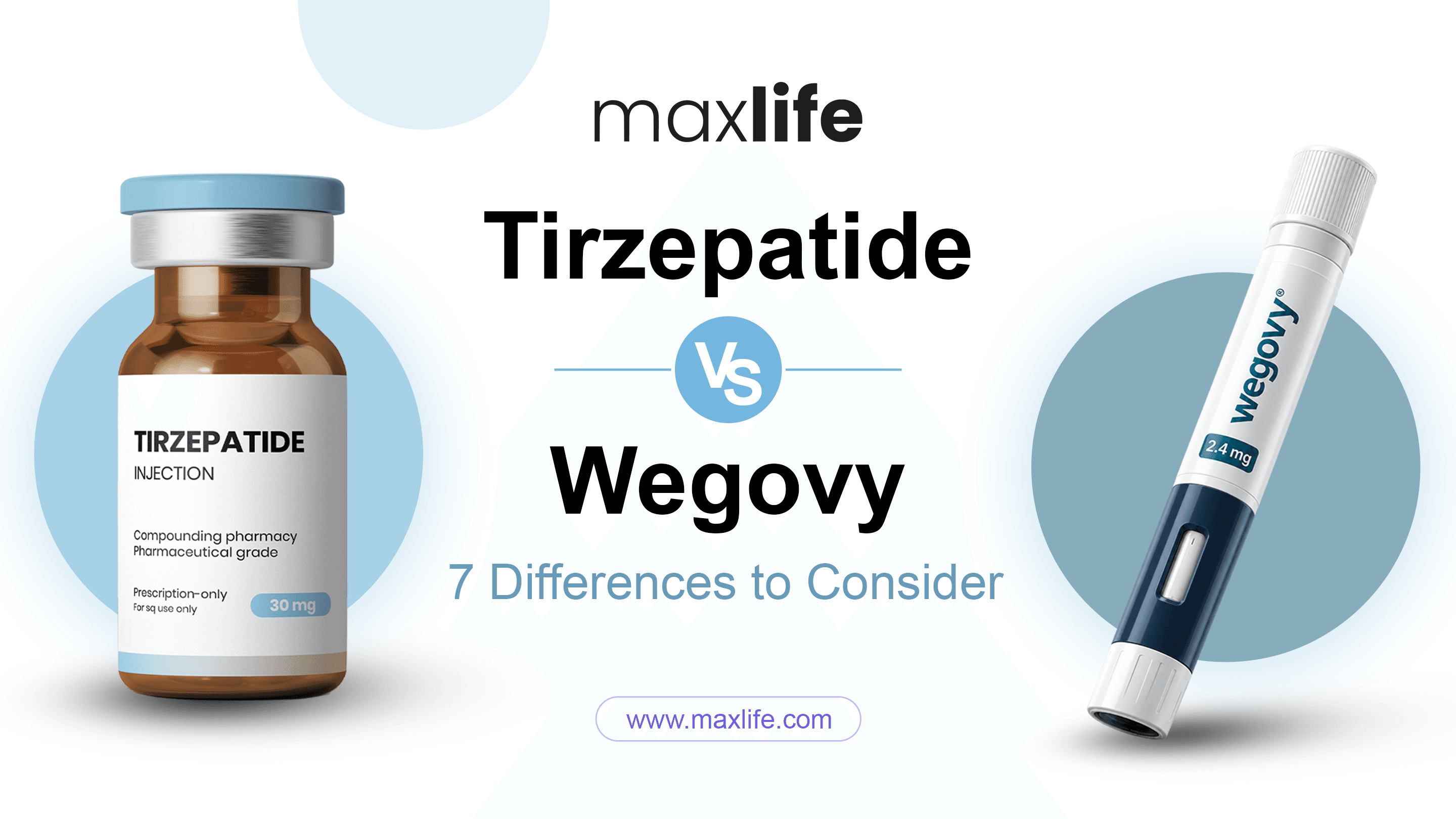
In the tirzepatide vs Wegovy comparison, tirzepatide acts on two hormone receptors while Wegovy's semaglutide acts on one, and in the only head-to-head trial, tirzepatide produced 20.2% average body weight loss against 13.7% for semaglutide. Wegovy has something tirzepatide does not, though: an FDA-approved cardiovascular benefit. One naming note before we start. Wegovy is a brand of semaglutide, and tirzepatide is the ingredient in Zepbound and Mounjaro, so this is really tirzepatide versus semaglutide. Below are the seven differences that make the decision.
Quick Answer: Which Is Better, Tirzepatide or Wegovy?
For weight loss alone, the head-to-head evidence favors tirzepatide. In SURMOUNT-5, adults taking tirzepatide lost an average of 20.2% of their body weight over 72 weeks compared with 13.7% on semaglutide.
Wegovy's advantages are real and lie elsewhere. It is approved to cut the risk of major cardiovascular events by roughly 20% in certain adults with heart disease. It is approved for use from age 12. Its side effects tend to be milder at maintenance doses.
Both are once-weekly injections that work on the same underlying pathway, and the six-point gap in average results doesn't apply to every case. Your health history and your tolerance decide it, with a licensed provider.
Tirzepatide vs Wegovy at a Glance
| Feature | Tirzepatide | Wegovy |
|---|---|---|
| Active ingredient | Tirzepatide | Semaglutide |
| Brand names | Zepbound, Mounjaro | Wegovy, Ozempic |
| Medication class | Dual GIP and GLP-1 receptor agonist | GLP-1 receptor agonist |
| FDA-approved for weight loss | Yes, as Zepbound (adults) | Yes (adults and adolescents) |
| Cardiovascular approval | No | Yes, for adults with established heart disease |
| Approved age range | Adults 18 and over | Adults and adolescents 12 and over |
| Injection frequency | Once weekly | Once weekly |
| Dose range | 2.5 mg to 15 mg (six strengths) | 0.25 mg titrated to 2.4 mg maintenance |
| Average weight loss (head-to-head trial) | 20.2% over 72 weeks | 13.7% over 72 weeks |
| Room-temperature storage | Up to 21 days (single-dose pens and vials) | Up to 28 days |
Head-to-head figures come from SURMOUNT-5, a 72-week randomized trial in 751 adults with obesity and without diabetes, published in the New England Journal of Medicine in 2025.
1. Tirzepatide Hits Two Receptors, Wegovy Hits One
Both medications imitate incretins, the gut hormones your body releases after a meal. Incretins tell the pancreas to put out insulin, tell the liver to make less sugar, slow the rate at which food leaves the stomach, and act on the appetite centers in the brain. As a result, you feel full sooner and stay full longer.
Semaglutide copies one of those hormones, GLP-1. Tirzepatide copies two, GLP-1 and GIP, which makes it a dual agonist. That is the main structural difference, and it explains most of what follows.
Adding GIP appears to amplify the effect on appetite and energy use. It also amplifies gastrointestinal side effects, since the same slowed digestion that curbs hunger also causes nausea. More receptor coverage buys more weight loss and costs more stomach upset.
The two are not interchangeable. Working through overlapping pathways does not make them equivalent doses of the same thing, and there is no conversion chart between them.
2. Tirzepatide Won the Head-to-Head Trial
Most GLP-1 comparisons stitch together separate trials and hope the populations line up. This one does not have to. SURMOUNT-5 put the two drugs against each other directly.
The trial randomized 751 adults with obesity and without diabetes to tirzepatide or semaglutide at their maximum tolerated dose for 72 weeks. Tirzepatide produced an average weight reduction of 20.2%, semaglutide 13.7%. In pounds, that was roughly 50 lb versus 33 lb. Waist circumference fell further on tirzepatide too, by 18.4 cm against 13.0 cm.
Why this carries more weight than the usual cross-trial arithmetic: same protocol, same enrolment criteria, same 72 weeks, same clinics. When one drug beats another under those conditions, the gap is measured rather than inferred.
The separate trials point the same way. In SURMOUNT-1, tirzepatide at 15 mg produced about 21% average weight loss over 72 weeks. In STEP 1, semaglutide 2.4 mg produced about 15% average weight loss over 68 weeks.
One caveat matters more than the headline. These are averages across hundreds of people, and individual results scatter widely around them. Plenty of patients lose more than 20% on semaglutide, and some lose very little on tirzepatide. The trial winner is not automatically your winner.
3. They Have Different FDA-Approved Uses
The branding makes this more confusing than it needs to be, so here is the actual split.
Wegovy is approved for chronic weight management, for cardiovascular risk reduction in certain adults, and for MASH, a form of fatty liver disease, in adults with moderate to advanced scarring. It is not approved to treat type 2 diabetes. That indication belongs to Ozempic, which contains the same ingredient under a different brand.
Tirzepatide is approved as Zepbound for chronic weight management and for moderate to severe obstructive sleep apnea in adults with obesity. Under the name Mounjaro, the same ingredient is approved for type 2 diabetes.
The practical consequence shows up on your invoice. Mounjaro prescribed for weight alone is off-label use, which insurers routinely decline to cover. Zepbound is the tirzepatide brand approved for weight loss, and it is the one a prescriber writing for weight management should reach for.
4. Wegovy Has Proven Cardiovascular Benefits
This section keeps the comparison honest, because for one group of readers it outranks everything above.
Wegovy is approved to reduce the risk of major adverse cardiovascular events, meaning heart attack, stroke, and cardiovascular death, in adults who have established heart disease and are overweight or obese. The approval rests on SELECT, a trial that followed more than 17,000 adults for up to five years and found roughly a 20% reduction in that combined risk against placebo.
Tirzepatide has no cardiovascular indication. It has been studied: SURPASS-CVOT compared tirzepatide with dulaglutide, an approved GLP-1 with established cardiovascular benefit, in over 13,000 adults with type 2 diabetes and atherosclerotic disease. Tirzepatide met the bar for non-inferiority, with a hazard ratio of 0.92, but did not prove superiority, and that result has not translated into an approved cardiovascular indication.
So the takeaway is direct. If you have diagnosed cardiovascular disease, Wegovy's approval is a legitimate reason for a prescriber to choose it over tirzepatide, even though the average weight loss is smaller. Six percentage points of body weight is not worth much against a proven reduction in heart attacks.
5. Different Age Ranges
Eligibility diverges at the younger end.
Wegovy is approved for adults and for adolescents aged 12 and older who meet the criteria for obesity. In adults, it is also approved at a lower weight threshold, for people who are overweight and have at least one weight-related condition such as high blood pressure, type 2 diabetes, or high cholesterol.
Tirzepatide for weight management is approved for adults only. Zepbound's label covers adults 18 and over.
For a teenager, then, the comparison collapses. Wegovy is the approved option of the two, and tirzepatide's stronger trial numbers don't change that decision. Any prescribing for an adolescent belongs with a pediatric specialist.
MaxLife's programs are for adult weight management only, so if you are considering treatment for a teenager, that conversation goes to their doctor.
6. Side Effects Are Similar, but Tirzepatide's Can Hit Harder
Both medications produce the same category of side effects, and for the same reason. Slowing digestion is part of how they work, so the gastrointestinal complaints come with the mechanism rather than being an accident of it.
Expect nausea, vomiting, diarrhea, constipation, and abdominal pain, at their worst in the first few weeks and again after each dose increase. For most people, they fade as the body adjusts, though a minority never settle and have to stop.
Higher tirzepatide doses tend to bring these on more often. That is partly the price of the stronger effect. Interestingly, SURMOUNT-5 found more people quit semaglutide for gastrointestinal reasons than quit tirzepatide (5.6% vs. 2.7%), which suggests the picture is less lopsided than the reputation.
Treat this as a real input rather than a footnote. If you have already tried a GLP-1 and spent weeks feeling ill, a gentler profile may matter more than six percentage points of average weight loss. Slow titration is the standard defense either way, and no reputable provider should be escalating you faster than your stomach can follow.
7. Dosing and Storage Differ
Both are subcutaneous injections given once a week into the abdomen, thigh, or upper arm. Take them any time of day, with or without food, on the same day each week. If you need to move your injection day, keep at least 72 hours between doses.
Tirzepatide comes in six strengths, from 2.5 mg up to 15 mg, escalating in 2.5 mg steps roughly every four weeks. Maintenance usually lands somewhere between 5 mg and 15 mg. Wegovy follows its own 16-week ladder from 0.25 mg to a 2.4 mg maintenance dose.
Storage is where travelers get caught out. Both are stored in the fridge between 36°F and 46°F. Out of the fridge, Wegovy lasts up to 28 days at room temperature, while single-dose tirzepatide pens and vials last about 21 days. On a long trip, that week is the difference between fine and wasted medication.
One format note: compounded versions of both come as vials that you draw into a syringe rather than prefilled pens, and the pharmacy sets its own beyond-use date, so follow the label you receive rather than the brand rules above.
Wegovy vs Tirzepatide for Weight Loss: Which Should You Choose?
The honest answer in the Wegovy vs tirzepatide debate is that it depends on which of these describes you.
Weight loss is the only goal and you tolerate medication well. The head-to-head data favor tirzepatide, and there is no serious argument against it here.
You have established cardiovascular disease. Wegovy's approved cardiovascular indication is a genuine clinical reason to choose it. Raise it explicitly with your provider rather than assuming they already have it in front of them.
You are under 18. Wegovy is the approved option, and a pediatric specialist should make that decision.
You have had a rough time on a GLP-1 before. Semaglutide's gentler profile may serve you better than a stronger drug you cannot stay on. A medication you abandon at week six loses you nothing but money.
You have plateaued on semaglutide at the maximum dose. This is the most common reason people start comparing the two, and switching to tirzepatide is a reasonable next step to discuss.
Cost is the binding constraint. At MaxLife, compounded semaglutide starts at $89 a month and compounded tirzepatide at $120 a month on a 3-month starter package, then $155 and $195 a month after that.
None of this is a self-select decision. Wegovy vs. tirzepatide is a prescribing question, not a shopping one: a licensed provider reviews your history, medications, and goals, then prescribes accordingly.
Can You Switch Between Tirzepatide and Wegovy?
Yes, and it happens constantly. A large share of people asking about tirzepatide vs Wegovy are already on semaglutide, have stalled short of their goal, and want to know whether the other drug is an upgrade.
The important caveat is that no equivalence table exists between the two. A 2.4 mg dose of semaglutide does not convert into any particular dose of tirzepatide. You start at tirzepatide's 2.5 mg starter dose and titrate up from there, the same as anyone new to it. Expect the early side effects to return during that climb, even though you have been on a GLP-1 for a year.
Your provider sets the switch timing, usually around when your next dose would have been due.
The reverse works too. If tirzepatide's side effects are unmanageable at doses that help you, moving to semaglutide is a sensible route rather than a defeat.
What you should not do is stop one and start the other on your own initiative, or overlap them while you decide.
Can You Take Them Together?
No. Do not combine them.
They act on overlapping pathways, so taking both stacks the side effects without any proven benefit. The combination has not been studied for safety, which means nobody can tell you what the risk actually is, and gastrointestinal reactions severe enough to cause dehydration and kidney injury are a plausible outcome.
If you have reached the maximum dose of one drug and stalled short of your goal, that is a conversation with your provider about diet, resistance training, sleep, other medications that may be working against you, or a switch. It is not a reason to add the second drug.
One more thing, and it matters most with telehealth. Your provider needs to know every medication you are taking, including anything prescribed by another clinic. If you are seeing two providers for weight management, tell both.
Safety Warnings Both Share
Both medications carry a boxed warning about thyroid C-cell tumors, which were observed in rodents at clinically relevant exposures. Whether the same risk applies to humans is unknown. Both are contraindicated if you or a close family member has had medullary thyroid carcinoma or multiple endocrine neoplasia syndrome type 2.
Both labels also list pancreatitis, gallbladder disease, acute kidney injury from dehydration, delayed gastric emptying that can complicate anesthesia, and low blood sugar when combined with insulin or a sulfonylurea. Because both slow the stomach, they can alter how other oral medications are absorbed.
One warning is specific to tirzepatide. It may reduce the effectiveness of oral contraceptives. If you use the pill, switch to a non-oral method or add a barrier method for four weeks after starting tirzepatide and for four weeks after each dose increase.
Tell your provider about any history of pancreatitis, gallstones, kidney disease, severe gastrointestinal conditions, or diabetic retinopathy, and stop treatment and seek care for severe or persistent abdominal pain.
Cost: Brand vs Compounded
Brand pricing is steep on both sides. Wegovy's list price sits above $1,300 a month, and tirzepatide's brands are somewhat lower, though manufacturer cash-pay programs have brought direct prices down considerably in the last two years. Insurance coverage for weight loss remains patchy, and many plans that cover these drugs for diabetes exclude them for obesity.
Compounded medications are the other route. Compounded semaglutide and compounded tirzepatide contain the same active ingredients as the brands, are prepared by licensed compounding pharmacies, and require a prescription. At MaxLife, they start at $89 and $120 a month, respectively, on a 3-month starter package ($267 and $360 billed upfront), then $155 and $195 a month after that.
Be clear on the trade-off. Compounded medications are not FDA-approved, are not reviewed for safety and efficacy the way brand products are, and are not covered by insurance. Compounded semaglutide is not Wegovy, and compounded tirzepatide is not Zepbound. Same molecule, different product and different regulatory status.
MaxLife plans include the medication, injection supplies, licensed provider review, ongoing messaging for dose adjustments and side-effect support, and shipping. Plans are FSA and HSA eligible.
Get Either Option With Medical Guidance
Both drugs are legitimate choices. Which one fits depends on your health history, how well you tolerate medication, and what you are trying to achieve, and that assessment is what a licensed provider is for.
MaxLife offers compounded tirzepatide and compounded semaglutide for adult weight management, so the decision stays clinical rather than being forced by whichever product happens to be in stock. Every plan starts with an eligibility review, follows a gradual titration schedule, and includes ongoing support if side effects show up.
Start with the free consultation and find out which one you qualify for.
Conclusion
In the tirzepatide vs Wegovy comparison, tirzepatide acts on two receptors rather than one and beat semaglutide in the only head-to-head trial, with 20.2% average body weight loss versus 13.7% over 72 weeks. Wegovy's counterweights are substantial: an approved cardiovascular benefit, approval for ages 12 and older, a milder side-effect profile, and a longer room-temperature window for travel. Both are once-weekly GLP-1 injections sharing the same boxed warning and a similar side-effect list. More weight loss on average does not make a drug right for you, and that call belongs to a licensed provider.
Tirzepatide vs Wegovy FAQs
Is tirzepatide stronger than Wegovy?
For weight loss, yes, on average. SURMOUNT-5 compared them directly over 72 weeks and found 20.2% average body weight loss on tirzepatide against 13.7% on semaglutide. Tirzepatide's dual action on GIP and GLP-1 receptors is the likely reason. Individual results vary widely, and "stronger" also means a higher chance of gastrointestinal side effects.
Is Wegovy the same as semaglutide?
Wegovy is a brand name for semaglutide. Ozempic is the same ingredient under a different brand, approved for type 2 diabetes rather than weight loss. So all Wegovy is semaglutide, but not all semaglutide is Wegovy.
Can I switch from Wegovy to tirzepatide, and what dose do I start on?
Switching is common and usually straightforward, but there is no dose equivalence between the two. You start at tirzepatide's 2.5 mg starter dose and titrate up in 2.5 mg steps, regardless of how high your semaglutide dose was. Your provider decides when to make the change and how quickly to increase the dose.
Can you take tirzepatide and Wegovy together?
No. They work through overlapping mechanisms, so combining them multiplies side effects without any proven additional benefit, and the combination has not been studied for safety. If one drug at its maximum dose is not getting you to your goal, talk to your provider about the alternatives.
Which has fewer side effects, tirzepatide or Wegovy?
Both cause the same gastrointestinal side effects, and higher tirzepatide doses tend to produce them more often. That said, in SURMOUNT-5, slightly more participants discontinued semaglutide for gastrointestinal reasons than tirzepatide. Slow titration is the main defense with either drug.
Is compounded semaglutide the same as Wegovy?
No. Compounded semaglutide contains the same active ingredient and is prepared by a licensed compounding pharmacy against a prescription, but it is not FDA-approved and is not the branded Wegovy product. It is also not covered by insurance, which is part of why it costs less
Find Out Which One You Qualify For
Compounded medications are not FDA-approved and are not covered by insurance. Pricing and availability are subject to change.
Check Your EligibilityThis article is for informational purposes only and is not a substitute for professional medical advice, diagnosis, or treatment. Individual results vary. Pricing, insurance coverage, and compounding regulations described here are subject to change; verify current details with your insurance provider, the manufacturer, or your prescriber before making treatment decisions. Compounded medications are not FDA-approved.
Sources
- New England Journal of Medicine: Tirzepatide as Compared with Semaglutide for the Treatment of Obesity
- New England Journal of Medicine: Tirzepatide Once Weekly for the Treatment of Obesity
- New England Journal of Medicine: Once-Weekly Semaglutide in Adults with Overweight or Obesity
- New England Journal of Medicine: Semaglutide and Cardiovascular Outcomes in Obesity without Diabetes
- New England Journal of Medicine: Cardiovascular Outcomes with Tirzepatide versus Dulaglutide in Type 2 Diabetes
- Wegovy (semaglutide) injection and tablets prescribing information
- Zepbound (tirzepatide) prescribing information
- FDA: Clarifies policies for compounders as national GLP-1 supply stabilizes