Contrave vs Semaglutide: 7 Differences to Consider
Medically reviewed by Dr. Kavya Patel, MD. Pricing is accurate as of September 2026 and subject to change.
Key Takeaways
- Semaglutide produced about 15% average weight loss in STEP 1, against about 8% for Contrave in the COR trials. The two have never been compared head-to-head.
- Contrave is a twice-daily pill that targets cravings. Semaglutide is a GLP-1, usually a weekly injection, that increases fullness.
- Contrave carries a boxed warning for suicidal thoughts and behaviors. It can't be used with seizure disorders, eating disorders, uncontrolled hypertension or opioid use.
- Contrave interacts with many common drugs, including antidepressants and metoprolol.
- Only semaglutide is approved for adolescents and for cardiovascular risk reduction.
- At MaxLife, compounded semaglutide is $89/mo for a 3-month starter package (billed at $267), then $155/mo.
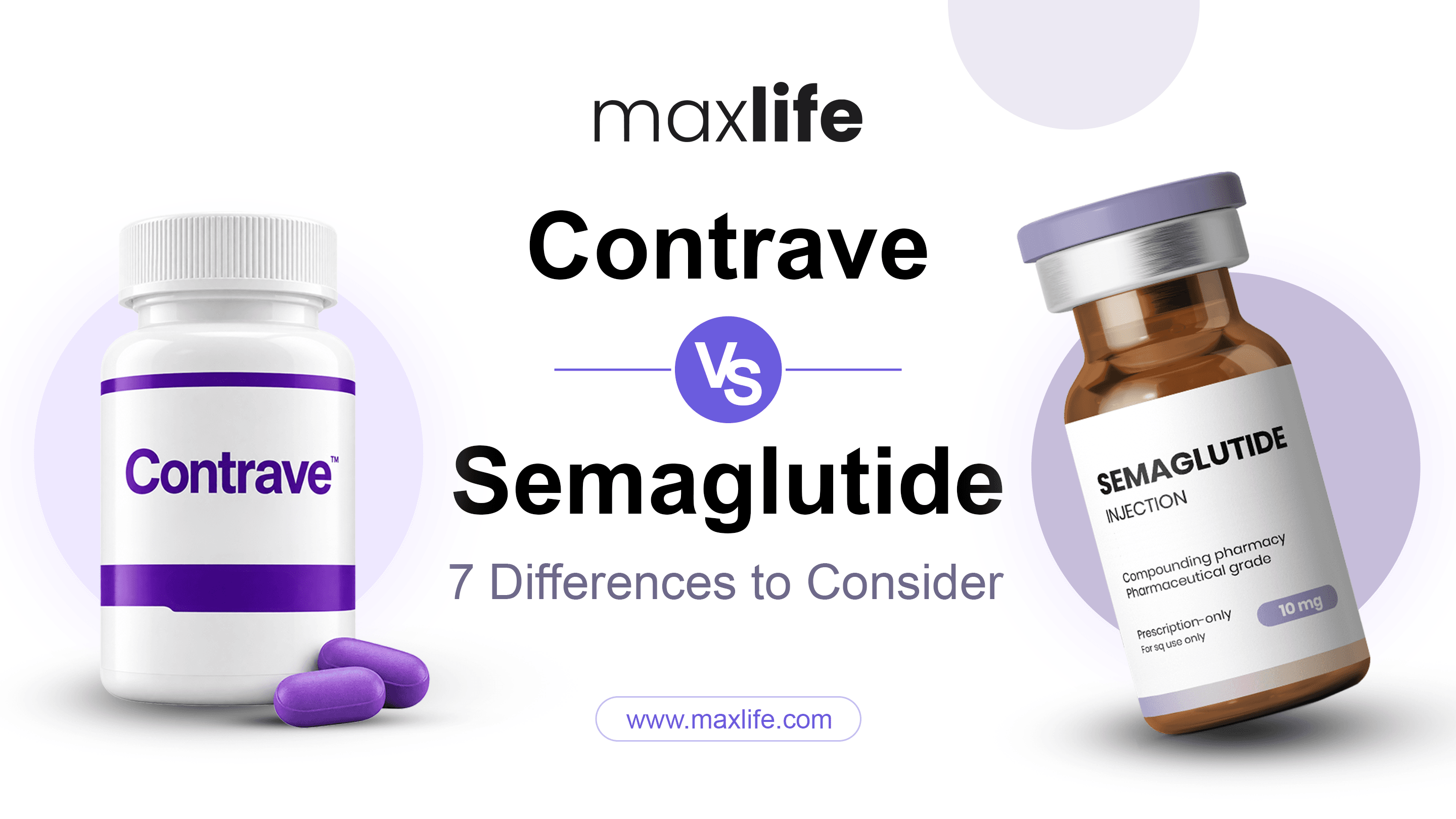
In the Contrave vs semaglutide comparison, Contrave is a twice-daily tablet that works on the brain's reward system, while semaglutide is a weekly injection that mimics a gut hormone. Trial data point to roughly 15% average body weight loss on semaglutide against about 8% on Contrave. Below are the seven differences that matter: how each drug works, what the numbers show, pill versus needle, side effects, drug interactions, and eligibility. Contrave's boxed warning and contraindications rule some people out before effectiveness is even considered.
Quick Answer: Which Is Better, Contrave or Semaglutide?
For weight loss alone, semaglutide produced roughly double the average result in trials. It is also approved for adolescents from age 12, and for reducing cardiovascular risk in certain adults with established heart disease. Contrave is approved for adults only, with no cardiovascular indication.
Contrave's advantages are real and lie elsewhere. It is a pill, not an injection. It costs less at brand pricing. And because it works on cravings and reward-driven eating rather than fullness, it suits some eating patterns better than a GLP-1 does.
The honest boundary is this: Contrave carries a boxed warning and a long list of contraindications that disqualify a meaningful share of people. That makes this a prescriber decision, not a preference.
Contrave vs Semaglutide at a Glance
| Feature | Contrave | Semaglutide |
|---|---|---|
| Active ingredients | Naltrexone HCl and bupropion HCl | Semaglutide |
| Brand names | Contrave | Wegovy injection and Wegovy pill (weight management), Ozempic (type 2 diabetes), Rybelsus (oral, type 2 diabetes) |
| Medication class | Opioid antagonist plus aminoketone antidepressant | GLP-1 receptor agonist |
| FDA-approved uses | Chronic weight management only | Chronic weight management, type 2 diabetes, cardiovascular risk reduction, MASH (varies by brand) |
| Approved age range | Adults 18 and over | Adults and adolescents 12 and over (Wegovy injection) |
| Form and frequency | Oral tablet, twice daily | Subcutaneous injection once weekly, or oral tablet once daily |
| Time to maintenance dose | About 4 weeks | About 4 months |
| Average weight loss in trials | About 8% over 56 weeks | About 15% over 68 weeks |
| Boxed warning | Suicidal thoughts and behaviors | Thyroid C-cell tumors |
The weight-loss figures come from separate placebo-controlled trials with different populations, durations and endpoints. Contrave and semaglutide have never been compared head-to-head, so treat the gap as indicative rather than a measured result.
1. They Work Through Completely Different Pathways
Contrave combines two older drugs: naltrexone, an opioid antagonist, and bupropion, an antidepressant. Neither was designed for weight loss. Together they appear to act on the brain's reward circuitry, the system that responds to pleasurable activity including eating. For many people, the practical effect is fewer cravings and less pull toward specific foods. Contrave may also modestly reduce appetite and nudge up energy expenditure, though the reward effect is the headline.
Semaglutide copies GLP-1, a hormone your gut releases after a meal. It increases fullness, reduces appetite, and slows how quickly food leaves the stomach. People on it often describe the change as food noise going quiet, meals ending sooner, and second helpings losing their appeal.
That split explains most of what follows. Contrave targets wanting food. Semaglutide targets feeling full. If your problem is grazing, evening snacking and reward eating, the mechanisms are not interchangeable, and neither are the results.
2. Semaglutide Produces More Weight Loss
First, the caveat: nobody has run a head-to-head trial. Every number below comes from a separate placebo-controlled study, and the trials differ in length, design and the amount of lifestyle support built in.
Semaglutide's evidence comes from STEP 1, which randomized 1,961 adults with overweight or obesity and without diabetes to semaglutide 2.4 mg or placebo for 68 weeks. Average weight loss was 14.9% of starting body weight, against 2.4% on placebo.
Contrave's evidence comes from the COR program, four 56-week trials. In COR-I, participants on Contrave 32/360 mg who completed the trial lost about 8% of their body weight; the intent-to-treat figure in the FDA label is 5.4%. COR-II landed in the same range.
The more interesting result is COR-BMOD, which paired the drug with intensive nutrition and exercise counseling. Completers there lost about 11.5%. That is a substantial jump, and it is underreported: Contrave's ceiling appears to move with structured behavioral support in a way that is easy to miss if you only read the headline number.
So semaglutide leads on average, and by a wide margin. Both drugs work, individual response scatters widely around these means, and a drug you tolerate at 8% beats one you abandon at week six.
3. Pill vs Injection, and How Long Titration Takes
Contrave is an extended-release tablet. You start with one tablet in the morning, add an evening tablet in week two, and reach the maintenance dose of two tablets twice daily at the start of week four. Swallow tablets whole; never cut, chew, or crush them, because breaking the extended-release coating dumps the dose. Do not take Contrave with a high-fat meal either. Fat significantly increases how much bupropion and naltrexone your body absorbs, which raises seizure risk.
Semaglutide is a once-weekly subcutaneous injection into the abdomen, thigh or upper arm. Take it any day of the week, any time of day, with or without food, using a short needle into the fat layer rather than muscle.
Titration is the other contrast. Contrave reaches full strength in about four weeks. Semaglutide's ladder from 0.25 mg to 2.4 mg runs roughly four months. Contrave gets you there faster. Semaglutide asks for four injections a month rather than around 120 tablets, which matters if you are the kind of person who forgets an evening dose.
4. Contrave Carries a Boxed Warning and Seizure Risk
This is the highest-stakes section on this page, and it is where the Contrave vs semaglutide decision gets taken out of your hands.
Contrave contains bupropion, an antidepressant, and carries a boxed warning for suicidal thoughts and behaviors. The risk documented with antidepressants was highest in children, adolescents and adults under 25. Anyone starting Contrave should be monitored for new or worsening depression, agitation, hostility, irritability, or unusual changes in mood and behavior, and family members should know what to watch for.
Bupropion also lowers the seizure threshold. Seizures occurred in roughly 0.1% of Contrave trial participants, and the risk is dose-related. Contrave is contraindicated in anyone with a seizure disorder or history of seizures, anyone with bulimia or anorexia nervosa, and anyone abruptly discontinuing alcohol, benzodiazepines, barbiturates, or antiseizure medication. If a seizure occurs, the drug is stopped and never restarted.
The naltrexone component adds its own hard stop. Contrave is contraindicated in anyone using chronic opioids or opiate agonists, or in acute opioid withdrawal. You need to be opioid-free for seven to ten days before starting. Trying to override the naltrexone blockade with a large opioid dose can be fatal.
Contrave is also contraindicated with uncontrolled hypertension and with MAOIs, and it can raise blood pressure and resting heart rate, so both need checking before treatment and at intervals during it.
These are not fine-print cautions. They disqualify a meaningful share of the people who go looking for Contrave in the first place.
5. Semaglutide Has a Different Risk Profile
Semaglutide's common side effects are mostly gastrointestinal: nausea, diarrhea, vomiting, constipation and abdominal pain. They are worst in the first weeks and after each dose increase, and for most people they fade as the body adjusts. Slow titration is the main defense, which is part of why the four-month climb exists.
The rarer but serious risks include pancreatitis, gallbladder disease including gallstones, acute kidney injury from dehydration, and delayed gastric emptying that can complicate anesthesia and sedation. Semaglutide also carries a boxed warning for thyroid C-cell tumors, seen in rodents at clinically relevant exposures; whether the same risk applies to humans is unknown. It is contraindicated in anyone with a personal or family history of medullary thyroid carcinoma or multiple endocrine neoplasia syndrome type 2.
Here is the honest comparison. Semaglutide's side effects are more likely to be unpleasant. Contrave's are more likely to be disqualifying. Feeling sick for three weeks is a tolerability problem you can often work through with your provider. A seizure history is a closed door.
6. Contrave Has More Drug Interactions
Most readers do not see this one coming, and it decides more cases than the effectiveness numbers do.
Bupropion inhibits the CYP2D6 enzyme, which puts Contrave in the path of a long list of common prescriptions: SSRIs and other antidepressants, some antipsychotics, and beta-blockers such as metoprolol, whose exposure can rise several-fold. Antiseizure medications, drugs that lower the seizure threshold, MAOIs, and opioid painkillers all interact too, and alcohol should be limited or avoided. If you need an opioid for surgery or an injury, Contrave has to be paused.
Semaglutide's interaction profile is much shorter. Because it slows gastric emptying, it can alter how quickly other oral medications are absorbed. Combined with insulin or a sulfonylurea, it raises the risk of low blood sugar, so those doses often need to be reduced.
The action item is simple: bring a complete list of everything you take, prescription and over-the-counter, to your consultation. For readers on an antidepressant or a beta-blocker, this alone often settles which option is realistically available.
7. Different People Are Eligible
The approval gap is wider than most comparisons admit.
Semaglutide as Wegovy is approved for chronic weight management in adults and in adolescents aged 12 and older who meet the obesity criteria. It is also approved to reduce the risk of major adverse cardiovascular events, meaning heart attack, stroke and cardiovascular death, in adults who are overweight or obese with established cardiovascular disease. That approval rests on the SELECT trial, which followed more than 17,000 adults for up to five years and found roughly a 20% reduction in that combined risk.
Contrave is approved for adults only, in combination with reduced calories and increased activity, for people with obesity or with overweight plus at least one weight-related condition. It has no cardiovascular indication and is not approved for anyone under 18.
So for two specific groups, the comparison collapses. For a teenager and for an adult with diagnosed heart disease, semaglutide is the option with the label behind it. MaxLife's programs are for adult weight management only, so treatment for an adolescent belongs with their doctor.
Contrave vs Semaglutide: Which Should You Choose?
The answer depends on which of these describes you.
Maximum weight loss is the priority. The trial data favor semaglutide, and by a margin no amount of caveating erases.
You will not or cannot inject. Contrave is the realistic oral option for weight management. Rybelsus is oral semaglutide, but it is approved for type 2 diabetes rather than weight loss.
You have a seizure history, an eating disorder history, uncontrolled hypertension, or you take opioids or an antidepressant. Contrave may be off the table entirely. Raise this at the start of the consultation, not the end.
Cravings, not portion size, are your pattern. If your difficulty is wanting food constantly rather than eating too much at meals, Contrave's mechanism targets exactly that.
Cost is the binding constraint. Contrave's retail price runs roughly $530 to $740 a month, though the manufacturer's cash-pay program brings that to about $99 for eligible patients. A telehealth provider can offer compounded semaglutide for less than brand pricing: at MaxLife it's $89/mo for a 3-month starter package (billed at $267), then $155/mo.
None of this is self-select. A licensed provider reviews your history and your medication list and prescribes accordingly.
Can You Take Contrave and Semaglutide Together?
Do not arrange this yourself. Combining weight-loss medications is not standard practice, and the Contrave-plus-semaglutide combination has not been well studied for safety, so no one can quantify the risk for you. What you can predict is that you would be stacking two side-effect profiles, including nausea on one side and blood pressure effects on the other, without any established gain in results.
Some obesity specialists do combine agents in specific circumstances, usually when one drug has stalled well short of a clinical target. That is an individualized decision with monitoring, dose adjustment and follow-up attached. You can't assemble it by ordering from two different providers.
Which brings up the practical warning about telehealth: your provider needs to know every medication you take, including anything prescribed by another clinic. If you are seeing two, tell both.
How Does Tirzepatide Compare?
Tirzepatide is the third option most people find while researching this. It acts on two receptors, GLP-1 and GIP, rather than one, and it has produced the largest average weight loss of the three in trials. SURMOUNT-1 reported about 21% over 72 weeks at the top dose, and in SURMOUNT-5, the only head-to-head trial against semaglutide, tirzepatide produced 20.2% against 13.7%.
So the hierarchy of average results runs tirzepatide first, semaglutide second, Contrave third. Contrave keeps two distinctions the others cannot claim: it is the only one of the three available as a weight-management pill, and the only one that works on the reward system rather than the incretin pathway. If you want the higher end of the injectable range, compounded tirzepatide is the option to discuss with a provider.
Get Semaglutide With Medical Guidance
Choosing between these two comes down to three things: what is on your medication list, what is in your health history, and what you can realistically stick to for a year. That is precisely the assessment a licensed provider is trained to make, and it is not something a comparison article can do for you.
MaxLife's provider-guided program offers compounded semaglutide for adult weight management, starting with an eligibility review, following a gradual titration schedule, and including ongoing support if side effects appear. Plans are $89/mo for a 3-month starter package (billed at $267), then $155/mo, and include the medication, supplies and provider messaging.
Conclusion
In the Contrave vs semaglutide comparison, semaglutide produced about 15% average body weight loss in STEP 1 against roughly 8% for Contrave in the COR trials, though the two have never been tested directly against each other. Contrave is a twice-daily pill that reaches full dose in about four weeks and costs less. Semaglutide is a weekly GLP-1 injection that takes around four months to titrate and delivers more, and it adds adolescent approval and a proven cardiovascular benefit. Contrave's boxed warning, seizure risk and drug interactions rule out a meaningful share of people. Bring your full medication list to a licensed provider and let them decide.
Contrave vs Semaglutide FAQs
Is Contrave as effective as semaglutide for weight loss?
No, not on average. Semaglutide 2.4 mg produced 14.9% average weight loss over 68 weeks in STEP 1, while Contrave produced about 8% over 56 weeks in the COR trials, rising to around 11.5% when paired with intensive behavioral counseling. The two have never been compared head-to-head, so this is a read across separate trials rather than a measured contest. Individual results vary widely in both directions.
Who should not take Contrave?
Contrave is contraindicated in anyone with a seizure disorder or history of seizures, bulimia or anorexia nervosa, uncontrolled hypertension, chronic opioid use or acute opioid withdrawal, abrupt discontinuation of alcohol, benzodiazepines, barbiturates or antiseizure drugs, concurrent MAOI use, other bupropion-containing products, or a known allergy to either ingredient. It also carries a boxed warning for suicidal thoughts and behaviors and is not approved for use under age 18.
Can I switch from Contrave to semaglutide?
Yes, and it is a common reason people start comparing the two. There is no dose equivalence between the drugs, so you begin at semaglutide's 0.25 mg starter dose and titrate up from there regardless of how long you were on Contrave. Your provider decides the timing and whether you need a taper. Do not stop one and start the other on your own initiative.
Is Contrave cheaper than semaglutide?
At brand pricing, yes. Contrave retails at roughly $530 to $740 a month, with a manufacturer cash-pay program bringing it to about $99 for eligible patients, while branded semaglutide list prices are considerably higher. Compounded semaglutide changes the maths, though: at MaxLife it's $89/mo for a 3-month starter package (billed at $267), then $155/mo, which puts it in the same range as Contrave's cash-pay price during the starter period.
Can you take Contrave and semaglutide together?
Not on your own initiative. The combination has not been well studied, so its safety profile is unestablished, and taking both stacks adds two side-effect profiles without proven additional benefit. Some specialists do combine weight-loss agents in specific cases, but that is an individualized clinical decision with monitoring attached, not something to arrange by ordering from two providers.
Does Contrave cause fewer side effects than semaglutide?
Not fewer, just different. Contrave's common side effects include nausea, constipation, headache, vomiting, dizziness, insomnia and dry mouth, and it can raise blood pressure and heart rate. Semaglutide's side effects are mostly gastrointestinal and usually ease with time. The more useful distinction is that semaglutide's side effects tend to be unpleasant, while Contrave's contraindications tend to be disqualifying.
Skip the Wait. Check Your Eligibility With MaxLife
Compounded medications are not FDA-approved and are not covered by insurance. Pricing and availability are subject to change.
Check Your EligibilityThis article is for informational purposes only and is not a substitute for professional medical advice, diagnosis, or treatment. Individual results vary. Pricing, insurance coverage, and compounding regulations described here are subject to change; verify current details with your insurance provider, the manufacturer, or your prescriber before making treatment decisions. Compounded medications are not FDA-approved.
Sources
- New England Journal of Medicine: Once-Weekly Semaglutide in Adults with Overweight or Obesity
- The Lancet: Effect of naltrexone plus bupropion on weight loss in overweight and obese adults (COR-I)
- New England Journal of Medicine: Tirzepatide as Compared with Semaglutide for the Treatment of Obesity
- Obesity: Weight Loss With Naltrexone SR/Bupropion SR Combination Therapy as an Adjunct to Behavior Modification (COR-BMOD)
- Contrave (naltrexone and bupropion) prescribing information
- Wegovy (semaglutide) injection and tablets prescribing information
- Contrave: Savings program
- New England Journal of Medicine: Semaglutide and Cardiovascular Outcomes in Obesity without Diabetes
Tirzepatide vs Wegovy: 7 Differences to Know
September 11, 20269 min
Semaglutide vs Ozempic: What's the Difference?
September 15, 20267 min

Ozempic Alternatives: What Actually Works for Weight Loss
September 18, 20267 min
Wegovy Alternative: 5 Options That Actually Work
August 18, 20267 min
Tirzepatide vs Saxenda: 7 Differences to Know
August 20, 20265 min
Trulicity vs Tirzepatide: 6 Key Differences to Know
August 20, 20267 min