Semaglutide vs Ozempic: What's the Difference?
Medically reviewed by Dr. Kavya Patel, MD. Pricing is accurate as of September 2026 and subject to change.
Key Takeaways
- Ozempic is a brand of semaglutide, so the two are not different drugs.
- Ozempic is FDA-approved for type 2 diabetes, not weight loss. Wegovy is the semaglutide brand approved for weight management.
- Compounded semaglutide contains the same molecule but is not FDA-approved, not a generic, and not covered by insurance.
- Ozempic self-pay runs about $349 to $499 a month through NovoCare. At MaxLife, compounded semaglutide starts at $89 a month on a 3-month starter package, then $155 a month after that.
- Compounded doses come in vials measured in units, so always follow the vial-specific instructions from your provider.
- Before paying, ask which named pharmacy prepares your medication and confirm it is base semaglutide, not a salt form.
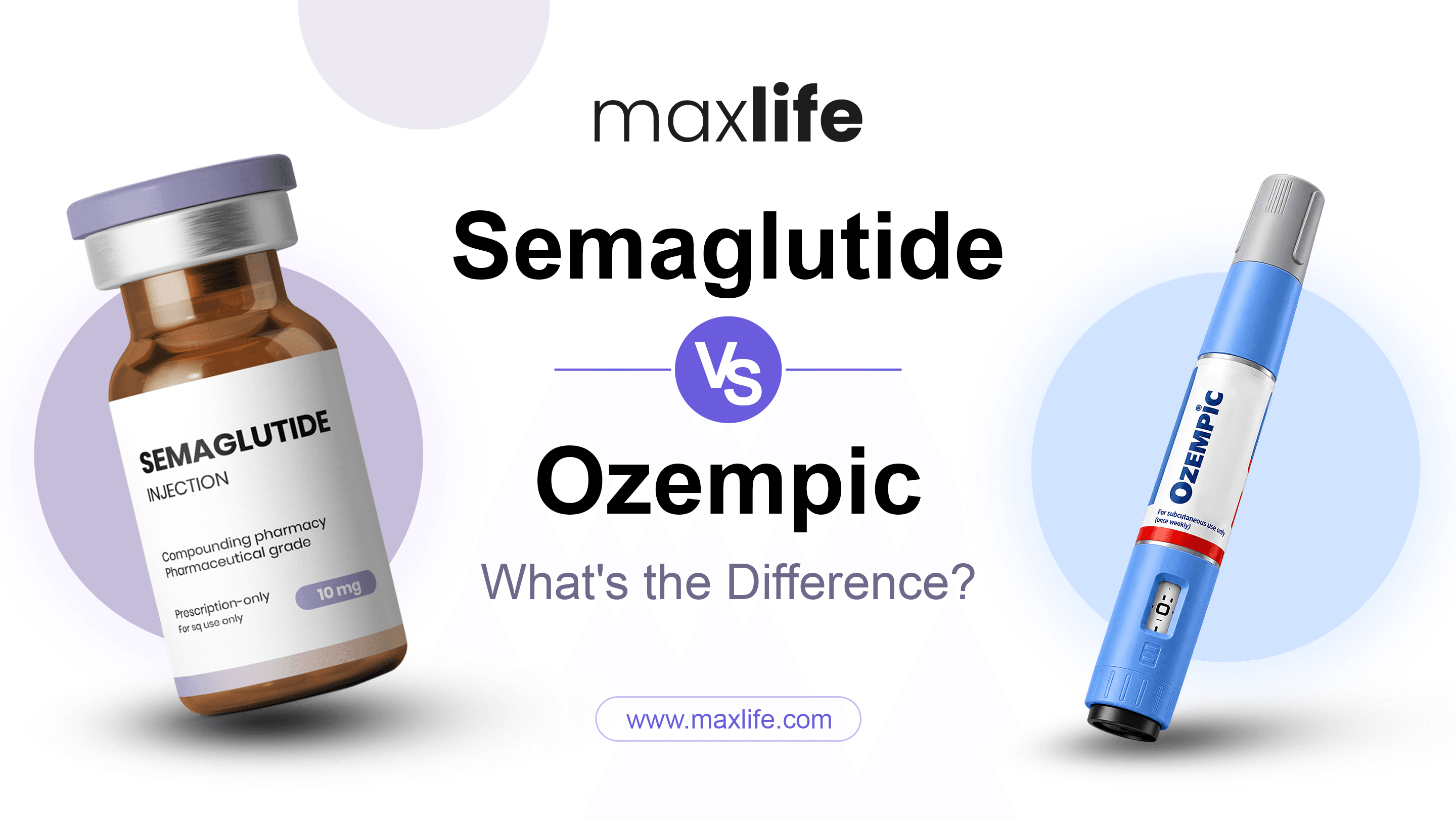
Semaglutide vs Ozempic is not a comparison between two drugs, because Ozempic is semaglutide. Semaglutide is the active ingredient. Ozempic is one of several Novo Nordisk brands built on it, alongside Wegovy. The comparison most people actually want is brand-name Ozempic versus compounded semaglutide, the same molecule prepared by a licensed compounding pharmacy at a fraction of the price. Below you find the brand map, what compounded really is, approval and regulatory status, dosing, side effects, cost, and how to vet a provider.
Quick Answer: Is Semaglutide the Same as Ozempic?
Not quite. Semaglutide is the active ingredient inside Ozempic, so every dose of Ozempic is semaglutide, but not every semaglutide product is Ozempic.
There are three routes to semaglutide in the United States:
- Ozempic: Novo Nordisk's brand, FDA-approved for type 2 diabetes, for reducing major cardiovascular events in adults with type 2 diabetes and established cardiovascular disease, and for slowing chronic kidney disease progression in adults with type 2 diabetes and CKD.
- Wegovy: Novo Nordisk's semaglutide brand, FDA-approved for chronic weight management, plus cardiovascular risk reduction and non-cirrhotic MASH with fibrosis.
- Compounded semaglutide: prepared for an individual patient by a licensed compounding pharmacy under a prescription. It is not FDA-approved.
So the difference between semaglutide and Ozempic is a difference of category, not chemistry. Whether you search it as semaglutide vs Ozempic or Ozempic vs semaglutide, the answer lands the same way: all three products share a molecule, and they differ in approval status, approved indication, regulatory oversight, and price.
Semaglutide Products at a Glance
The table below covers the injectable products, since most people mean injections when they compare these. Novo Nordisk now also sells oral semaglutide tablets under both brand names, at different doses and prices.
| Feature | Ozempic | Wegovy | Compounded semaglutide |
|---|---|---|---|
| Active ingredient | Semaglutide | Semaglutide | Semaglutide (base form) |
| Manufacturer or source | Novo Nordisk | Novo Nordisk | Licensed compounding pharmacy (503A or 503B) |
| FDA-approved | Yes | Yes | No |
| Approved use | Type 2 diabetes; cardiovascular risk reduction and CKD progression in type 2 diabetes | Chronic weight management; cardiovascular risk reduction; non-cirrhotic MASH with fibrosis | None; compounded drugs carry no FDA-approved indication |
| Approved for weight loss | No (off-label use only) | Yes | No |
| Form | Prefilled click-dose pen | Prefilled pen | Vial, drawn with a syringe |
| Weekly dose range | 0.25 mg up to 2 mg maximum | 0.25 mg up to 2.4 mg maintenance (7.2 mg HD pen also available) | Set by your prescriber; typically follows the weight-management ladder |
| Insurance coverage | Often covered for type 2 diabetes; rarely for weight loss | Sometimes covered for obesity, depending on the plan | Not covered |
| Typical monthly cost | About $1,028 list; $349 to $499 self-pay via NovoCare Pharmacy | About $1,350 list; $349 self-pay via NovoCare Pharmacy | Starts at $89 a month at MaxLife on a 3-month starter package, then $155 a month, medication and supplies included |
What Compounded Semaglutide Actually Is
Compounding pharmacies prepare medication for an individual patient against a prescription. Compounded semaglutide contains the same active ingredient found in Ozempic and Wegovy, which is why the two are so often compared.
Now, the part that matters more than the similarity. Compounded semaglutide is not a generic. No generic semaglutide exists in the US because Novo Nordisk's patents still hold, and a generic would need FDA approval as therapeutically equivalent to the brand. Compounded semaglutide is not FDA-approved. The FDA states plainly that it does not review compounded drugs for safety, effectiveness, or quality before they reach patients, and recommends compounded versions only when a patient's medical need cannot be met by an approved product.
There is also a specific ingredient issue worth knowing about. Some products have been sold as "semaglutide sodium" or "semaglutide acetate." These are salt forms, not the base semaglutide used in the approved products, and the FDA has said the salt forms are different active ingredients with no lawful basis for use in compounding. Before you start, confirm in writing that your prescription is for base semaglutide. If a provider can't answer that question clearly, don't buy from them.
503A vs 503B: The Distinction That Matters
Not all compounding pharmacies operate under the same rules. There are two categories, and both are legitimate.
- 503A pharmacies are licensed by the state board of pharmacy. They compound for an individual patient against a specific prescription and are regulated primarily at the state level.
- 503B outsourcing facilities register with the FDA, are subject to FDA inspection, and must follow current good manufacturing practice (CGMP) standards.
Neither one produces an FDA-approved drug. What differs is the oversight layer above the pharmacy.
Four questions to ask any provider before you pay:
- Which pharmacy prepares my medication, by name?
- Is it a 503A pharmacy or a 503B outsourcing facility?
- Is it licensed to ship to my state?
- Is the active ingredient base semaglutide, not a salt form?
A provider that will not name its pharmacy is telling you something. MaxLife names its dispensing partners, including Hallandale Pharmacy, Red Rock Pharmacy, and Strive Pharmacy, rather than keeping the source vague. That transparency is the signal to look for.
Has the Semaglutide Shortage Changed the Rules?
Yes, and much published advice is out of date.
When semaglutide was on the FDA's drug shortage list, compounders could produce copies at scale to meet demand. That period is over. The FDA declared the semaglutide shortage resolved on February 21, 2025. Enforcement discretion then ended for 503A pharmacies on April 22, 2025, and for 503B outsourcing facilities on May 22, 2025. The shortage-based pathway no longer exists.
What remains is a separate, longstanding route: compounding for an individual patient's documented clinical need. This does not depend on a shortage. In practice, a prescriber must document a clinically significant difference from the approved product for that specific patient. A documented allergy to an inactive ingredient in the commercial product is one example. FDA guidance also identifies a threshold of four or fewer prescriptions of a given formulation per calendar month for the "essentially a copy" analysis. Separately, in April 2026, the FDA proposed permanently excluding semaglutide from the 503B bulk drug substances list.
This area has moved repeatedly, and it is still moving. Status verified against FDA sources on September 10, 2026. Check the FDA's current guidance and shortage list before making a decision, and ask any provider to explain the basis on which your prescription is being compounded.
Ozempic Is Approved for Diabetes, Not Weight Loss
This distinction reframes the whole search for anyone comparing these for weight.
Per its FDA prescribing information, Ozempic is approved as an adjunct to diet and exercise to improve glycemic control in adults with type 2 diabetes; to reduce the risk of major adverse cardiovascular events in adults with type 2 diabetes and established cardiovascular disease; and to reduce the risk of sustained eGFR decline, end-stage kidney disease, and cardiovascular death in adults with type 2 diabetes and chronic kidney disease.
Weight loss is not on that list. Anyone prescribed Ozempic purely to lose weight is using it off-label. Off-label prescribing is legal and common, but it usually ends any hope of insurance coverage, because payers approve against the label. (For more on how payers treat these drugs, see our guide to weight loss drugs covered by insurance.)
Wegovy is the semaglutide brand actually approved for chronic weight management, at a higher maintenance dose than Ozempic's 2 mg ceiling. So if weight loss is your goal, Ozempic was never the right comparison target. The honest version of the question is Wegovy versus compounded semaglutide: same molecule, same dose ladder, very different price and oversight.
Dosing: Pen vs Vial
Ozempic arrives as a prefilled pen that delivers set doses. It titrates 0.25 mg for four weeks, then 0.5 mg, then 1 mg, then a 2 mg maximum, stepping up after at least four weeks at each dose.
Wegovy titrates on a longer ladder for weight management: 0.25 mg for weeks 1 to 4, 0.5 mg for weeks 5 to 8, 1 mg for weeks 9 to 12, 1.7 mg for weeks 13 to 16, then 2.4 mg maintenance from week 17.
Compounded semaglutide typically follows that same weight-management ladder, but it arrives as a vial you draw with a syringe rather than a click-dose pen. That difference matters more than it sounds.
Here is the practical trap. Your prescription is written in milligrams. Your syringe is marked in units. The conversion depends entirely on the concentration of your specific vial, which varies between pharmacies and between formulations. A dosing chart you found online was written for someone else's vial. The FDA has received adverse event reports, some involving hospitalization, tied to exactly this kind of miscalculation. Follow the written instructions your provider gives you for your vial, and call them rather than guessing.
Do They Work the Same?
The same active ingredient at the same dose is expected to behave the same way in the body. That is the reasonable starting assumption, and it is why compounded semaglutide is prescribed at all.
For the numbers: in the STEP 1 trial, 1,961 adults with overweight or obesity received once-weekly semaglutide 2.4 mg or placebo alongside lifestyle counseling for 68 weeks. The semaglutide group lost a mean of 14.9% of body weight, versus 2.4% on placebo. That is roughly a 15% average loss, and it is the figure most weight-loss marketing is quoting when it cites "15%."
Now, the limit that marketing tends to skip. On compounded semaglutide vs Ozempic or Wegovy, that trial studied the approved product. Compounded preparations have not been through their own clinical trials. Their expected effect is inferred from the ingredient and dose, not demonstrated for the specific preparation you receive. Nobody can honestly tell you that equivalence has been proven, because it has not been tested.
Side Effects Are the Same
Because the active ingredient is the same, the side-effect profile is effectively identical.
Common effects include nausea, vomiting, diarrhea, constipation, abdominal pain, headache, fatigue, reduced appetite, and injection-site irritation. They are worst at the start and after each dose increase, and usually ease as the body adjusts.
Rarer but serious risks include pancreatitis, gallbladder disease, low blood sugar when combined with insulin or an insulin secretagogue, kidney problems from dehydration, and allergic reactions. Both brands carry a boxed warning about thyroid C-cell tumors observed in rodents, and both are contraindicated in anyone with a personal or family history of medullary thyroid carcinoma or multiple endocrine neoplasia syndrome type 2.
One compounding-specific point: some compounded formulas add other ingredients, such as B vitamins. Your formula may not match the brand exactly, so ask for the full ingredient list and check it against your allergies.
Compounded Semaglutide vs Ozempic: The Cost Gap
Ozempic's list price is about $1,028 for a 28-day supply. Novo Nordisk's self-pay pricing through NovoCare Pharmacy brings that to roughly $349 to $499 a month, depending on dose, and Wegovy self-pay runs about $349. Retail pricing without those programs runs higher. Coverage depends on your diagnosis, so weight-loss use is usually paid out of pocket. (For a full breakdown, see our guide to semaglutide cost.)
Compounded semaglutide costs a fraction of that. At MaxLife, compounded semaglutide starts at $89 a month on a 3-month starter package, then $155 a month after that, with medication, supplies, licensed provider review, and free overnight shipping included; no insurance required. Program expenses may be eligible for FSA or HSA reimbursement, depending on your plan's rules.
Be clear-eyed about what the gap buys and what it costs. You save a few hundred dollars a month. You give up FDA approval, any chance of insurance coverage, and the convenience of a prefilled pen. That is the trade, stated plainly.
One more thing: compare total monthly cost, not headline price. Membership fees, lab charges, consultation fees, and upfront multi-month commitments are where cheap programs stop being cheap. Ask what the number is in month four.
Can You Switch From Ozempic to Compounded Semaglutide?
Yes, and it is one of the most common reasons people arrive at telehealth in the first place, usually after being quoted a brand price they cannot sustain.
Because the active ingredient is the same, a provider may be able to continue you at or near your current dose rather than restarting at 0.25 mg. That is their clinical call, based on how long you have been treated, how well you tolerate it, and your current dose. Do not assume it.
Two things genuinely change. You move from a click-dose pen to a vial and syringe, so your dosing instructions will be rewritten in units for your specific vial's concentration. You also lose insurance coverage if you had it, so check before you cancel a covered prescription.
Two things to avoid. Do not overlap doses during the transition. Your last brand dose and your first compounded dose need proper spacing. And do not self-direct the switch. Have a licensed provider set the timing and the dose.
How Does Tirzepatide Compare?
Tirzepatide is a different molecule. It acts on two receptors, GLP-1 and GIP, rather than one.
In SURMOUNT-5, a 72-week head-to-head trial of 751 adults with obesity and without diabetes, tirzepatide produced a mean weight loss of 20.2% versus 13.7% for semaglutide. That is a meaningful gap, as published in the New England Journal of Medicine in 2025.
The same brand-versus-compounded structure applies to tirzepatide. Mounjaro and Zepbound are the approved brands; compounded tirzepatide carries the same lack of FDA approval as compounded semaglutide. At MaxLife, compounded tirzepatide starts at $120 a month and compounded semaglutide at $89 a month on a 3-month starter package, then $195 and $155 a month after that. (See our tirzepatide cost guide for brand pricing.)
Treat the choice as clinical, not arithmetic. Trial averages do not predict your response, and tolerance varies. Some people do better on one than the other.
Get Compounded Semaglutide With Medical Guidance
The compounded route only makes sense with real medical oversight. That means four things: a licensed provider reviewing eligibility and monitoring you afterward, a named, licensed pharmacy preparing the medication, written dosing instructions specific to your vial's concentration, and someone to contact when side effects hit at week three.
Price alone is not a program. MaxLife is built on those four points, with named pharmacy partners and provider messaging included in the membership. If you want to know whether you qualify, the compounded semaglutide eligibility check takes a few minutes.
Conclusion
Semaglutide is an active ingredient. Ozempic is a brand that contains it. They are not two different drugs, which is why the semaglutide vs Ozempic framing dissolves as soon as you look at it.
Ozempic is approved for type 2 diabetes and carries cardiovascular and kidney indications, not weight loss. Wegovy is the approved weight-management brand. Compounded semaglutide contains the same molecule, is prepared by a licensed compounding pharmacy under a prescription, is not a generic, and is not FDA-approved or reviewed for safety, efficacy, or quality.
The trade-off is specific: far lower cost, no FDA approval, no insurance coverage, a vial instead of a pen. Whether a GLP-1 is appropriate for you, and at what dose, is a decision for a licensed provider.
Semaglutide vs Ozempic FAQs
Is semaglutide the same as Ozempic?
Semaglutide is the active ingredient in Ozempic, so every Ozempic dose is semaglutide. But not every semaglutide product is Ozempic. Wegovy is also semaglutide, approved for weight management instead of diabetes, and compounded semaglutide is the same molecule prepared by a compounding pharmacy without FDA approval. The real difference between semaglutide and Ozempic is that one is an ingredient and the other is a brand containing it.
Is compounded semaglutide as effective as Ozempic?
It contains the same active ingredient, so at the same dose it is expected to work the same way. That expectation has not been tested. Compounded preparations have not been through their own clinical trials, so equivalence is inferred from the ingredient rather than demonstrated. The 15% average weight loss figure comes from trials of the approved product.
Is compounded semaglutide a generic version of Ozempic?
No. A generic must be FDA-approved as therapeutically equivalent to the brand, and no generic semaglutide exists in the US while Novo Nordisk's patents are in effect. Compounded semaglutide is a preparation a pharmacy makes for an individual patient. The FDA does not review it for safety, effectiveness, or quality.
Why is compounded semaglutide so much cheaper?
On compounded semaglutide vs Ozempic pricing, there is no brand list price, no patent-protected product, no direct-to-consumer advertising budget, and no insurance middle layer. Compounded programs also sell cash-pay in bulk. The lower price reflects a different supply route and a different regulatory status, not a discount on the same approved product.
Can I switch from Ozempic to compounded semaglutide?
Usually yes, with a provider's involvement. Because the ingredient is the same, they may continue you near your current dose rather than restarting at 0.25 mg, though that depends on your history and tolerance. Expect to move from a pen to a vial and syringe, and expect to lose insurance coverage if you had it.
How do I know a compounded semaglutide provider is legitimate?
Ask which pharmacy prepares your medication and whether it is named openly, whether that pharmacy is licensed in your state, whether it is a 503A pharmacy or an FDA-registered 503B outsourcing facility, and whether the active ingredient is base semaglutide rather than a salt form. Requires a licensed provider consultation and written, vial-specific dosing instructions. Any vagueness on these points is a reason to walk away.
See If Compounded Semaglutide Is Right for You
Compounded medications are not FDA-approved and are not covered by insurance. Pricing and availability are subject to change.
Check Your EligibilityThis article is for informational purposes only and is not a substitute for professional medical advice, diagnosis, or treatment. Individual results vary. Pricing, insurance coverage, and compounding regulations described here are subject to change; verify current details with your insurance provider, the manufacturer, or your prescriber before making treatment decisions. Compounded medications are not FDA-approved.
Sources
- Ozempic (semaglutide) prescribing information
- Wegovy (semaglutide) injection and tablets prescribing information
- FDA: Drugs@FDA database
- FDA: Clarifies policies for compounders as national GLP-1 supply stabilizes
- FDA: Proposes to exclude semaglutide, tirzepatide, and liraglutide from 503B bulks list
- FDA: Medications containing semaglutide marketed for type 2 diabetes or weight loss
- NovoCare: Ozempic self-pay offer
- NovoCare: NovoCare Pharmacy
- New England Journal of Medicine: Once-Weekly Semaglutide in Adults with Overweight or Obesity
- New England Journal of Medicine: Tirzepatide as Compared with Semaglutide for the Treatment of Obesity