Microdosing GLP-1s: What the Evidence Says About Low-Dose Semaglutide and Tirzepatide
Reviewed by the MaxLife operations team. Pricing is accurate as of November 2026 and subject to change.
Key Takeaways
- In semaglutide's dose-finding trial, average weight loss at 52 weeks was 6.0% on the lowest daily dose and 13.8% on the highest, compared with 2.3% on placebo.
- In a 2026 health-records study, people who stayed on 0.25 mg of semaglutide for at least 6 months lost an average of 2.2% of their weight at 12 months.
- The heart and kidney benefits shown for semaglutide came at 2.4 mg and 1 mg a week; no trial has tested them at a microdose.
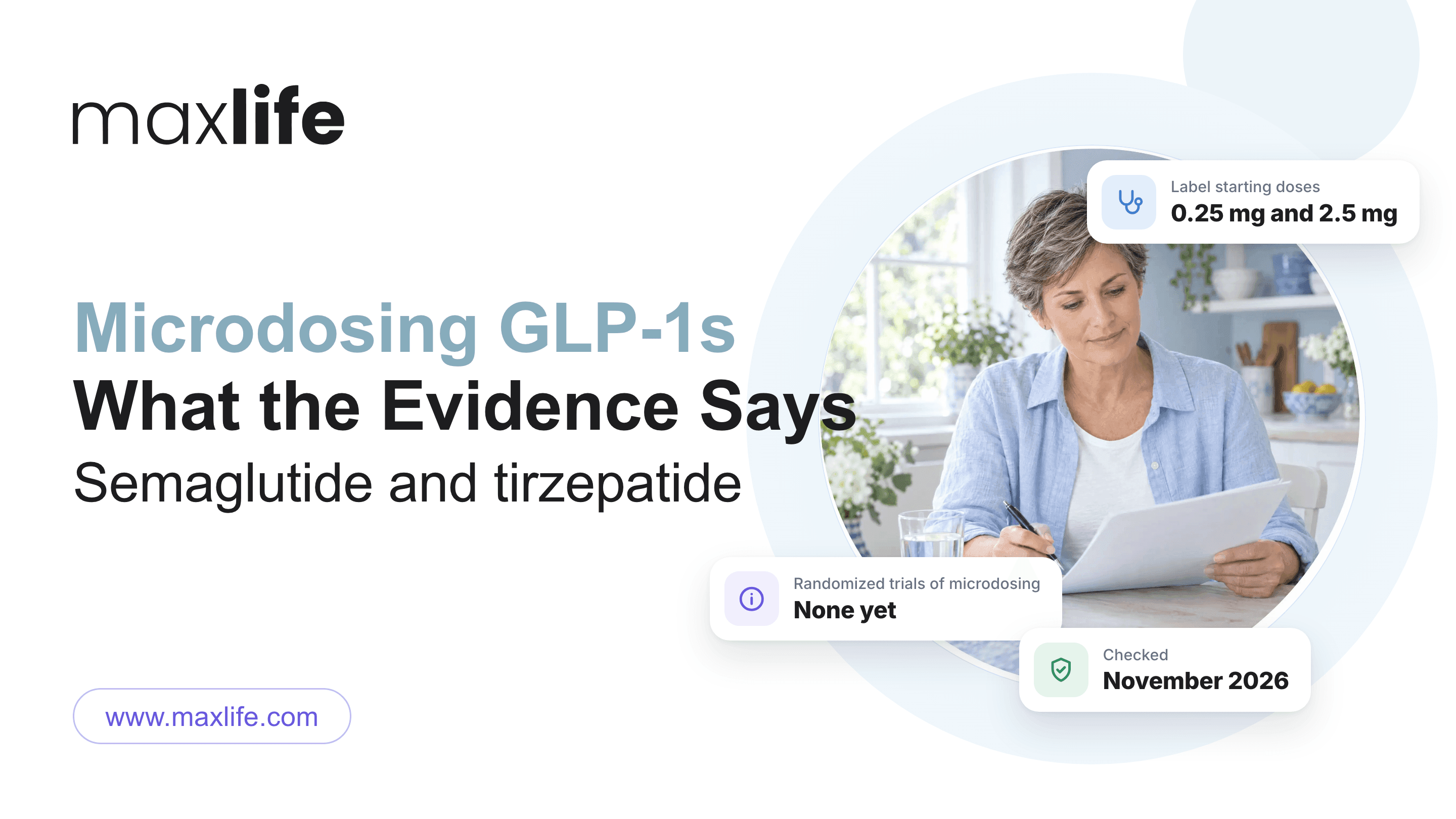
Microdosing a GLP-1 means taking less than the label's starting dose of semaglutide (0.25 mg a week) or tirzepatide (2.5 mg a week), or spacing doses more than a week apart. It is off-label, and as of November 2026 no randomized trial has tested it. A medical review published November 13, 2026 says it is "not supported by manufacturers, scientific societies, drug regulatory agencies and official clinical guidelines." The trials that do exist show that smaller doses bring less weight loss on average, and the labels already let a prescriber step you up more slowly or keep you on a lower maintenance dose.
Many people look into microdosing to spend less. At MaxLife the price doesn't depend on the dose: compounded semaglutide is $89 a month and compounded tirzepatide is $120 a month, flat, with no membership fee. Compounded medicines are not FDA-approved, and a licensed provider decides whether treatment fits you and at which dose. This page covers the evidence; it isn't dosing advice.
What Does Microdosing a GLP-1 Mean?
There is no official definition. A 2026 commentary in Expert Opinion on Pharmacotherapy describes it as "the use of 25-50% of manufacturer-recommended starting doses or extended dosing intervals." The November 2026 review in Minerva Endocrinology separates three practices that often share the name:
- Microdosing: doses below a medicine's lowest approved starting dose.
- Fractional dosing: dialing part of a dose on a multi-dose pen by counting the pen's clicks.
- Split dosing: taking a once-weekly medicine in smaller amounts more than once a week.
Some people also stretch the gap between doses past a week. To see what "below the starting dose" means for each medicine, here is where the labels start and where maintenance begins:
| Medicine | Label starting dose | Lowest maintenance dose |
|---|---|---|
| Wegovy® injection (semaglutide) | 0.25 mg once a week | 1.7 mg once a week |
| Wegovy pill (semaglutide) | 1.5 mg once a day | 25 mg once a day |
| Ozempic® (semaglutide, type 2 diabetes) | 0.25 mg once a week | 0.5 mg once a week |
| Zepbound® (tirzepatide) | 2.5 mg once a week | 5 mg once a week |
Sources: the Wegovy, Ozempic and Zepbound prescribing information, checked November 2026. The full schedules are in our semaglutide dosage chart and tirzepatide dosage chart.
Starting doses are a first step, not a dose to stay on: the Zepbound label says its 2.5 mg dose "is for treatment initiation and is not approved as a maintenance dosage." Staying lower within the label is a different thing from microdosing. If a step is hard to tolerate, the Wegovy label says to "consider delaying dosage escalation for 4 weeks," and it lists 1.7 mg as a maintenance dose next to the recommended 2.4 mg. Your prescriber can use both options.
Has Microdosing GLP-1s Been Studied?
Not in a randomized trial. When we searched PubMed on November 21, 2026, none of the published papers on microdosing semaglutide, tirzepatide or other GLP-1 medicines was a randomized controlled trial. They are commentaries, letters, reviews and one health-records study.
That 2026 records study looked at people who kept filling only the lowest dose for at least 6 months:
- Semaglutide 0.25 mg: 814 people lost an average of 2.2% of their weight at 12 months.
- Tirzepatide 2.5 mg: 1,016 people lost an average of 5.5%.
The authors say this pattern "may overlap with, but does not establish, intentional microdosing," and a records study can't show cause and effect. Both numbers are far below what the same medicines did at maintenance doses in trials. Our post on microdosing tirzepatide covers the tirzepatide side in detail.
In research, "low dose" usually means a lower label dose, not a microdose. In the 2026 HARMONY cohort, 113 adults with obesity in China took semaglutide at 0.5 or 1 mg a week, Ozempic's maintenance doses, and lost an average of 9.9% at 24 weeks. It was an observational study with no comparison group.
Do Lower GLP-1 Doses Still Cause Weight Loss?
Yes, but less on average. The clearest evidence for semaglutide is the dose-finding trial behind Wegovy, published in The Lancet in 2018. It randomly assigned 957 adults without diabetes to one of five daily semaglutide doses or placebo for 52 weeks.
The Lancet · 2018
Smaller semaglutide doses, less weight loss
Average weight change after 52 weeks, by daily semaglutide dose.
O'Neil and colleagues, The Lancet, 2018: randomized, double-blind phase 2 trial in 957 adults without diabetes and with a BMI of 30 or more, with diet and activity counseling. Doses were once-daily injections of brand semaglutide, stepped up every 4 weeks; bars show the estimated average weight change at week 52. Funded by Novo Nordisk. These results have not been shown for compounded semaglutide.
More semaglutide meant more weight loss on average, although the 0.3 mg group did slightly less well than the 0.2 mg group. Two details matter if you're thinking about microdosing:
- Even the lowest dose wasn't a microdose. These were daily injections. At 0.05 mg a day, the lowest group took 0.35 mg a week, more than Wegovy's 0.25 mg weekly starting dose.
- Side effects followed the dose. The authors call the stomach symptoms, mainly nausea, "dose-related."
On the full weekly dose, adults taking Wegovy 2.4 mg lost an average of 14.9% of their body weight over 68 weeks in STEP 1, compared with 2.4% on placebo. All of these results come from brand semaglutide in clinical trials and have not been shown for compounded semaglutide.
Does Microdosing Reduce GLP-1 Side Effects?
It hasn't been tested, and a lower dose doesn't make them go away. The labels' answer to side effects is the slow step-up, which is there "to reduce the risk of gastrointestinal adverse reactions," plus more time at a step if needed.
In STEP 2, a trial in adults with type 2 diabetes, stomach side effects affected 57.5% of people on semaglutide 1.0 mg, 63.5% on 2.4 mg and 34.3% on placebo. Less than half the dose brought only a small drop. Early reports gathered in the Expert Opinion commentary suggest microdosing may mean less nausea, but the authors say high-quality evidence "is essentially absent." For practical help, see our guide to GLP-1 nausea and constipation relief.
Can You Microdose With an Ozempic or Wegovy Pen?
The pens aren't made for it, and their instructions say so:
- Ozempic pens: "Do not set the dose by counting the number of clicks you hear." For the starter pen, "Only doses of 0.25 mg or 0.5 mg can be selected," and the 1 mg pen selects only 1 mg. A pen in use goes in the trash after 56 days, even if medicine is left.
- Wegovy pens: each single-dose pen gives one preset dose, and the Wegovy FlexTouch pen holds four 2.4 mg doses.
- Wegovy pills: "Swallow tablets whole. Do not split, crush, chew or dissolve."
Zepbound and Mounjaro® pens are covered in our tirzepatide microdosing FAQ. If a pen's dose feels like too much, the label options above, chosen by your prescriber, are the route that has been tested.
Is Microdosing Compounded Semaglutide or Tirzepatide Safe?
Measuring is the main known risk. Compounded semaglutide and tirzepatide usually come in multi-dose vials, and the strength differs between pharmacies, so the same dose in milligrams can mean a different number of syringe units from one vial to the next.
- Dosing errors are already reported. The FDA has received reports of dosing errors with compounded semaglutide, some needing hospital care, including patients who took "five to 10 times more than the intended dose." In one case a provider meant to prescribe 0.25 mg (5 units) and wrote 25 units instead. The smaller the dose, the smaller the volume, and the easier it is to be off by a large share.
- Doses are a prescriber's call. The FDA says health care providers "should be vigilant" when setting doses and titration schedules for compounded semaglutide or tirzepatide (FDA, content current as of October 1, 2026).
- Skip "research use" products. The same FDA page warns about semaglutide and tirzepatide sold "for research purposes" or "not for human consumption" with dosing instructions, and urges people not to buy them.
- A smaller dose keeps the label warnings, including the boxed warning about thyroid C-cell tumors in rodents and the warnings about pancreatitis and gallbladder problems.
Compounded medicines are not FDA-approved, which means the FDA hasn't reviewed them for safety, effectiveness or quality. Our page on whether compounded semaglutide is safe explains its legal status and what to check.
Does Microdosing GLP-1s Help Inflammation, Longevity or Heart Health?
No trial has shown that. The heart and kidney benefits people cite come from trials of full doses:
- Heart: in SELECT, 17,604 adults with heart disease and overweight or obesity, but no diabetes, took Wegovy 2.4 mg a week or placebo for about 3.3 years. Heart attack, stroke or death from heart causes happened in 6.5% on semaglutide and 8.0% on placebo, a 20% lower risk.
- Kidneys: in FLOW, 3,533 adults with type 2 diabetes and kidney disease took semaglutide 1 mg a week (Ozempic). Their risk of serious kidney events or death from kidney or heart causes was 24% lower than on placebo.
- On the label: Wegovy's maintenance dose for lowering heart risk is 2.4 mg, or 1.7 mg, and its dose for the liver disease MASH is 2.4 mg.
None of these trials tested a microdose. Claims that low doses calm inflammation or slow aging rest on reasoning from full-dose results and on personal stories, not on a tested low-dose regimen.
Is a Lower GLP-1 Dose Enough to Keep Weight Off?
It can keep some of it off, based on the one trial that tested a lower maintenance dose. In SURMOUNT-MAINTAIN, people who dropped from 10 or 15 mg of Zepbound to 5 mg kept most of their loss but regained more than those who stayed on the full dose. Our post on stopping tirzepatide has the numbers, along with what happened when people stopped semaglutide in the STEP 4 trial. We found no randomized trial of a semaglutide dose below the label's maintenance doses for keeping weight off.
Is Microdosing GLP-1s Cheaper?
Not with brand semaglutide, because the price doesn't drop with the dose. As of November 21, 2026, NovoCare Pharmacy charges $349 a month for Wegovy pens at any dose from 0.25 mg to 2.4 mg ($399 for the 7.2 mg Wegovy HD), and $349 a month for Ozempic at 0.25, 0.5 or 1 mg ($499 at 2 mg). Stretching a pen runs into the instructions and the 56-day limit above. Brand tirzepatide is priced by dose; our semaglutide cost guide compares every route for semaglutide.
At MaxLife, the price is also the same at every dose: compounded semaglutide is $89 a month and compounded tirzepatide is $120 a month, flat. It covers the medicine if prescribed, a free online consultation, free ongoing medical support, supplies and free expedited shipping, with no membership fee. MaxLife is a telehealth patient management platform, not a pharmacy. An independent licensed provider reviews your online intake, which takes about 2 minutes, and licensed partner pharmacies prepare and dispense the medicine.
How to Talk to Your Provider About a Lower GLP-1 Dose
Start with why you want a lower dose: side effects, cost, reaching a goal weight or something else. Each points to a different option, such as more time at a step, a lower maintenance dose the label allows, or a different medicine. Questions worth asking:
- What is my dose in milligrams, and how many units is that on the vial I have?
- Can I stay at this step longer before moving up?
- If I lower my dose, what will we watch, and when would we change course?
The dose question MaxLife members ask most is how many units to draw for the dose their provider prescribed. The answer comes from the label on the vial in your hand, because units depend on its strength. Members who write about side effects often connect them to a recent step up; if that's you, say so in your refill check-in so your provider can decide whether you stay where you are for longer. Two more tips from our care team: don't prefill syringes, and if it has been more than 2 weeks since your last injection, contact the care team before your next dose.
How we made this page: we researched it from the sources listed below. The MaxLife operations team reviews every page before it goes live, and a licensed clinician also reviews our medical articles.
Frequently Asked Questions
Compounded Semaglutide $89/mo or Tirzepatide $120/mo, Flat
MaxLife compounded semaglutide $89 a month and tirzepatide $120 a month, flat. All-inclusive, no membership fee, the same price at every dose. A licensed provider decides.
Check Your EligibilityThis article is for informational purposes only and is not a substitute for professional medical advice, diagnosis, or treatment. Individual results vary. Prices, coverage and compounding rules change; confirm current details with your prescriber, your plan or the seller before you decide. Compounded medications are not FDA-approved.
Sources
- Minerva Endocrinology: Microdosing, fractional and split dosing of injectable GLP-1-based drugs (November 13, 2026)
- Expert Opinion on Pharmacotherapy: Considerations and challenges in microdosing of GLP-1-based receptor agonists (2026)
- Biology Methods and Protocols: Cardiometabolic benefits and tolerability in patients on sustained low doses of semaglutide or tirzepatide (2026)
- Diabetes, Obesity and Metabolism: Weight changes with lower doses of semaglutide in clinical practice, HARMONY cohort (2026)
- The Lancet: Semaglutide compared with liraglutide and placebo for weight loss, dose-ranging phase 2 trial (2018)
- New England Journal of Medicine: Once-weekly semaglutide in adults with overweight or obesity, STEP 1 (2021)
- The Lancet: Semaglutide 2.4 mg once a week in adults with overweight or obesity and type 2 diabetes, STEP 2 (2021)
- New England Journal of Medicine: Semaglutide and cardiovascular outcomes in obesity without diabetes, SELECT (2023)
- New England Journal of Medicine: Effects of semaglutide on chronic kidney disease in patients with type 2 diabetes, FLOW (2024)
- Wegovy (semaglutide) injection and tablets prescribing information, June 2026 (DailyMed)
- Ozempic (semaglutide) injection prescribing information and instructions for use, June 2026 (DailyMed)
- Zepbound (tirzepatide) prescribing information, September 2026 (DailyMed)
- FDA: Dosing errors associated with compounded injectable semaglutide products (July 26, 2024)
- FDA: Concerns with unapproved GLP-1 drugs used for weight loss (content current as of October 1, 2026)
- NovoCare Pharmacy: Wegovy self-pay pricing (checked November 21, 2026)
- NovoCare Pharmacy: Ozempic self-pay pricing (checked November 21, 2026)
What Is Microdosing Tirzepatide? What the Evidence Says
November 12, 20267 min
Semaglutide Dosage Chart for Weight Loss: Doses, Schedule and Units
November 5, 20269 min
What Happens When You Stop Tirzepatide?
November 20, 20268 min
GLP-1 Constipation and Nausea: What Helps and How Long It Lasts
November 15, 20269 min