Metformin vs Semaglutide: 7 Differences to Know
Medically reviewed by Dr. Kavya Patel, MD. Pricing is accurate as of September 2026 and subject to change.
Key Takeaways
- Metformin is not a form of semaglutide. Metformin is a biguanide tablet, and semaglutide is a GLP-1 receptor agonist.
- Metformin is approved only for type 2 diabetes. Semaglutide is approved for weight management as Wegovy.
- Semaglutide averaged about 15% weight loss in STEP 1. Metformin is weight-neutral, with typical losses of about 4 to 6 pounds.
- The two can be safely combined under a prescriber's care, and often are in type 2 diabetes.
- Generic metformin costs around $10 to $25 a month. At MaxLife, compounded semaglutide starts at $89 a month on a 3-month starter package, then $155 a month after that.
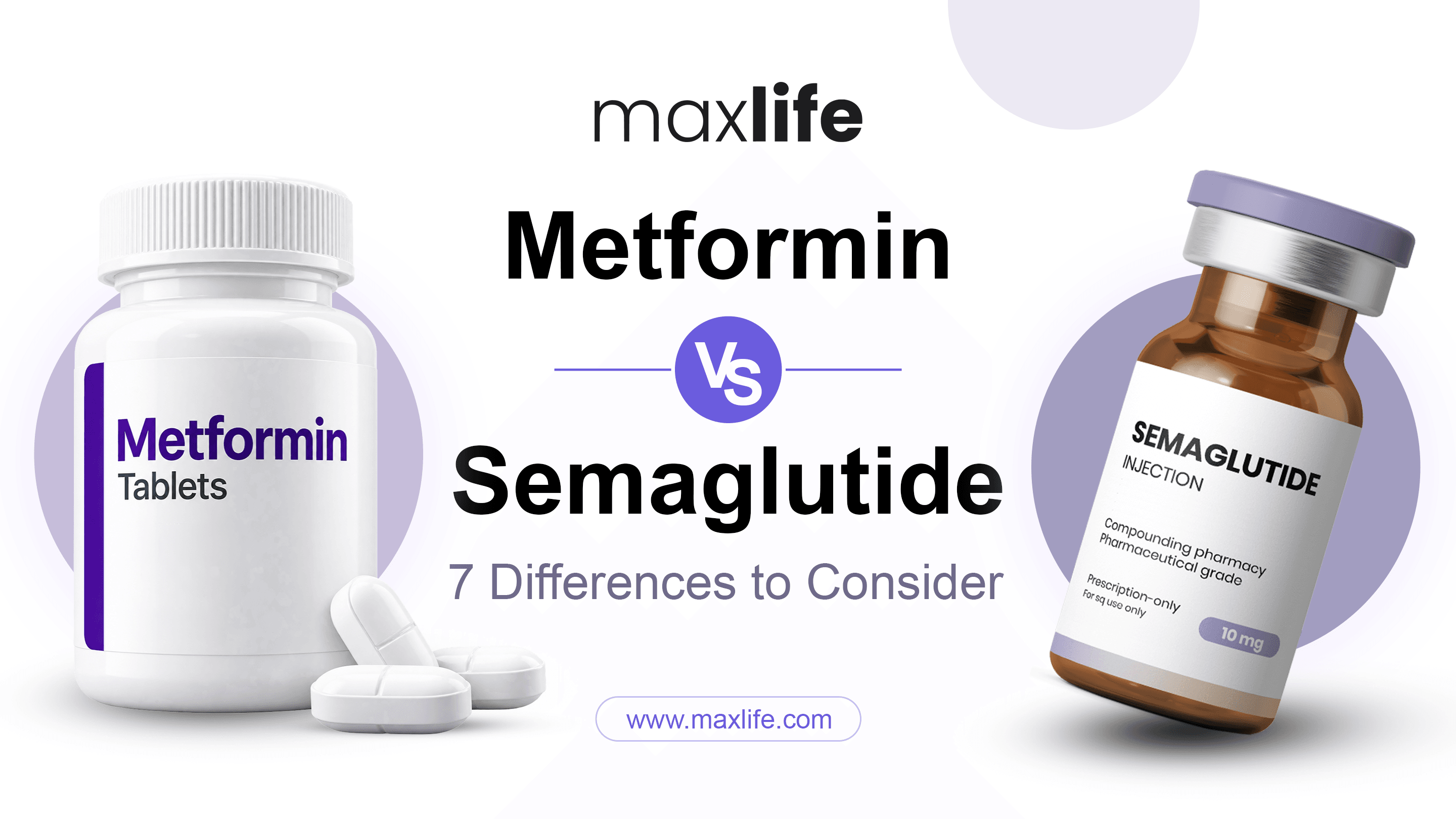
If you are weighing metformin vs semaglutide, the first thing to correct is the premise: these are not the same class of drug, and metformin is not a form of semaglutide. Metformin is a biguanide tablet approved only for type 2 diabetes. Semaglutide is a GLP-1 receptor agonist injection approved for chronic weight management under the brand Wegovy. The results gap is wide. Semaglutide averaged about 15% body weight loss in its pivotal trial. Metformin is classified as weight-neutral, with typical losses of roughly 4 to 6 pounds. Here are the seven differences that matter, and how to think about choosing.
Is Metformin a Semaglutide?
No. Metformin is not a semaglutide, and the two are not related drugs in any way.
Semaglutide is a GLP-1 receptor agonist. It mimics a natural gut hormone called glucagon-like peptide-1, and it is given as a once-weekly injection under the skin. Metformin is a biguanide, a much older class introduced into clinical use in the 1950s. It is taken as a tablet once or twice daily, and it does not mimic any hormone. Instead, it helps your body use the insulin it already produces more effectively.
The approvals differ too. Metformin is not approved for weight loss anywhere on its label. Semaglutide is, under the brand Wegovy.
So why the confusion? Both drugs are prescribed to people managing blood sugar and body weight, both are common in type 2 diabetes care, and both can reduce appetite to some degree. Similar patients, similar conversations, completely different pharmacology.
Metformin vs Semaglutide at a Glance
| Feature | Metformin | Semaglutide |
|---|---|---|
| Drug class | Biguanide | GLP-1 receptor agonist |
| Brand names | Glucophage, Glucophage XR, and generics | Wegovy, Ozempic |
| FDA-approved uses | Type 2 diabetes only | Chronic weight management and cardiovascular risk reduction (Wegovy); type 2 diabetes, cardiovascular risk reduction and chronic kidney disease in type 2 diabetes (Ozempic) |
| Approved for weight loss | No | Yes, as Wegovy |
| Form and frequency | Oral tablet, once or twice daily | Subcutaneous injection, once weekly |
| Approved age range | Adults and children 10 and older (immediate-release); adults only (extended-release) | Adults and adolescents 12 and older (Wegovy injection); adults only (Ozempic) |
| Average weight effect | Weight-neutral to modest, roughly 4 to 6 lbs | About 15% of body weight at 2.4 mg weekly |
| Generic available | Yes | No |
| Typical monthly cost | Around $10 to $25 cash | $1,349 list price; $349 direct self-pay; from $89 compounded at MaxLife (3-month starter package) |
Weight figures come from separate clinical trials in different populations. Metformin and semaglutide have never been compared head-to-head for weight loss.
1. They Work Through Completely Different Mechanisms
Everything else on this page follows from this one difference.
Semaglutide copies the GLP-1 hormone your gut releases after you eat. That single action produces four effects at once. It signals the pancreas to release insulin when blood sugar is high. It tells the liver to produce less glucose. It slows how quickly food leaves the stomach. And it acts on appetite centers in the brain, which is why people describe hunger and food noise going quiet on it.
Metformin does none of that. It is not a hormone mimic, and it does not push the pancreas to release more insulin. It works upstream instead: it makes your tissues more sensitive to the insulin you already make, reduces the amount of glucose your liver produces, and slightly lowers how much glucose your gut absorbs from food.
The practical translation is worth memorizing. Semaglutide is an appetite drug that also improves blood sugar. Metformin is a blood sugar drug that sometimes nudges weight. Same treatment room, different jobs.
2. Semaglutide Produces Far More Weight Loss
One caveat before the numbers. There is no head-to-head trial of metformin against semaglutide for weight loss. The figures below come from separate studies with different populations, durations and endpoints, so treat the comparison as indirect.
In the STEP 1 trial, adults with obesity and without diabetes taking semaglutide 2.4 mg weekly lost an average of 14.9% of their body weight over 68 weeks, against 2.4% on placebo. Half the treated group lost 15% or more.
Metformin sits in a different bracket entirely. The American Diabetes Association classifies its weight effect as neutral. In the Diabetes Prevention Program, the metformin group averaged 2.1 kg of weight loss, roughly 4.6 pounds, over nearly three years. Other analyses put the realistic ceiling at around 2 to 3 kg, or 4 to 6 pounds, and a meaningful share of people lose nothing at all.
The honest conclusion on semaglutide vs metformin for weight loss: the gap is not close. Anyone expecting metformin to produce GLP-1-style results will be disappointed. That said, the modest effect is real for some people, especially those with significant insulin resistance. It is a side benefit of the drug, not its purpose.
3. Only Semaglutide Is Approved for Weight Loss
This approval line settles most of the comparison.
Semaglutide is approved for chronic weight management under the brand Wegovy, in adults and adolescents 12 and older with obesity, and in adults with overweight plus at least one weight-related condition. Wegovy is also approved to reduce the risk of major cardiovascular events. Under a separate brand, Ozempic, semaglutide is approved for type 2 diabetes, cardiovascular risk reduction in type 2 diabetes, and slowing kidney disease progression.
Metformin is approved for type 2 diabetes. That is the whole list. It has no weight-loss indication under Glucophage or any generic.
Prescribers do use metformin off-label, most often for PCOS, prediabetes, or antipsychotic-associated weight gain. Off-label prescribing is legal and sometimes appropriate, but it is a clinician's judgment rather than a labeled use, and it changes what insurance will cover and how the conversation goes.
If weight loss is the actual goal, only one of these two drugs has the label behind it.
4. Metformin Is Usually the First-Line Choice for Diabetes
None of the above makes metformin a weak drug. It is one of the most useful medications in modern practice.
Metformin has been in clinical use since the 1950s. It lowers A1C effectively, carries a long safety record across millions of patients, does not cause hypoglycemia on its own, and is available as a cheap generic. For most adults with type 2 diabetes who need medication beyond diet and exercise, it is still the usual first agent.
Worth knowing: the ADA Standards of Care moved away from a blanket first-line rule in 2022. Treatment choice now depends on what else is going on. When glycemic control is the main goal and there are no complicating conditions, metformin is typically where prescribers start. When weight is itself a treatment target, or when there is established cardiovascular disease, chronic kidney disease, or heart failure, guidelines point toward agents with proven benefit in those areas. Semaglutide has cardiovascular and kidney outcome indications on its label. Metformin does not.
5. Tablet vs Weekly Injection
The day-to-day experience of these two drugs is not remotely similar.
Metformin is a tablet. Immediate-release versions are usually taken twice daily with meals; extended-release is once daily with the evening meal. Taking it with food matters, because it substantially reduces the stomach upset the drug is known for.
Semaglutide for weight management is a once-weekly subcutaneous injection into the abdomen, thigh, or upper arm, using a pre-filled pen with a very short needle. You take it on the same day each week, at any time of day, with or without food. An oral semaglutide tablet has since been approved for weight management in adults, but the injection remains the form used in the weight-loss trials cited here and the form most programs dispense.
The trade-off is roughly 52 injections a year against 400 to 700 tablets. Many people prefer the weekly rhythm. Some are simply not comfortable with needles, and that is a legitimate reason to talk options through with a provider. One more practical point: metformin is available in fixed-dose combination tablets with several other diabetes medications, which semaglutide is not.
6. They Carry Different Risks
Both drugs share a familiar complaint. Nausea, vomiting and diarrhea are the most common side effects of each. Metformin in particular is notorious for early stomach upset, though it usually settles within a few weeks and often improves with the extended-release form or by taking doses with food. With semaglutide, gastrointestinal effects tend to appear as the dose steps up, which is why titration is gradual.
Beyond that overlap, the risk profiles diverge.
Semaglutide carries a boxed warning for thyroid C-cell tumors, based on findings in rodents. Human relevance is unknown, but the drug is contraindicated in anyone with a personal or family history of medullary thyroid carcinoma or multiple endocrine neoplasia syndrome type 2. Rarer risks on the label include acute pancreatitis, gallbladder disease, kidney injury from dehydration, and a delay in stomach emptying that matters before anesthesia.
Metformin carries a boxed warning for lactic acidosis. It is rare but serious, and the risk climbs when kidney function is impaired, which is why prescribers check kidney function before starting and periodically after, and may reduce or stop the dose. Long-term metformin use can also lower vitamin B12 levels, so periodic testing is standard.
7. The Cost Gap Is Enormous
For many people reading a metformin vs semaglutide comparison, this is the real question.
Metformin has been generic for decades. It commonly costs $10 to $25 a month at retail pharmacies, and sometimes under $10 with a discount card. It is one of the cheapest prescriptions in routine use.
Semaglutide has no generic. Wegovy's list price is around $1,349 a month, and manufacturer self-pay pricing sits at several hundred dollars monthly. Insurance coverage for weight management specifically remains uncommon, which is why so many people pay out of pocket.
Compounded semaglutide is the third route, and it deserves a straight description. It contains the same active ingredient, is prepared by a licensed compounding pharmacy, and still requires a prescription and provider oversight. At MaxLife, it starts at $89 a month on a 3-month starter package, then $155 a month after that. Compounded medications are not FDA-approved, are not reviewed for safety and efficacy the way branded products are, and are not covered by insurance.
The framing that helps: the question isn't which drug is cheaper. It is what result you are paying for.
Semaglutide vs Metformin for Weight Loss: Which Should You Choose?
There is no single answer, because the right choice depends on why you are asking. Four common situations:
Weight loss is your goal and you do not have diabetes. Metformin was not designed for this job, and the data reflect that. Discussing a medication with a weight-management indication is the more direct route.
You have type 2 diabetes. Metformin is probably already your foundation, and it is a good one. Semaglutide is more often added to it than swapped for it, particularly when weight or cardiovascular risk is also on the table. Your diabetes prescriber makes that decision.
You have PCOS or significant insulin resistance. Metformin may be doing real metabolic work, improving insulin sensitivity and, in some cases, menstrual regularity, even when the scale barely moves. Judging it purely by weight undersells what it is there for.
Cost is the binding constraint. Metformin is dramatically cheaper. It will not produce comparable weight loss. Both statements are true at once, and anyone who tells you otherwise is selling something.
Whichever situation fits, this is a clinical decision made with a licensed provider who knows your history. MaxLife's program is for adult weight management, not diabetes or PCOS care.
Can You Take Metformin and Semaglutide Together?
Yes. This combination is common, clinically established, and used deliberately rather than by accident.
The reasoning is straightforward. The two drugs work through entirely different mechanisms, so their effects on blood sugar are complementary rather than duplicated. Neither causes low blood sugar on its own the way insulin or sulfonylureas can, so combining them does not create that risk. Semaglutide's own registration trials in type 2 diabetes were largely run in people already taking metformin, and no clinically significant drug interaction between the two has been found.
The usual scenario: someone is on metformin for type 2 diabetes, and semaglutide is added for weight loss, cardiovascular protection, or kidney benefit.
The boundaries matter. This is a prescriber's decision, not a self-directed one. Every provider involved needs your full medication list. And because both drugs affect the gut, taking them together does raise the likelihood of nausea and diarrhea, especially during dose increases.
How Does Tirzepatide Compare?
Tirzepatide is the natural third question, and the short answer is that it currently produces the largest average weight loss of the three.
Where semaglutide acts on one receptor, tirzepatide acts on two: GLP-1 and GIP. In the SURMOUNT-1 trial, adults with obesity and without diabetes on the 15 mg weekly dose lost an average of 20.9% of body weight over 72 weeks. Again, this is a separate trial rather than a direct comparison with semaglutide's STEP 1 result, so the ranking is indirect.
The honest hierarchy: tirzepatide leads in average weight loss, semaglutide follows closely, and metformin is not really at the bottom of that list because it was never on it. It belongs to a different drug category with a different purpose. If you are comparing GLP-1 options rather than drug classes, compounded tirzepatide is the relevant comparison to semaglutide.
Get Semaglutide With Medical Guidance
If you have been taking metformin and your weight hasn't moved, that is the expected outcome, not a personal failure. The drug is doing what it was built to do, and weight loss was never the main job.
It may be worth discussing whether a medication designed for weight management fits your situation. MaxLife's provider-guided program offers compounded semaglutide for adult weight management, with an eligibility review before you start, gradual dose titration, and ongoing support for side effects. Diabetes care stays with your prescribing physician.
Conclusion
Metformin is not a semaglutide, and the two do not belong to the same drug class. Semaglutide is a weekly GLP-1 injection approved for chronic weight management, with trials averaging around 15% body weight loss. Metformin is a daily biguanide tablet approved for type 2 diabetes only, classified as weight-neutral, with modest losses of roughly 4 to 6 pounds where they occur. Metformin is the long-standing foundation of diabetes care at a generic price. Semaglutide costs far more and delivers far more weight loss. A prescriber can safely combine the two. Which one fits you is a decision for a licensed provider.
Metformin vs Semaglutide FAQs
Is metformin the same as semaglutide?
No. "Is metformin a semaglutide?" is one of the most common questions about these two drugs, and the answer is no. Metformin is a biguanide taken as a daily tablet and approved only for type 2 diabetes. Semaglutide is a GLP-1 receptor agonist given as a weekly injection and approved for chronic weight management under the brand Wegovy. Different drug classes, different mechanisms, different approvals.
How much weight can you lose on metformin?
Modest amounts at best. In the Diabetes Prevention Program, participants taking metformin averaged about 2.1 kg, roughly 4.6 pounds, over nearly three years. Most estimates land in the 4 to 6 pound range, and many people lose nothing. Metformin is officially classified as weight-neutral.
Can you take metformin and semaglutide together?
Yes, and it is a common combination. The two work through different mechanisms; no significant interaction has been identified, and neither causes low blood sugar alone. A prescriber must make the call, and both can cause overlapping gastrointestinal side effects.
Is metformin a cheaper alternative to semaglutide?
It is far cheaper, but it is not an alternative. Metformin runs $10 to $25 a month against several hundred for semaglutide, but it produces a fraction of the weight loss and has no weight-loss approval. Cheaper only counts if the drug does the job you need.
Should I switch from metformin to semaglutide for weight loss?
That depends on why you take metformin. If you take it for type 2 diabetes, semaglutide is more often added than substituted. If you were prescribed it mainly hoping for weight loss, a medication with a weight-management indication may suit better. Either way, discuss it with your prescriber rather than stopping metformin on your own.
Does metformin help with weight loss if you have PCOS?
Somewhat. A meta-analysis behind the international PCOS guideline found metformin reduced BMI by about 0.53 kg/m² compared with placebo, and by about 0.89 kg/m² in people with a BMI of 25 or above. That is a real but small effect, typically a few pounds. Metformin's main value in PCOS is improving insulin sensitivity, not weight loss.
Get Semaglutide With Medical Guidance
Compounded medications are not FDA-approved and are not covered by insurance. Pricing and availability are subject to change.
Check Your EligibilityThis article is for informational purposes only and is not a substitute for professional medical advice, diagnosis, or treatment. Individual results vary. Pricing, insurance coverage, and compounding regulations described here are subject to change; verify current details with your insurance provider, the manufacturer, or your prescriber before making treatment decisions. Compounded medications are not FDA-approved.
Sources
- New England Journal of Medicine: Once-Weekly Semaglutide in Adults with Overweight or Obesity
- New England Journal of Medicine: Reduction in the Incidence of Type 2 Diabetes with Lifestyle Intervention or Metformin
- Metformin hydrochloride tablets prescribing information
- Wegovy (semaglutide) injection and tablets prescribing information
- American Diabetes Association: Pharmacologic Approaches to Glycemic Treatment, Standards of Care in Diabetes 2026
- NovoCare: Wegovy self-pay pricing
- New England Journal of Medicine: Tirzepatide Once Weekly for the Treatment of Obesity
- FDA: Clarifies policies for compounders as national GLP-1 supply stabilizes
Contrave vs Semaglutide: 7 Differences to Consider
September 11, 20269 min
Tirzepatide vs Wegovy: 7 Differences to Know
September 11, 20269 min
Semaglutide vs Ozempic: What's the Difference?
September 15, 20267 min

Ozempic Alternatives: What Actually Works for Weight Loss
September 18, 20267 min
Trulicity vs Tirzepatide: 6 Key Differences to Know
August 20, 20267 min