Tirzepatide vs Ozempic: 8 Differences to Know
Medically reviewed by Dr. Kavya Patel, MD. Pricing is accurate as of September 2026 and subject to change.
Key Takeaways
- Tirzepatide and Ozempic are different drugs. Ozempic is a brand of semaglutide, and tirzepatide is sold as Mounjaro and Zepbound.
- Ozempic is not approved for weight loss. The approved weight-loss comparison is Zepbound versus Wegovy.
- Tirzepatide won both head-to-head trials: 20.2% vs 13.7% weight loss (SURMOUNT-5) and up to 2.30% vs 1.86% A1C reduction (SURPASS-2).
- Ozempic keeps a kidney disease indication and a longer room-temperature window (56 days vs 21).
- There is no dose conversion between the two. Never take them together.
- At MaxLife, compounded semaglutide starts at $89 a month and compounded tirzepatide at $120 a month on a 3-month starter package, then $155 and $195 a month after that.
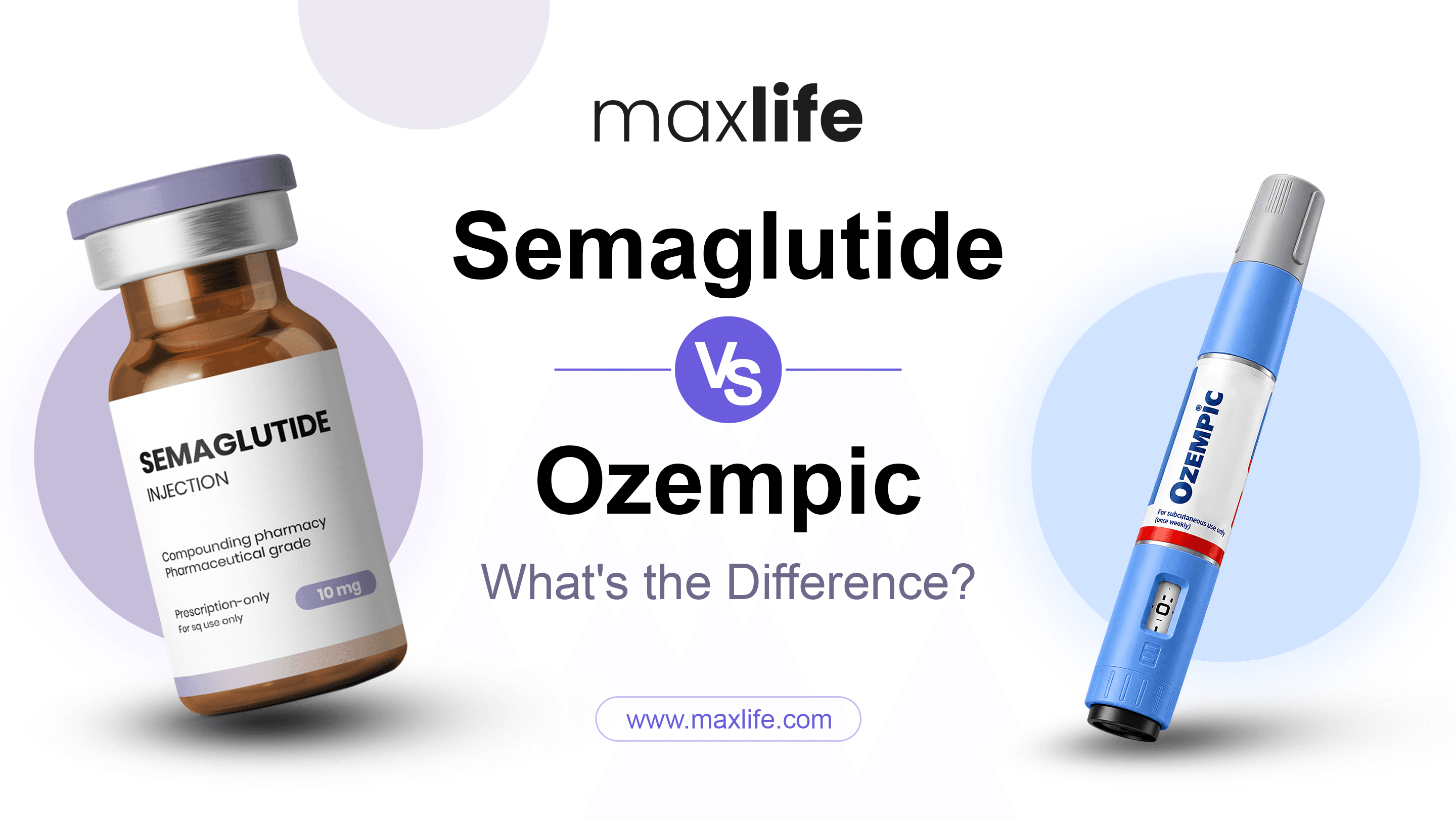
Any tirzepatide vs Ozempic comparison has to start with a correction: these are not two versions of the same thing. Tirzepatide is an active ingredient. Ozempic is a brand name for a different ingredient, semaglutide. In the one head-to-head weight-loss trial between them, tirzepatide produced 20.2% average body weight loss versus 13.7% for semaglutide over 72 weeks. And here is a fact most people searching this never get told: Ozempic is not approved for weight loss at all. Below are the eight differences that matter, and how to work out which molecule fits your situation.
Quick Answer: Is Tirzepatide the Same as Ozempic?
No. Ozempic contains semaglutide, a GLP-1 receptor agonist approved for type 2 diabetes, cardiovascular risk reduction, and chronic kidney disease. Tirzepatide is a different molecule altogether: a dual GIP and GLP-1 receptor agonist, sold as Mounjaro for type 2 diabetes and as Zepbound for chronic weight management and obstructive sleep apnea.
Both are once-weekly injections. Both lower blood sugar and reduce appetite. But they belong to different drug classes, come from different manufacturers, and are not interchangeable. No dose of one maps to an equivalent dose of the other.
One more point reframes the whole question. If weight loss is your goal, the honest comparison is Zepbound versus Wegovy, because neither Ozempic nor Mounjaro is approved for it.
Tirzepatide vs Ozempic at a Glance
| Feature | Tirzepatide (Mounjaro, Zepbound) | Ozempic (semaglutide injection) |
|---|---|---|
| Active ingredient | Tirzepatide | Semaglutide |
| Medication class | Dual GIP and GLP-1 receptor agonist | GLP-1 receptor agonist |
| Manufacturer | Eli Lilly | Novo Nordisk |
| FDA-approved uses | Mounjaro: type 2 diabetes; reducing major cardiovascular event risk in adults with type 2 diabetes at high cardiovascular risk. Zepbound: chronic weight management; moderate to severe obstructive sleep apnea in adults with obesity | Type 2 diabetes; reducing major cardiovascular event risk in adults with type 2 diabetes and known heart disease; slowing chronic kidney disease progression in adults with type 2 diabetes and CKD |
| Approved for weight loss | Yes, as Zepbound. No, as Mounjaro | No. Wegovy is the semaglutide brand approved for weight loss |
| Dose range | 2.5 mg to 15 mg weekly (six strengths) | 0.25 mg to 2 mg weekly (four strengths) |
| Injection frequency | Once weekly | Once weekly |
| Average weight loss | 20.2% at 72 weeks † | 13.7% at 72 weeks † |
| Average A1C reduction | Up to 2.30% at 40 weeks ‡ | 1.86% at 40 weeks ‡ |
| Room-temperature storage once in use | Up to 21 days, up to 86°F (single-dose pens and vials) | Up to 56 days, 59°F to 86°F |
| Generic available in the US | No | No |
† SURMOUNT-5, a direct head-to-head trial in 751 adults with obesity and without diabetes, at maximum tolerated doses (tirzepatide 10 or 15 mg, semaglutide 1.7 or 2.4 mg).
‡ SURPASS-2, a direct head-to-head trial in 1,879 adults with type 2 diabetes taking metformin, treatment-regimen estimand, tirzepatide 15 mg versus semaglutide 1 mg.
The weight and A1C rows come from two different trials in two different populations, so read each row against itself rather than across the table.
The Brand Map: Which Drugs Contain Tirzepatide and Which Contain Semaglutide
| Brand | Active ingredient | Maker | FDA-approved for |
|---|---|---|---|
| Ozempic | Semaglutide | Novo Nordisk | Type 2 diabetes; cardiovascular risk reduction in type 2 diabetes with known heart disease; slowing chronic kidney disease progression in type 2 diabetes with CKD |
| Wegovy | Semaglutide | Novo Nordisk | Chronic weight management; cardiovascular risk reduction in adults with known heart disease and obesity or overweight; noncirrhotic MASH with moderate to advanced fibrosis |
| Mounjaro | Tirzepatide | Eli Lilly | Type 2 diabetes; cardiovascular risk reduction in adults with type 2 diabetes at high cardiovascular risk |
| Zepbound | Tirzepatide | Eli Lilly | Chronic weight management; moderate to severe obstructive sleep apnea in adults with obesity |
Novo Nordisk makes the semaglutide brands. Eli Lilly makes the tirzepatide brands. Here is the part people miss: two products can share an active ingredient and a manufacturer and still not be the same medication. Ozempic and Wegovy are both semaglutide from Novo Nordisk, but Ozempic tops out at 2 mg weekly for diabetes, while Wegovy goes up to 2.4 mg for weight management and to 7.2 mg in its higher-dose version, and they have separate approvals. Mounjaro and Zepbound are the same drug (tirzepatide) with different approvals. One note on formulation: Ozempic is now also sold as a daily tablet for type 2 diabetes. This comparison refers to the once-weekly injections.
1. Tirzepatide Hits Two Receptors, Ozempic Hits One
Both drugs imitate incretins, the gut hormones your body releases after a meal. Incretins do four useful things at once. They signal the pancreas to release insulin when blood sugar is high. They tell the liver to produce less glucose. They slow how quickly food leaves the stomach. They also act on appetite centers in the brain, which people describe as quieting food noise.
Semaglutide mimics one incretin, GLP-1. Tirzepatide mimics two: GLP-1 and GIP, making it a dual agonist. GIP is thought to improve how the body handles fat and may dampen nausea signaling, which would let patients tolerate stronger appetite suppression.
That single structural difference is the leading explanation for the results in the next few sections. Adding the second receptor is the most likely reason tirzepatide outperforms semaglutide on both weight and blood sugar in direct trials, though the mechanism is still a hypothesis rather than a settled finding.
2. Ozempic Is Not a Weight Loss Drug
This difference between Ozempic and tirzepatide is what changes most people's search. Ozempic is approved for three things: improving blood sugar control in adults with type 2 diabetes, reducing the risk of major cardiovascular events in adults with type 2 diabetes and known heart disease, and slowing the progression of chronic kidney disease in adults with type 2 diabetes and CKD.
Weight loss is not on that list. It never has been.
Plenty of people lose weight on Ozempic, and plenty of clinicians prescribe it for that reason. But prescribing it purely for weight is off-label use, and that has a practical consequence: an insurer that covers Ozempic for a diabetes diagnosis will often refuse the identical prescription written for weight loss.
Mounjaro sits in exactly the same position on the tirzepatide side. It is a diabetes drug that causes weight loss, not a weight loss drug.
So the properly approved pairing is Zepbound versus Wegovy. If you are comparing Ozempic vs tirzepatide with the goal of losing weight, that is the comparison you actually want, and the trial evidence below is what decides it.
3. Tirzepatide Won Both Head-to-Head Trials
Most articles cite one comparison. There are two, and tirzepatide won both.
For weight, SURMOUNT-5 randomized 751 adults with obesity or overweight and no diabetes to tirzepatide or semaglutide, each titrated to the maximum tolerated dose, for 72 weeks. Average body weight fell 20.2% on tirzepatide against 13.7% on semaglutide. Waist circumference dropped 18.4 cm versus 13.0 cm. Both differences were statistically significant.
For blood sugar, SURPASS-2 randomized 1,879 adults with type 2 diabetes already taking metformin for over 40 weeks. A1C fell by up to 2.30% on tirzepatide against 1.86% on semaglutide. Weight fell 11.2 kg versus 5.7 kg in the same trial.
Direct trials carry more weight than indirect ones because everything else is held constant: the same protocol, the same eligibility criteria, the same duration, the same measurement schedule. Comparing separate trials means comparing different populations and different definitions of success.
The indirect evidence points the same way. A 2026 meta-analysis of ten head-to-head studies covering 41,381 people found tirzepatide produced 4.28 percentage points more weight loss on average, with every included study favoring it. A real-world cohort of more than 18,000 patients published in JAMA Internal Medicine found on-treatment losses of 10.1% versus 5.8% at six months and 15.3% versus 8.3% at twelve.
These are averages. Individual results vary enormously, and some people lose more on semaglutide than they would have on tirzepatide.
4. The Dose-Matching Caveat Nobody Mentions
SURPASS-2 has a limitation worth understanding before you quote its numbers.
It compared tirzepatide at up to 15 mg against semaglutide at 1 mg. At the time, 1 mg was the highest approved Ozempic dose, so the design was fair by the standards of the day. Ozempic's maximum is now 2 mg, and higher semaglutide doses improve both glycemic control and weight loss.
The honest reading: the A1C gap in that specific trial is probably wider than a fully dose-matched comparison would produce today.
But the caveat does not overturn the conclusion. SURMOUNT-5 ran semaglutide at 2.4 mg, its full weight-management dose, against tirzepatide at 10 or 15 mg, and tirzepatide still won by 6.5 percentage points. When both drugs are pushed to their approved ceilings, the result holds.
Worth watching: a 7.2 mg semaglutide dose was approved for obesity in March 2026 as Wegovy HD. It has not been tested head-to-head against tirzepatide, so that comparison is still open.
5. They Have Different Dose Ladders
Ozempic has four steps. You start at 0.25 mg once weekly for four weeks, a starter dose meant to help your body adjust rather than control blood sugar. From there, you move to 0.5 mg, then 1 mg, then a maximum of 2 mg.
Tirzepatide has six. It starts at 2.5 mg, then climbs through 5, 7.5, 10, 12.5, and 15 mg. Both drugs step up roughly every four weeks, and only if you are tolerating the current dose.
The practical consequence is headroom. Tirzepatide's extra strengths allow finer titration, which helps if side effects flare at a given step, and it leaves room to go if progress stalls. Ozempic runs out of ladder sooner.
Administration is otherwise identical. Both are once-weekly subcutaneous injections into the abdomen, thigh, or upper arm. You can take either at any time of day, with or without food. Both allow you to move your dosing day, though the minimum gap differs: at least 72 hours for tirzepatide and at least 48 hours for Ozempic.
6. Ozempic Has a Kidney Approval Tirzepatide Does Not
For a long time, Ozempic's clearest advantage was its cardiovascular and kidney indications. Half of that gap has now closed.
In August 2026, the FDA approved Mounjaro to reduce the risk of major cardiovascular events in adults with type 2 diabetes at high cardiovascular risk. The approval rested on SURPASS-CVOT, which followed more than 13,000 people with type 2 diabetes and established atherosclerotic disease for a median of about four years and found tirzepatide non-inferior to dulaglutide, an established GLP-1, with an 8% lower event rate that did not reach superiority.
The kidney indication remains unmatched. Ozempic is approved to slow chronic kidney disease progression, kidney failure, and cardiovascular death in adults with type 2 diabetes and CKD. No tirzepatide product carries a renal indication.
The takeaway is straightforward. If you have type 2 diabetes with chronic kidney disease, that approval is a legitimate clinical reason for a prescriber to choose Ozempic despite the smaller average weight loss. It reflects outcome data, not marketing.
7. Side Effects Are Similar, With One Difference Worth Knowing
The side-effect profiles overlap heavily. Both commonly cause nausea, diarrhea, vomiting, constipation, abdominal pain, indigestion, and reduced appetite, plus occasional redness or itching at the injection site. Symptoms are worst in the first weeks and after each dose increase, and usually settle as the body adapts.
Both carry the same boxed warning. Rodent studies showed dose-dependent thyroid C-cell tumors, and it is not known whether this applies to humans. Both are contraindicated if you or a close relative has had medullary thyroid carcinoma or multiple endocrine neoplasia syndrome type 2.
Both labels also warn about pancreatitis, gallbladder disease, low blood sugar when combined with insulin or a sulfonylurea, worsening of diabetic retinopathy, acute kidney injury from dehydration, and severe allergic reactions.
Now, the differences that the comparison pages skip. Tirzepatide can reduce the effectiveness of oral contraceptives because delayed stomach emptying affects absorption. The label advises switching to a non-oral method or adding a barrier method for four weeks after starting and for four weeks after every dose increase. Ozempic carries no equivalent warning.
One more: gastrointestinal effects become more frequent at higher tirzepatide doses. That said, in SURMOUNT-5, semaglutide caused more GI-driven discontinuations: 5.6% vs. 2.7%. Neither drug is reliably gentler.
8. Storage and Travel Differ
Unopened, both live in the refrigerator between 36°F and 46°F, in the original carton, away from light. Neither should ever be frozen. If either has been frozen, discard it.
The gap opens once a pen is in use. An Ozempic pen can sit at controlled room temperature, 59°F to 86°F, for up to 56 days. Single-dose tirzepatide pens and vials get up to 21 days at up to 86°F, and once a tirzepatide product has been kept at room temperature, it should not go back in the fridge.
For a long trip, or if your refrigeration is unreliable, that eight-week window is a real advantage for Ozempic.
Two practical notes. Compounded vials dispensed by a pharmacy come with their own storage instructions, which can differ from the brand label, so follow the directions supplied with your product. And both require a proper sharps container for needle disposal.
Is Tirzepatide Better Than Ozempic?
Better on average is not the same as better for you. The Ozempic vs. tirzepatide answer depends on the situation.
Weight loss, no diabetes diagnosis. Tirzepatide leads on every direct measure. Note that Zepbound rather than Ozempic is the approved comparison, since Ozempic is not indicated for weight at all.
Type 2 diabetes with chronic kidney disease. Ozempic's renal approval is a real argument in its favor, and one no tirzepatide product can match.
Type 2 diabetes with heart disease. Both now carry cardiovascular indications, so this is no longer a tiebreaker.
Difficult gastrointestinal side effects. Neither drug is clearly gentler. What matters more is titration speed, and tirzepatide's six strengths make a slower climb easier to manage.
Plateaued at Ozempic's 2 mg ceiling. Tirzepatide has five strengths above its starter dose. Switching is a reasonable conversation to have.
Cost is the constraint. Compounded semaglutide is consistently the cheaper of the two. At MaxLife, it starts at $89 a month on a 3-month starter package, then $155 a month, compared with $120 and then $195 for compounded tirzepatide.
None of this is a prescription. Which drug suits you depends on your diagnoses, your medication list, and your history, and that assessment belongs to a licensed provider.
Can You Switch From Ozempic to Tirzepatide?
Yes, and it is common. The typical case is someone who has reached Ozempic's 2 mg maximum, held there for months, and stopped making progress.
Two caveats matter. First, there is no conversion table between the two drugs. Being on 2 mg of semaglutide does not entitle you to start partway up the tirzepatide ladder. You begin at 2.5 mg and titrate from there, which means going through the adjustment period again, including the early nausea.
Second, your provider decides the timing. Semaglutide has a long half-life and clears slowly, so the gap between your last Ozempic dose and your first tirzepatide dose is a clinical judgment, not a guess.
The reverse switch is equally valid. If tirzepatide's side effects prove unmanageable, moving to semaglutide is a normal step.
Do not stop one and start the other on your own. That is how people end up with an unnecessary gap in coverage, rebound appetite, or overlapping drug levels.
Can You Take Tirzepatide and Ozempic Together?
No. Never combine them.
They act on the same GLP-1 receptor through overlapping mechanisms, so stacking them multiplies side effects without any established added benefit. No human safety studies support the combination, and no prescribing information supports it. Realistic consequences include severe nausea and vomiting, dehydration, and a higher risk of pancreatitis.
If you are at the maximum dose of one drug and have not reached your goal, the answer is a conversation with your prescriber about switching or about what else is contributing, not a second injection.
This matters especially with telehealth. If you use more than one provider, each of them needs your full medication list, including anything prescribed elsewhere.
Are Tirzepatide and Ozempic Still in Shortage?
No. Both shortages are over, and any page still telling you otherwise is out of date.
The FDA declared the tirzepatide shortage resolved on 19 December 2024 and the semaglutide shortage resolved on 21 February 2025. As of 10 September 2026, neither injectable appears on the FDA drug shortage database.
That resolution changed how compounding works. Large-scale compounding of a drug that copies an approved product is permitted while that drug is listed in shortage. Once the shortage ends, compounders operate under the narrower rules that apply to preparing a medication for an individual patient's documented clinical need, such as a required dose or formulation the commercial product does not provide. Compounded semaglutide and tirzepatide are still legally available on that basis.
Supply can change. Check the FDA drug shortage database at FDA Drug Shortages for the current position before you make a decision based on availability.
Cost: Brand vs Compounded
At list price, both sit above $1,000 a month. Ozempic runs around $1,028, Mounjaro about $1,080, and Zepbound about $1,086.
Almost nobody pays the list price. What you actually pay depends on your indication, and this is where the difference between Ozempic and tirzepatide gets expensive: a plan may cover Ozempic for type 2 diabetes and reject the same drug for weight loss. Manufacturer cash-pay programs have narrowed the gap, with direct cash prices running roughly $199 to $499 depending on the brand, the dose, and which introductory offers are live, but coverage for weight management remains patchy.
Compounded medications are another route, and they deserve a clear description. Compounded semaglutide and tirzepatide contain the same active ingredients as the brands, are prepared by licensed compounding pharmacies, and require a prescription. At MaxLife, compounded semaglutide starts at $89 a month and compounded tirzepatide at $120 a month on a 3-month starter package, then $155 and $195 a month after that, with medication, injection supplies, licensed provider review, ongoing dose adjustments, and overnight shipping included; both are FSA- and HSA-eligible.
The trade-off is real. Compounded drugs are not FDA-approved, are not reviewed for safety or efficacy before they reach you, and are not covered by insurance.
Get Either Option With Medical Guidance
Both molecules are legitimate. Which one suits you depends on your diagnosis, your medical history, how you tolerate the first few doses, and what you are trying to achieve, and that is precisely what a licensed provider is there to assess.
MaxLife offers both compounded tirzepatide and compounded semaglutide for adult weight management, so you can choose based on clinical grounds rather than whichever one you can get hold of. Every plan includes an eligibility review, a gradual titration schedule, and ongoing support if side effects appear.
Keep type 2 diabetes, heart, and kidney care with your prescribing physician.
Conclusion
Tirzepatide is not the same as Ozempic. Ozempic contains semaglutide and is approved for type 2 diabetes, cardiovascular risk reduction, and chronic kidney disease, but not for weight loss. Tirzepatide is a dual GIP and GLP-1 agonist sold as Mounjaro and Zepbound.
In direct head-to-head trials, tirzepatide beat semaglutide on weight (20.2% vs 13.7%) and on A1C (up to 2.30% vs 1.86%). Ozempic keeps the kidney indication and a much longer room-temperature window.
Better on average does not mean better for you. Choosing a GLP-1 is a clinical decision, and it belongs with a licensed provider who knows your history.
Tirzepatide vs Ozempic FAQs
Is tirzepatide the same as Ozempic?
No. Tirzepatide is an active ingredient sold as Mounjaro and Zepbound. Ozempic is a brand name for semaglutide, a different active ingredient. Tirzepatide acts on two receptors, GIP and GLP-1, while semaglutide acts on GLP-1 alone. Both are once-weekly injections, but they are different molecules in different drug classes and cannot be substituted for one another.
Is tirzepatide better than Ozempic for weight loss?
On average, yes. SURMOUNT-5 compared them directly over 72 weeks and found 20.2% average weight loss with tirzepatide against 13.7% with semaglutide. A meta-analysis of head-to-head studies and a real-world cohort of more than 18,000 patients both point in the same direction. Individual response varies widely, and Ozempic is not approved for weight loss regardless.
Why isn't Ozempic approved for weight loss?
Novo Nordisk sought and received a separate approval for semaglutide as a weight-loss drug under the brand Wegovy, at a higher maximum dose of 2.4 mg. Ozempic was studied and approved for type 2 diabetes, later adding cardiovascular and kidney indications. Approvals are granted per indication and per dose, so Ozempic remains a diabetes medication even though it contains the same ingredient.
Can I switch from Ozempic to tirzepatide, and what dose do I start on?
Yes, switching is common, especially after plateauing at Ozempic's 2 mg maximum. There is no dose conversion between the two, so you restart at tirzepatide's 2.5 mg starter dose and titrate upward roughly every four weeks. Your provider sets the timing of the changeover. Do not stop one and start the other without medical direction.
Can you take tirzepatide and Ozempic together?
No. They work through overlapping mechanisms, so combining them can compound side effects such as nausea, vomiting, and dehydration without an established added benefit, and the combination has not been studied for safety. If you have reached the maximum dose of one without hitting your goal, discuss switching with your prescriber instead.
Is compounded tirzepatide the same as Mounjaro or Zepbound?
No. Compounded tirzepatide contains the same active ingredient and is prepared by a licensed compounding pharmacy on prescription, but it is not Mounjaro or Zepbound. Compounded medications are not FDA-approved, are not reviewed for safety, efficacy, or quality before dispensing, and are not covered by insurance. The same distinction applies to compounded semaglutide, which is not Ozempic or Wegovy.
Find Out Which One You Qualify For
disclosure: Compounded medications are not FDA-approved and are not covered by insurance. Pricing and availability are subject to change.
Check Your EligibilityThis article is for informational purposes only and is not a substitute for professional medical advice, diagnosis, or treatment. Individual results vary. Pricing, insurance coverage, and compounding regulations described here are subject to change; verify current details with your insurance provider, the manufacturer, or your prescriber before making treatment decisions. Compounded medications are not FDA-approved.
Sources
- JAMA Internal Medicine: Semaglutide vs Tirzepatide for Weight Loss in Adults With Overweight or Obesity
- New England Journal of Medicine: Tirzepatide versus Semaglutide Once Weekly in Patients with Type 2 Diabetes
- FDA: Drug Shortages
- Ozempic (semaglutide) injection prescribing information
- Mounjaro (tirzepatide) prescribing information
- Zepbound (tirzepatide) prescribing information
- Eli Lilly: FDA approves Mounjaro to reduce cardiovascular risk in adults with type 2 diabetes
- FDA: Clarifies policies for compounders as national GLP-1 supply stabilizes
Tirzepatide Cost: How Much Does It Cost Per Month?
August 20, 20267 min
Tirzepatide vs Wegovy: 7 Differences to Know
September 11, 20269 min

Tirzepatide Weight Loss: Before and After
September 18, 20267 min
Semaglutide vs Ozempic: What's the Difference?
September 15, 20267 min

Wegovy Alternative: 5 Options That Actually Work
August 18, 20267 min
Trulicity vs Tirzepatide: 6 Key Differences to Know
August 20, 20267 min