Why Am I Not Losing Weight on Semaglutide, Ozempic or Wegovy?
Pricing is accurate as of November 2026 and subject to change.
Key Takeaways
- In a 2026 analysis of 7,594 people in the SELECT trial, those who stayed on semaglutide reached their lowest weight after a median of 19 months, and their starting traits explained less than 10% of who lost more.
- Ozempic is dosed for blood sugar and tops out at 2 mg; Wegovy's weight-loss doses are 1.7 mg and 2.4 mg, and its label allows up to 7.2 mg.
- Only about 1% to 2% of a Wegovy pill is absorbed, so the label's routine matters: an empty stomach, no more than 4 ounces of water and a 30-minute wait.
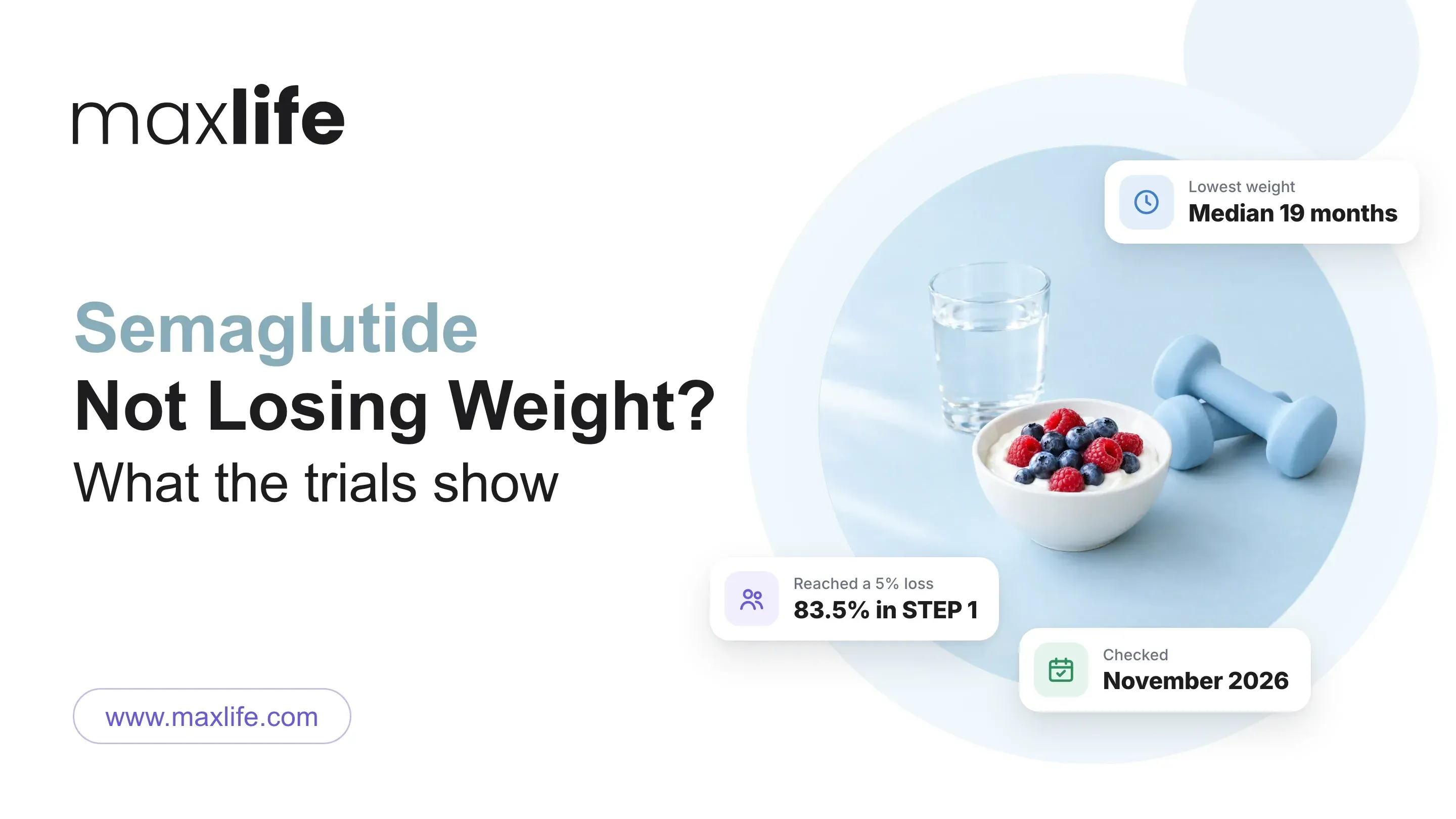
Most people lose weight on semaglutide, but not everyone does, and almost nobody loses in a straight line. In the STEP 1 trial, adults taking Wegovy® (brand semaglutide) lost 14.9% of their weight on average over 68 weeks, yet about 1 in 6 lost less than 5%, according to the Wegovy label. When the scale stalls, the usual reasons are being early in the 16-week step-up, an Ozempic® dose set for blood sugar, a plateau after many months, missed doses, food and drink, other medicines or health conditions and, with compounded vials, how the dose is measured. These results come from brand Wegovy and have not been shown for compounded semaglutide, and only your provider should change your dose.
Start with your own situation. Here is what the labels and studies say, as checked in November 2026:
| Your situation | What the label or study says | Next step |
|---|---|---|
| Weeks 1 to 16 of Wegovy shots | 0.25, 0.5, 1 and 1.7 mg are step-up doses; the maintenance dose starts in week 17 | Give it time |
| On Ozempic 0.5, 1 or 2 mg | Approved for type 2 diabetes and dosed for blood sugar; 2 mg is the maximum | Ask if a weight-loss plan fits you |
| 12 weeks on your full dose, less than 5% lost | NIDDK: your provider will probably advise stopping | Review the plan with your provider |
| Months of steady loss, then a stall | Expected; in one large study the lowest weight came at a median of 19 months | Keep going and track the trend |
| Missed 2 or more Wegovy shots in a row | The label restarts the step-up at a lower dose | Ask how to restart |
| Taking the Wegovy pill | Only about 1% to 2% is absorbed, and how you take it changes that | Check the routine below |
Does Semaglutide Work for Everyone?
No. Semaglutide helps most people lose weight, but in every Wegovy trial some people lost less than 5% of their starting weight, the mark the trials and the National Institute of Diabetes and Digestive and Kidney Diseases (NIDDK) use to judge a response. This chart shows how many people reached at least 5% in each trial group, from the results tables in the Wegovy label:
Wegovy label · 6 trial groups
How many people lost at least 5% of their weight
Share of people in each group who reached a 5% loss by the end of the trial. The rest did not.
- Adults without diabetes
- Adults with type 2 diabetes
- Placebo
Wegovy prescribing information, DailyMed version of June 2026, Tables 8, 11 and 12: everyone who started, with missing weights estimated. All groups had diet and activity counseling. Novo Nordisk-funded trials of brand Wegovy; these results have not been shown for compounded semaglutide.
Three things stand out. Type 2 diabetes makes a big difference: in STEP 2, about 1 in 3 adults with diabetes taking Wegovy 2.4 mg didn't reach 5%, compared with about 1 in 6 adults without diabetes in STEP 1. The 7.2 mg dose moved more people past every mark, most clearly at the top: in STEP UP, 45.5% lost at least 20% on 7.2 mg, compared with 32.3% on 2.4 mg. And the placebo groups lost some weight too, because everyone got diet and activity coaching, which shows that the medicine works together with your habits, not instead of them.
Nobody can tell in advance who will respond. A 2026 analysis of the SELECT trial followed 7,594 adults with overweight or obesity and heart disease, without diabetes, who stayed on semaglutide for at least a year. Their age, sex, health history, lab results and body measurements together explained less than 10% of the differences in how much they lost, although women lost more than men (a median of 16.6% at their lowest weight, compared with 12.4%). The honest test is your own trend over months on the full dose, reviewed with your provider.
Why Am I Not Losing Weight on Ozempic?
Often because Ozempic is dosed for blood sugar, not for weight. The Ozempic label approves it for adults with type 2 diabetes, to improve blood sugar and to lower heart and kidney risks, and sets the maintenance dose at 0.5 mg, 1 mg or 2 mg "based on glycemic control," with 2 mg as the maximum. Wegovy, the semaglutide brand approved for weight loss, steps up to 2.4 mg and allows up to 7.2 mg. In Ozempic's diabetes trials, average losses ranged from 3.2 to 6.4 kg (about 7 to 14 pounds) over 30 to 56 weeks.
Diabetes itself also slows weight loss. Even at the Wegovy dose, adults with type 2 diabetes lost 9.6% on average in STEP 2, compared with 14.9% for adults without diabetes in STEP 1. Insulin and sulfonylureas are among the medicines NIDDK says can add weight, and with semaglutide they raise the risk of low blood sugar, so your prescriber may adjust them. If weight loss is your goal, ask your provider which plan fits you; our guide to Ozempic vs Wegovy compares the two brands dose by dose.
Is It Too Early to Tell if Your GLP-1 Is Working?
If you started less than about 4 months ago, probably yes. Wegovy shots climb in 4-week steps, from 0.25 mg to 0.5 mg, 1 mg and 1.7 mg, and reach the maintenance dose in week 17, and the label lets your prescriber hold a step for another 4 weeks if a dose is hard to tolerate. The Wegovy pill steps up once a month and reaches its 25 mg maintenance dose on day 91. The label uses the lower doses "to reduce the risk of gastrointestinal adverse reactions," so small early losses are expected. Our guide to how long semaglutide takes to work shows the average loss at each step.
NIDDK gives a fair point to judge: if you have not lost at least 5% of your starting weight after 12 weeks on the full dose of a weight-management medicine, your health care professional will probably advise you to stop it, according to its page on prescription medications for obesity. On the Wegovy shot schedule, that check comes about 7 months after the first dose at the earliest, later if a step was delayed.
Why Did My Weight Loss Stop on Semaglutide?
Because every weight-loss treatment reaches a plateau, and on semaglutide it usually comes after many months, not weeks. In STEP 1, the average weight curve flattened between weeks 52 and 60. In the 2026 SELECT analysis, people who stayed on semaglutide reached their lowest weight after a median of 19 months, with the middle half getting there between 10 and 30 months, at a median loss of 12.5%. A stall after a year of steady loss is the expected end of the curve, not a sign that the medicine stopped working.
Staying on treatment is what holds the result. When STEP 1 ended, the people who stopped Wegovy had regained about two-thirds of the weight they lost within a year, according to the STEP 1 extension. Our semaglutide before and after guide covers the longer trials. Talk to your provider before you stop or space out doses because of a plateau.
Is It a Real Stall or Just a Slow Week?
Compare your average over 4 weeks, not one weigh-in to the next. Water and digestion move the number: constipation affected 24% of people taking Wegovy in its weight-loss trials, compared with 11% on placebo, and a heavy gut or a salty dinner can hide a week of fat loss. A tape measure around your waist once a month gives a second reading that water moves less.
Other Reasons a GLP-1 Like Semaglutide Can Seem Not to Work
These are worth ruling out with your provider before anyone changes your dose:
- Missed or late shots. Semaglutide is made for a steady weekly level. For Wegovy shots, the label says that after 2 or more missed doses in a row, the step-up restarts at a lower dose, which pushes results back by weeks. Our semaglutide dosage chart has the missed-dose rule for each product.
- How you take the Wegovy pill. The label says to take the tablet in the morning on an empty stomach with no more than 4 ounces of plain water, and to wait at least 30 minutes before you eat, drink or take other pills. Only about 1% to 2% of each tablet is absorbed, and in the label's studies more was absorbed with less water and a longer wait. In type 2 diabetes, blood levels from the pill run lower than from the shot, and the label suggests considering other options, including the shot, if the pill doesn't work well enough.
- Calories that slip past a smaller appetite. The Wegovy label says to use it "in combination with a reduced-calorie diet and increased physical activity," and in most of its trials everyone was coached to eat about 500 fewer calories a day and to be active 150 minutes a week. Sweet drinks, alcohol and grazing can cancel out a smaller appetite. Our guides to semaglutide and alcohol, the GLP-1 diet and protein balance on a GLP-1 can help.
- Another medicine. NIDDK's page on factors affecting weight lists some medicines for epilepsy, depression or psychotic disorders, steroids, insulin and sulfonylureas, some blood pressure medicines such as beta-blockers, alpha-blockers and calcium channel blockers, and some antihistamines as medicines that may contribute to weight gain. Never stop one on your own; ask your prescriber.
- A health condition, sleep or stress. The same page names PCOS, Cushing's syndrome, hypothyroidism, depression and long-term stress among the health problems that can lead to weight gain, and links short sleep to eating more. It recommends 7 to 9 hours a night for adults 18 to 64.
Not Losing Weight on Compounded Semaglutide?
Compounded semaglutide can stall for every reason above. It is prepared by a licensed pharmacy for one patient's prescription and is not FDA-approved, which means the FDA has not reviewed it for safety, effectiveness or quality. It has not been tested in trials like STEP, so none of the trial numbers on this page apply to it. Two checks are specific to vials:
- The amount you draw. Your prescription is written in milligrams, but you measure units on a syringe, and the number of units depends on the vial's concentration. In an August 12, 2026 letter to state medical boards, the FDA said compounded drugs "often have different concentrations than FDA approved products." Read the strength on each new vial and follow its label and your prescriber's directions; our dosage calculator shows how units and milligrams relate.
- Where it came from and how it was kept. The FDA advises filling a prescription at a state-licensed pharmacy and warns against semaglutide sold "for research purposes" or "not for human consumption," in its page on unapproved GLP-1 drugs. Store your vial as the pharmacy label directs.
MaxLife is a telehealth patient management platform, not a pharmacy or drug maker. A licensed provider reviews your online intake and decides whether compounded semaglutide is right for you, and licensed partner pharmacies prepare and ship it. Compounded semaglutide is $89 a month, flat, the same price at every dose, so if your provider moves you up, what you pay doesn't change. It is all-inclusive, with no membership fee, and you can cancel anytime with notice before your next billing period. Results vary and are not guaranteed. If your insurance covers Wegovy, the brand may cost you less, and it is the product the trial results above belong to; our semaglutide cost guide compares the routes.
Should You Ask for a Higher Dose or a Switch?
Ask, yes; decide alone, no. Your provider weighs your trend, side effects and health history, and there are three honest paths:
- A higher dose, within the label. The Wegovy label allows 7.2 mg for people who have tolerated 2.4 mg for at least 4 weeks and need more weight loss, and tells prescribers to "consider treatment response and tolerability." In STEP UP, average loss at 72 weeks was 18.8% on 7.2 mg and 15.5% on 2.4 mg, counting everyone who started. Some side effects rose too: 22% felt unusual skin sensations such as tingling or burning on 7.2 mg, compared with 6% on 2.4 mg. Never take extra units or extra shots on your own.
- A different medicine. In the head-to-head SURMOUNT-5 trial, adults without diabetes lost 20.2% on Zepbound® (tirzepatide) and 13.7% on Wegovy over 72 weeks. That is an average, and a provider decides whether a switch fits you; see switching to tirzepatide, and if you already take it, why you may not be losing weight on tirzepatide.
- Stopping. If you lost less than 5% after 12 weeks on your full dose, NIDDK says stopping is the usual advice, and your provider can talk through what comes next.
Among MaxLife members, a stall usually leads to one of three requests: a higher dose, a switch to tirzepatide, or help with hunger that has come back. Each is a fair question for your provider. The check-in before every refill already collects what the provider needs to answer it (your weight, dose, appetite, side effects and the date of your last injection), so add a line about the stall there, with your 4-week trend and any new medicines. If you're worried, you don't have to wait for the next refill.
Some symptoms need care right away, not a dose discussion. The Wegovy label says to stop the medicine and call your provider for severe stomach pain that won't go away, with or without nausea or vomiting, which can be a sign of pancreatitis.
In November 2026 we re-read the Wegovy and Ozempic labels on DailyMed (June 2026 versions), the NIDDK and FDA pages and the studies cited here. How we made this page: we researched it from the sources listed below. The MaxLife operations team reviews every page before it goes live, and a licensed clinician also reviews our medical articles.
Frequently Asked Questions
Compounded Semaglutide: $89/mo Flat, All-Inclusive
MaxLife compounded semaglutide: $89 a month, flat. All-inclusive, no membership fee, the same price at every dose. A licensed provider decides.
Check Your EligibilityThis article is for informational purposes only and is not a substitute for professional medical advice, diagnosis, or treatment. Individual results vary. Prices, coverage and compounding rules change; confirm current details with your prescriber, your plan or the seller before you decide.
Why trust our experts

April Foster, DO MPH
Reviewer
Board Certified Family Medicine Physician licensed nationwide providing collaborative oversight to NPs, PAs, and RN. Also specializing in telemedicine services nationwide.
Sources
- Wegovy (semaglutide) injection and tablets prescribing information and Medication Guide, DailyMed (June 2026)
- Ozempic (semaglutide) injection prescribing information, DailyMed (June 2026)
- Wilding JPH et al. Once-Weekly Semaglutide in Adults with Overweight or Obesity (STEP 1). N Engl J Med. 2021
- Lingvay I et al. Predictors of Peak Body Weight Loss With Semaglutide in the SELECT Trial. Diabetes Care. 2026
- Wilding JPH et al. Weight regain and cardiometabolic effects after withdrawal of semaglutide: the STEP 1 trial extension. Diabetes Obes Metab. 2022
- Aronne LJ et al. Tirzepatide as Compared with Semaglutide for the Treatment of Obesity (SURMOUNT-5). N Engl J Med. 2025
- Friedrichsen M et al. The effect of semaglutide 2.4 mg once weekly on energy intake, appetite, control of eating, and gastric emptying in adults with obesity. Diabetes Obes Metab. 2021
- NIDDK: Factors Affecting Weight & Health
- NIDDK: Prescription Medications to Treat Overweight & Obesity
- FDA letter to the Federation of State Medical Boards on compounded GLP-1 multi-dose vials (August 12, 2026)
- FDA: FDA's Concerns with Unapproved GLP-1 Drugs Used for Weight Loss (content current as of October 1, 2026)
How Long Does Semaglutide Take to Work? Wegovy and Ozempic Week by Week
November 22, 202610 min
Semaglutide Dosage Chart for Weight Loss: Doses, Schedule and Units
November 5, 20269 min
Why Am I Not Losing Weight on Tirzepatide?
November 9, 202610 min
Semaglutide Before and After: Weight Loss Results and What to Expect
November 5, 202610 min